Reaction Condition Scaling From Microwell to Milliliter CFPS Formats

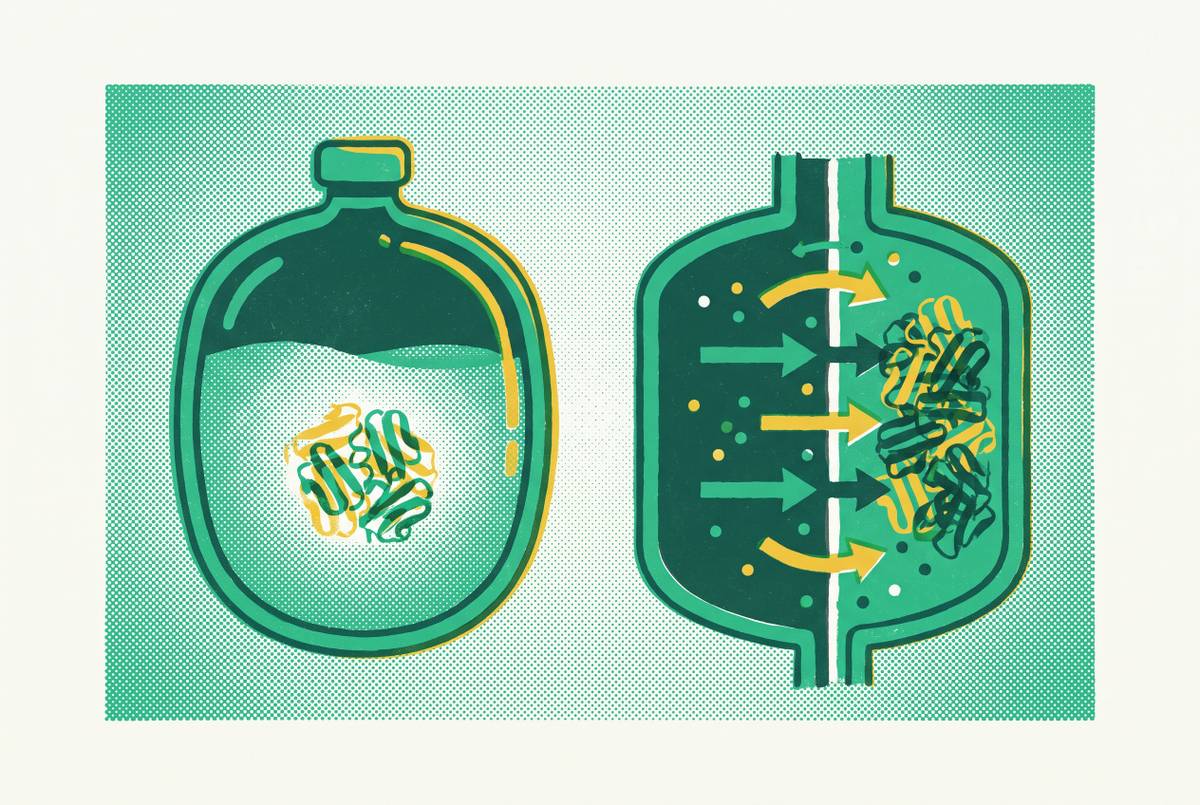
Moving a cell-free protein synthesis (CFPS) reaction from a microwell to a milliliter-scale vessel is not a matter of pouring more liquid into a bigger container. Oxygen transfer, surface-to-volume ratio, and reagent concentration all shift at the same time, and each one has to be re-tuned on its own terms or yield and reproducibility collapse. CFPS runs in an open, tunable system where every physical and chemical variable sits within direct reach of the experimenter, and that same openness means changing the vessel changes the reaction itself. A 2025 review of CFPS reactor formats catalogued thirteen distinct reactor types, each with its own productivity, scalability, technical complexity, and environmental stability profile, which is strong evidence that format functions as a design variable rather than a packaging decision. Most protein engineering programs run rapid screens of large variant libraries in one format and then need milligram-scale production in another, so crossing the microwell-to-milliliter boundary is close to unavoidable; treat that crossing as a simple volume increase, and you get yield collapse and irreproducible results.
Oxygen transfer as the dominant variable in scaling volume
Oxygen transfer is the first and most consequential variable to break when a CFPS reaction moves from microwell to milliliter scale, and it breaks in kind, not just in degree. A microwell holds its liquid as a thin film, so oxygen can diffuse passively from the air above into the bulk of the reaction, keeping the system supplied without any mechanical help. At milliliter scale the geometry works against that: the liquid column deepens, the surface shrinks relative to the volume it serves, and passive diffusion no longer reaches the reaction's interior. The effect shows up as more than slower protein synthesis. A construct that expresses cleanly as soluble protein in a microwell screen can come out aggregated or misfolded in a 10 mL flask because the oxygen the folding machinery depended on never reached it, even though the DNA template and the extract are unchanged. Vessel geometry, agitation mode, and fill volume stop being incidental choices at this point and become parameters that have to be set on purpose for the new scale, not carried over from whatever worked in the plate.
What surface-to-volume ratio controls beyond oxygen
Surface-to-volume ratio does more than set the ceiling on oxygen delivery. It also governs how fast a reaction loses water to evaporation, how evenly its reagents mix, and how much hydrophobic surface is available to help a protein fold. In a microwell, the same high surface-to-volume ratio that helps oxygen in also lets water out: evaporation during incubation concentrates whatever is left behind, which can inflate or suppress apparent yield in ways that have nothing to do with the biology being tested. That artifact shrinks or reverses once the reaction moves to milliliter scale, where evaporation is a smaller fraction of the total volume. Scaling data on the ALiCE® eukaryotic CFPS system shows that growing a reporter-protein reaction from a 100 µL microtiter plate format to 10 mL and then 100 mL in standard Erlenmeyer flasks can produce a simple, linear increase in output, but that linearity only held because the physical conditions, oxygen supply among them, were managed deliberately at each step rather than left to follow the volume up on their own. Mixing changes with format as well: in a microwell, diffusion distances are short enough that the reaction stays homogeneous without help, while at milliliter scale, rocking, orbital shaking, or stirring become necessary to keep reagents distributed evenly, and the shear those methods introduce can itself affect proteins that are sensitive to mechanical stress. Hydrophobic surface interactions add a further layer: they provide real benefit to folding, particularly for membrane proteins and other hydrophobic targets, but the amount of hydrophobic surface available per unit of reaction volume is itself a function of format, so a target that folds well in one vessel class may lose that support in another.
Reagent concentrations at microwell versus milliliter scale
Even when oxygen supply and mixing are handled correctly at the new scale, the reagent concentrations that produced the best yield in a 10 to 30 µL microwell reaction are not safe to assume at milliliter scale. The boundary conditions that govern how fast reagents are consumed and how fast they are regenerated change with format, so the concentration landscape itself shifts, not just the position of the optimum within it. Magnesium is the clearest documented case: CFPS output is known to be highly sensitive to small changes in magnesium salt concentration, and the magnesium actually available to the reaction depends on two format-linked effects at once, the evaporation that concentrates it in a microwell and the buffering capacity of the extract, which scales with volume rather than staying fixed. Energy regeneration follows the same pattern. Phosphoenolpyruvate-based and other metabolic energy systems are built to hold ATP levels steady across an extended synthesis run, but the rate at which that energy supply depletes differs between a thin liquid film and a stirred bulk reaction, because oxygen availability, mixing, and local pH all act on the regeneration enzymes and all three of those conditions change with format. DNA template concentration is no exception: transcription rate and the stability of the resulting mRNA respond to the local ionic environment, and that environment shifts with the evaporation and dilution effects tied to vessel geometry. A microwell screen, in other words, hands a researcher a map of conditions that worked at one scale, and that map is a starting point for the next format, not a protocol to be copied into it.
Which reactor format fits screening versus production
Choosing a reactor format is, in practice, choosing an oxygen transfer regime, a mixing mode, and an evaporation profile all at once. The 2025 survey of CFPS reactor types found thirteen distinct formats in active use rather than one dominant design. That same review evaluated each format against productivity, scalability, technical complexity, and environmental stability, and no single vessel scored well across all four. Screening and production tend to live in different formats as a result. Batch microwell and plate formats remain the workhorse for screening: they support high throughput, they parallelize well, they fit standard liquid-handling automation, and they are constrained in return by evaporation, limited oxygen control, and small absolute yield per well. Erlenmeyer flasks and tube formats at the milliliter scale pick up where plates leave off for initial production; you trade the parallelism of a microwell plate for larger absolute yield per vessel, and you get better oxygen control through fill volume and agitation rate. Rocking-motion bioreactors mark a further step up: the CELL-tainer® CT20, used in the ALiCE® work, produced preliminary data from 1 L reactions that the authors describe as the first published example of a eukaryotic CFPS reaction scaled past the 10 mL mark by several orders of magnitude, and reaching that scale required its own engineering, not a repeat of what worked in a flask. Lyophilized reagent formats, flagged in a 2026 perspective on microbial CFPS as an advantage for decentralized manufacturing, solve a different problem: they decouple the reagent system from a fixed location, but reconstituting a lyophilized kit at a new volume still calls for the same oxygen, surface-to-volume, and concentration re-calibration as any other format change. You can run automation-compatible plate formats on standard liquid-handling equipment to parallelize condition screening before you commit to a milliliter-scale vessel at all; a 2025 review of CFPS in drug discovery describes off-the-shelf reagents paired with parallelized experimentation as a way to explore many conditions for protein synthesis and engineering before scale-up decisions are locked in. Cell-free systems built for format flexibility make this kind of staged approach workable in practice. OpenCFPS™ reagents from Sepia Bio are designed to run across microwell, milliliter, and larger scales with the formulation documented rather than withheld, so a researcher can adjust oxygen supply, vessel geometry, and extraction conditions independently instead of being locked into whatever scale the kit happened to be optimized for.
Why difficult proteins amplify every scaling problem
Proteins that are already near the edge of solubility, stability, or correct folding in a microwell are the ones that suffer most when oxygen, surface-to-volume ratio, and reagent concentration all shift at once during a format change. A robust reporter protein can absorb a fair amount of mismanagement and still fold, but a difficult target often cannot. Membrane proteins illustrate the stakes directly: they are frequently cytotoxic when overexpressed in living cells and account for a large share of gene products overall, and in CFPS they depend on hydrophobic surface interactions to fold correctly, interactions whose availability per unit volume is set by vessel format. Scaling a membrane protein reaction means explicitly tracking how much hydrophobic surface the new format offers, not assuming it carries over from the plate. Disulfide-bonded proteins raise a related problem: forming disulfide bonds in bacterial CFPS requires an oxidizing environment, which runs against the reducing conditions native to bacterial cytoplasm, and that oxidizing state depends directly on oxygen transfer rate. A microwell reaction tuned to stay correctly oxidizing can turn reducing at milliliter scale if oxygen supply isn't maintained through the transition, and a protein that folded correctly at one scale can misfold at the next for that reason alone. Toxic proteins carry a third version of the same risk. CFPS can produce proteins that would kill a living cell, with no viability penalty, a capability the 2026 microbial CFPS perspective names as one of the platform's central advantages, but the concentration of toxic product that builds up inside the reaction scales with volume. At milliliter scale, that accumulation can suppress the transcription and translation machinery itself, and a microwell reaction, with its smaller absolute yield, never reveals this. The proteins that benefit most from what cell-free synthesis can do, membrane proteins, disulfide-rich proteins, toxic proteins, are the same proteins that punish careless scaling the hardest, which makes disciplined re-calibration central to what the platform is for rather than an optional refinement.
A practical re-calibration sequence: what to adjust first, second, and third when moving formats
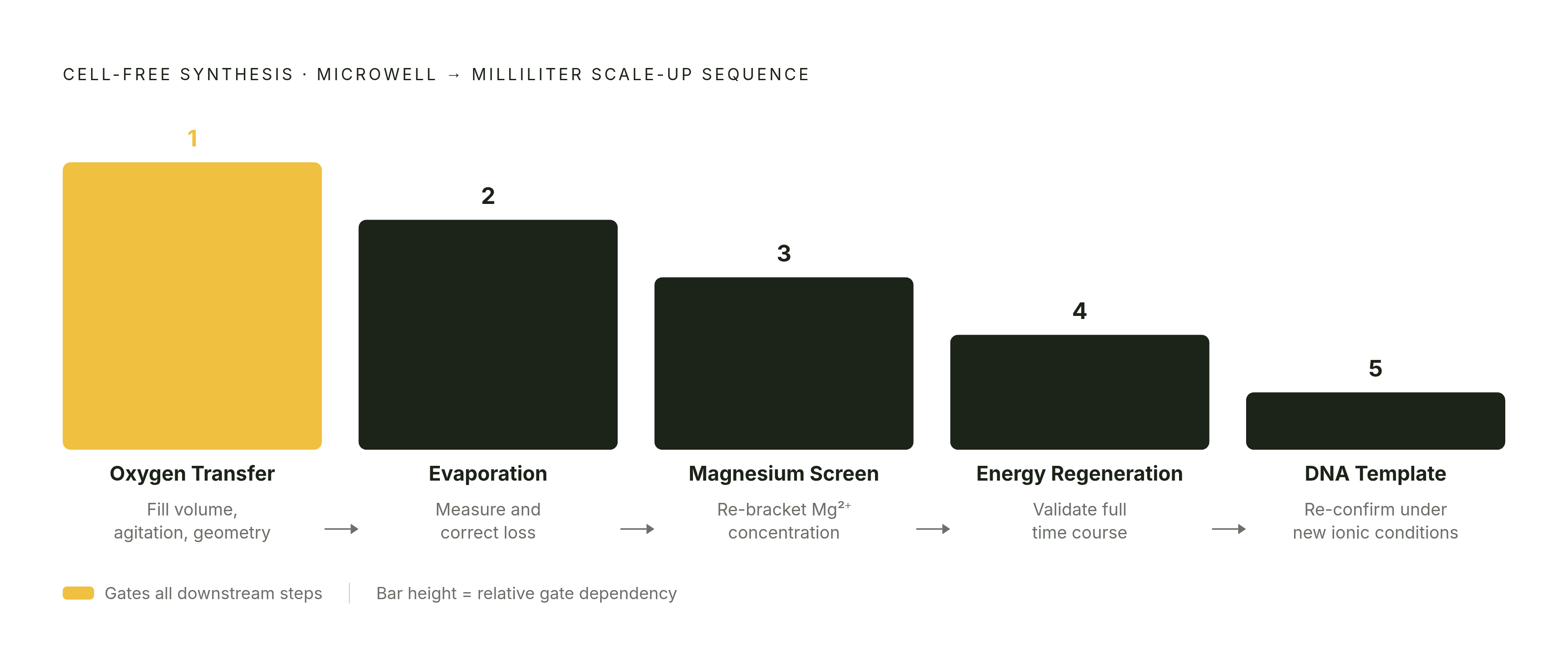
The order in which conditions get re-tuned after a format change follows directly from how the mechanisms depend on one another. Oxygen transfer comes first because it gates everything downstream of it, from folding to redox state to energy regeneration. Surface-to-volume management comes second because it governs evaporation and hydrophobic effects, both of which distort any concentration data collected before they're accounted for. Reagent concentration comes third, because optimizing concentrations inside the wrong physical environment produces an optimum that is wrong for the environment that follows. Step one is to set fill volume, agitation rate, and vessel geometry to secure adequate oxygen transfer at the new format, and to hold those settings fixed before touching anything else. Step two is to measure actual evaporation loss under the incubation conditions of the new format and correct for it, since any concentration-dependence data collected before that correction will be distorted by water loss rather than by the chemistry being tested. In step three, you re-bracket magnesium concentration in a small screening matrix; magnesium is the reagent most often flagged as needing format-specific re-optimization, and you can check it efficiently before committing to a full-scale concentration study. Step four is to re-validate energy regeneration across the full time course of the reaction at the new scale, because depletion kinetics differ between formats, and a time-course yield measurement is the only way to tell whether the reaction is energy-limited before it reaches its endpoint. Step five is to re-confirm DNA template concentration, since transcription rate and mRNA stability respond to the ionic environment, and a template level that saturated transcription in a microwell can turn out to be sub-saturating, or even inhibitory, once the format changes the ionic conditions around it.
Reagent Transparency, Lot Documentation, and Re-Calibration Cost
None of the five steps above can be run with confidence unless the researcher knows what is actually in the reaction, magnesium concentration, energy substrate levels, redox state, as a known starting point rather than a guess. When a commercial reagent system is opaque, the extract functions as a black box, and a failed scale-up offers no principled place to start diagnosing it: the magnesium level in the buffer, the redox state of the extract, and the energy system in use are all unknowns at once. A 2026 perspective on microbial CFPS names reproducibility as one of the field's persistent barriers to industrial adoption, pointing to extract-to-extract and batch-to-batch variability as a standing obstacle to standardization, and lot-level QC data is the minimum a lab needs to tell whether a failed scale-up stems from the format change or from the reagent lot itself. Reagents documented down to the genome and buffer level change that calculation directly, because a researcher can spike individual components, magnesium, amino acids, chaperones, at the new format scale without having to guess at background levels the reagent might already contain. OpenCFPS™ from Sepia Bio is built on that premise, shipping with lot-specific certificates of analysis and composition data so that a scale-up failure can be traced to a format variable or a reagent variable rather than treated as an unexplained black box. The transparency of a well-documented formulation also matters for oxygen-transfer troubleshooting specifically: because the composition is known and published, a researcher can model oxygen dynamics, adjust extraction conditions, and test a fix without the confounding metabolism of a living cell to account for, an advantage that belongs to cell-free systems and not to cell-based expression when a format change is underway. Cost is the last piece of what determines whether this kind of re-calibration actually gets done. Re-bracketing magnesium, re-validating energy regeneration, and re-confirming template concentration all mean running the same optimization again at the new scale, and that only happens if the reagents are priced to make repeated optimization affordable. If reagents are priced to support real experimental throughput, rather than priced as if each milligram-scale production run were a one-off, you can treat every format transition as its own optimization problem instead of extrapolating blindly from whatever worked in the plate.
Sources
- Microbial cell-free protein synthesis and its progression toward industrial use - PMC
- Cell-free protein synthesis platforms for accelerating drug discovery - PMC
- ALiCE^®^: A versatile, high yielding and scalable eukaryotic cell-free protein synthesis (CFPS) system
- Cell-Free Protein Synthesis Reactor Formats: A Brief History and Analysis
- Sepia Biosciences | Cell-Free Protein Synthesis