Batch vs. Continuous Exchange CFPS for Milligram Protein Yields
Extending reaction time with continuous exchange boosts milligram yields.
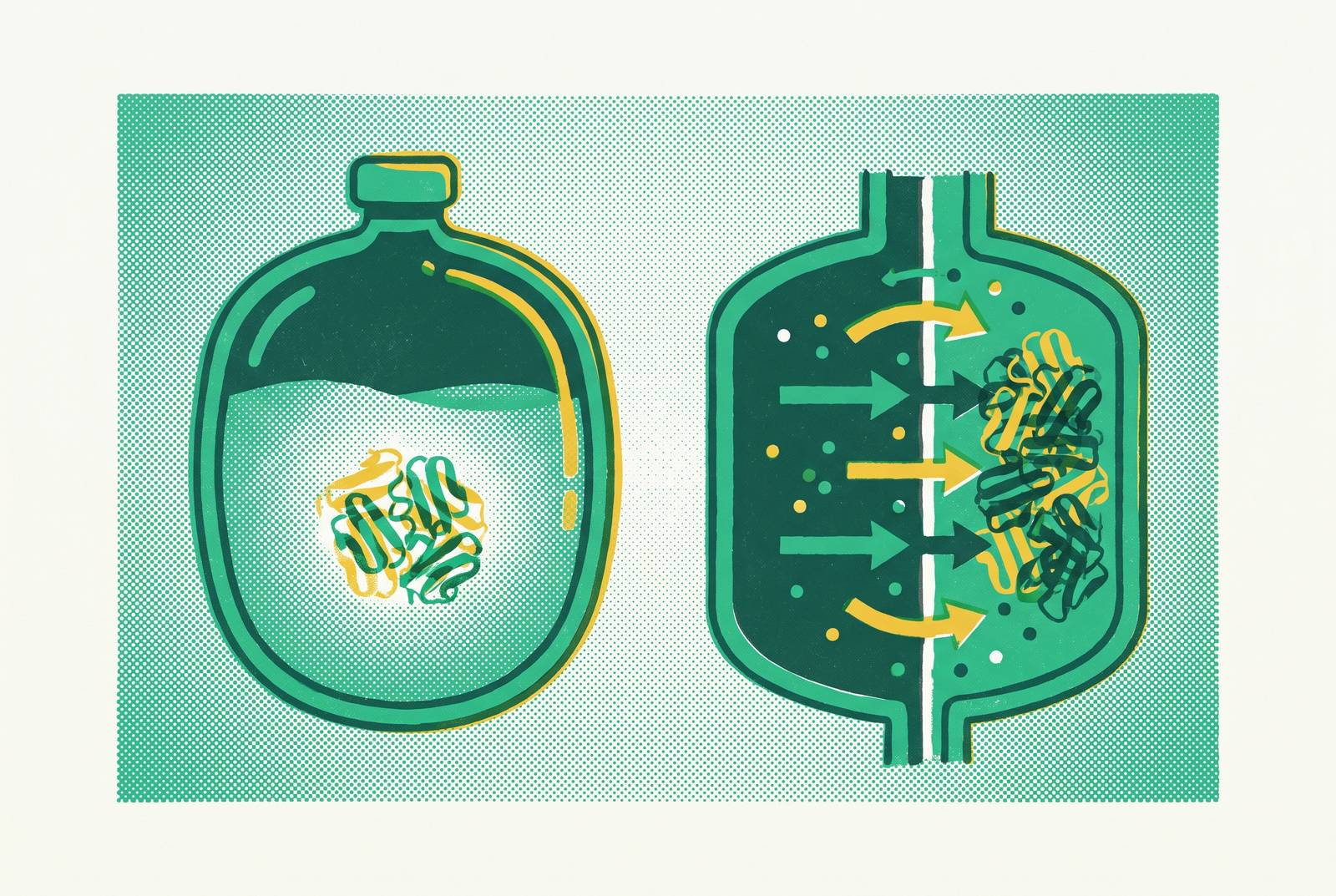
A cell-free protein synthesis (CFPS) reaction stops because the reaction poisons itself. Energy substrates run out and inhibitory by-products build up faster than a closed system can handle either problem, and that race, not any single ingredient failing, sets the clock on how long synthesis can continue.
CFPS rebuilds transcription and translation outside a living cell, using lysate drawn from lysed cells. There's no cell membrane to maintain, no growth cycle to manage, and no requirement that the host stay alive. That openness is the whole appeal: a scientist can add or remove components freely, in ways no living cell would tolerate. But openness cuts both ways. Nucleotides, amino acids, and the energy cocktail that drives translation all start depleting the moment the reaction begins, and in a standard closed-tube format, nothing replaces them.
At the same time, ATP hydrolysis, the reaction that powers translation, throws off free phosphate as a by-product. Free phosphate doesn't just sit there. It accumulates in the reaction volume and directly inhibits the translation machinery it came from, so the lysate turns toxic to its own synthetic capacity as the reaction runs. Two mechanisms, resource exhaustion on one side and inhibitory buildup on the other, converge on the same outcome: active protein synthesis in a standard batch CFPS reaction collapses within a few hours.
Reaction lifetime is that window, and it's the variable every format decision in CFPS ultimately comes back to. Extend it, and yield goes up. Fail to extend it, and yield is capped no matter how good the lysate is. The rest of the batch-versus-continuous-exchange decision is a question of how directly a scientist needs to attack that one constraint.
Batch format and its yield ceiling across lysate systems
Batch CFPS is a single closed vessel: every component, lysate, energy mix, nucleotides, template genetic material, goes in at once, and nothing is added or removed until the reaction is stopped. It's the simplest possible implementation of cell-free synthesis, and it's genuinely good at what it does. The ceiling it runs into depends heavily on which lysate system is doing the work.
E. coli batch reactions sit at the top of that range. Work by one research group (2011) showed E. coli batch systems reaching yields up to 4 mg/mL, the highest output documented for any closed-format CFPS system. That number reflects decades of work optimizing E. coli lysate composition and energy regeneration chemistry, and it makes E. coli batch a legitimate milligram-scale production tool for a wide range of targets.
Eukaryotic batch systems operate on a different scale. Microsome-containing systems, the kind needed for proteins that require the folding and processing machinery of the endoplasmic reticulum, top out around 50 µg/mL in batch mode, roughly two orders of magnitude below E. coli batch. Plant lysate systems, including ALiCE and BY-2 tobacco extract, fall between the two extremes: published yields range from 50 µg/mL to 3 mg/mL depending on the specific protein and reaction conditions. That spread shows how much batch yield depends on what's being made, not just which lysate is making it.
For many soluble, unmodified proteins expressed in E. coli lysate, batch mode delivers enough material for milligram-scale work without any need for a more complex format. The constraint sharpens for proteins that are complex, chemically modified, or membrane-associated, where the eukaryotic batch ceiling becomes a real obstacle rather than a minor inconvenience. None of this makes batch a lesser tool. Its setup is fast, its cost per reaction is low, and it slots directly into plate-based automation without modification. Because batch reactions run in parallel across high-throughput platforms, documented reagent formulations and lot-level quality control become especially valuable: Sepia Bio's OpenCFPS™ reagents, built to work across both batch and continuous exchange formats, let scientists standardize batch protocols and track down performance differences between runs without rebuilding an experiment from scratch.
The membrane-and-chamber architecture that makes CECF reactions last longer
CECF extends reaction lifetime through a specific piece of engineering, not through a better lysate recipe. The architecture is a reaction chamber and a feeding chamber, separated by a semipermeable dialysis membrane, and the extended reaction lifetime that results follows directly from how that membrane behaves.
Small molecules move freely across it. Energy substrates, nucleotides, and amino acids diffuse in from the feeding chamber as they're consumed in the reaction chamber, replenishing the supply that a batch reaction simply runs out of. Free phosphate and other inhibitory by-products diffuse the other way, out of the reaction chamber and into the much larger feeding chamber, where they dilute to concentrations too low to interfere with translation. The protein product itself is too large to cross the membrane, so it accumulates in the reaction chamber rather than washing away with the waste. That size-selectivity is the entire mechanism: resupply and waste removal happen simultaneously, through the same membrane, without any need to touch the reaction once it starts.
The membrane's molecular weight cutoff, the volume ratio between feeding and reaction chambers, and the diffusion kinetics between them are all parameters a scientist can tune, though the details of that optimization belong to a separate discussion of CECF workflow design. What matters for the format comparison is the outcome: CECF reactions commonly run 48 hours or longer, against a few hours for standard batch.
A continuous-flow variant, CFCF, also exists, and it replaces passive diffusion with active pumping of fresh substrate through the reaction chamber. It carries substantially higher operational complexity than CECF, and Hunt et al. Hunt et al. (Chemical Reviews) note that CECF has seen more favorable adoption in practice as a result. If you understand why batch CFPS hits its ceiling, through energy depletion and inhibitory buildup, you can judge whether a given target needs that extended runtime or whether batch is enough. So a lab can test at the bench, with reagents engineered to work reliably in both formats, whether a target justifies the added complexity of exchange before committing to a new platform.
The yield gap between batch and CECF across chassis
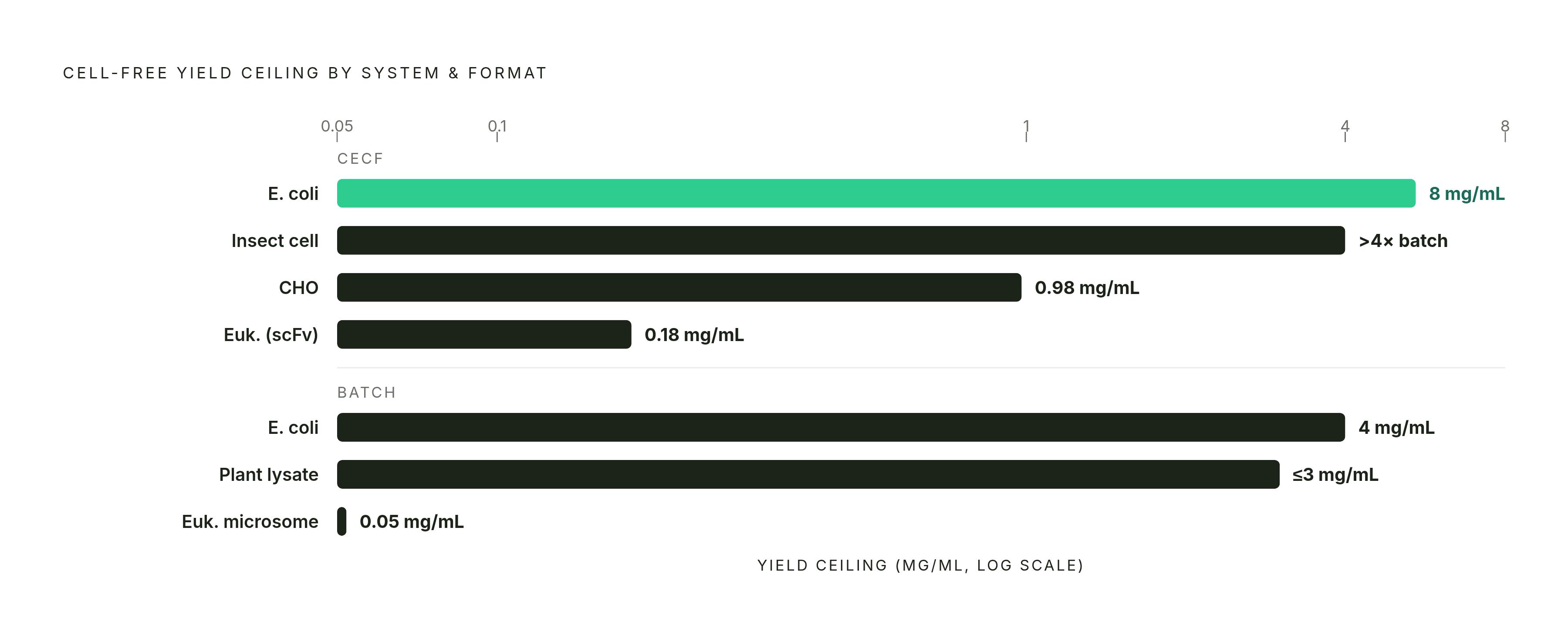
Membrane exchange raises yield over batch for every lysate system tested, but how much it raises it depends heavily on the chassis and the target protein. You see that pattern across prokaryotic, insect, and mammalian systems alike, but the absolute numbers vary widely.
CHO-based CECF, developed for membrane proteins, reached yields up to 980 µg/mL (Thoring et al., Scientific Reports, 2017), the highest reported for any microsome-containing eukaryotic cell-free system at the time of publication. The same CHO-CECF work produced a substantial increase in scFv yields over batch. Before that optimization, the eukaryotic CECF baseline for scFv production was up to 15 µg/mL in batch-based microsome systems and up to 180 µg/mL in earlier CECF formats; the CHO-CECF gains represent a step beyond that already-established improvement over batch.
Insect-cell CECF shows a comparable pattern on different proteins: more than a fivefold increase in fluorescence intensity and more than a fourfold increase in total protein yield over batch, in reactions run for 48 hours in a two-chamber dialysis device. E. coli semicontinuous systems push furthest of all, reaching 8 mg/mL, the highest ceiling for any cell-free format documented across these sources, and sustaining active synthesis over an extended period rather than collapsing within hours.
What these numbers don't do is erase the gap between prokaryotic and eukaryotic chassis. CECF amplifies whatever ceiling the underlying lysate already supports, but you still have to pick the right chassis first. An E. coli target gains enormously from extended runtime because E. coli lysate already has high synthetic capacity to extend. A membrane protein that requires microsomal processing still needs a eukaryotic lysate, CHO or insect, no matter how long the reaction runs. Format choice and chassis choice are two separate axes of the same decision, and getting the second one wrong can't be fixed by optimizing the first.
CECF's cost structure versus batch
CECF reactions cost roughly tenfold more than batch reactions on a per-reaction basis. That difference comes from the feeding-chamber volume, the membrane itself, and the longer incubation time the format requires, all of which add material and instrument time that a simple one-pot batch reaction never needs.
Measured per milligram of protein rather than per reaction, that math reverses. Because CECF yields climb so much higher than batch for the same target and lysate, roughly four times more protein can be produced for the same total spend. The higher sticker price per reaction converts into a lower price per milligram once yield is factored in, which makes CECF the economically sound choice for milligram-scale targets despite costing more upfront.
A concrete figure from mammalian CECF work illustrates the scale involved: one microgram of EGFR produced in a CHO-based CECF reaction costs approximately USD 0.40, once lysate preparation, translation buffer, energy mix, and plasmid costs are all accounted for. Energy cocktails, nucleotides, and lysate preparation make up the large majority of production cost in either format; reagent transparency matters because a scientist who can see and adjust the formulation directly can control cost rather than accept whatever a sealed kit charges. Sepia Bio's OpenCFPS™ reagents are priced with that dominant cost structure in mind, aiming to make energy cocktail and lysate cost accessible at throughput scale, with documented formulations that let a team benchmark and optimize rather than work against opaque kit economics.
None of this puts CFPS, in either format, in competition with fermentation at manufacturing scale. Even an optimized CECF reaction doesn't approach fed-batch fermentation titers. CFPS belongs to the research-through-milligram range of production, so if you evaluate it against fermentation on cost grounds, you need to scope the comparison correctly from the start.
Proteins that batch cannot express at useful yield and CECF can
For certain protein classes, you can't treat the batch lifetime ceiling as something you just tune for better yield. It's a feasibility barrier: the protein can't be made in a living host at all, or it can't accumulate to a measurable amount inside the few hours a batch reaction stays active. CECF removes both obstacles at once, and it's often the only in vitro route that gets a scientist characterization-grade material.
Toxic proteins illustrate the first case directly. A living host dies before it can produce meaningful amounts of a protein that disrupts its own physiology, and CFPS sidesteps that constraint entirely because there's no cell viability to protect. Batch CFPS can still express toxic proteins, since there's no host to kill, but its short runtime caps how much accumulates before the reaction shuts down. CECF extends the production window without reintroducing any of the viability concerns a living cell would carry.
Membrane proteins need a lipid environment to fold correctly, and a standard aqueous reaction can't give them that on its own. Stech et al. (2014) showed that insect-cell CECF reactions allow de novo synthesized membrane proteins to translocate into endogenous microsomal vesicles carried over in the lysate, and the extended runtime CECF provides gives that translocation process enough time to produce material suitable for functional and structural analysis.
Proteins that need post-translational modification, disulfide bond formation or glycosylation, require the ER-derived microsomal machinery that CHO and insect lysates retain. The insect CECF system demonstrated this directly by producing biologically active tissue-type plasminogen activator (tPA), a protein with multiple intramolecular disulfide bonds, in a result that stands as one of the clearer demonstrations of CECF reaching targets batch systems can't.
Multi-domain and insoluble proteins benefit from the open nature of any cell-free reaction, since chaperones, detergents, nanodiscs, or lipid supplements can be added directly without reformulating a living host. That intervention works in batch too, but it pays off more reliably with the longer runtime CECF provides. Across all these categories, the practical outcome is the same: for characterization work that demands real quantities of protein, SPR, NMR, crystallography, biochemical assays, CECF is frequently the only viable route available outside a living cell. The yield advantage CECF holds over batch is real but strongly target-dependent, and confirming which proteins benefit most from extended reaction time takes systematic testing within whatever lysate system a lab has chosen. Difficult proteins, toxic, unstable, insoluble, or multi-domain, tend to show the largest gains under continuous exchange, and reagent systems documented thoroughly enough to separate substrate effects and inhibition effects from chassis-specific variation let a team tune format choice to its actual protein instead of extrapolating from someone else's published yield curve.
Where batch remains the right tool for high-throughput screening
When the goal is comparing many variants against each other rather than maximizing yield from one construct, batch format wins on operational grounds that CECF can't match. Batch reactions can be set up simultaneously across a 96-well or 384-well plate, and functional readouts, such as fluorescence reporters or other activity assays, can be measured directly in that same plate without transferring or purifying anything first.
Batch also drops the cloning step entirely for many screening applications. PCR products can serve directly as template, with no transformation and no colony picking required, which compresses an entire round of variant synthesis and functional testing down to a matter of hours.
That speed would mean little if the screen didn't reflect real protein behavior, but the correlation holds up. FRET-based activity assays run in batch CFPS tracked protease functionality closely and correlated well with activity measured from purified protein afterward, so the screen functions as a predictive measurement rather than a rough proxy. One demonstration of that throughput: an ML-guided directed evolution campaign (ACS Synthetic Biology, 2025) expressed and functionally tested a library of 192 protease variants, completing each round from expression to measurement in under six hours.
The two formats work best as stages in one pipeline rather than competing choices. Batch handles the screening of large variant libraries, and then CECF takes over for milligram-scale production of whichever hits the screen identifies. OpenCFPS™ is built around that same two-stage logic: the same reagent system scales from plate-based batch screening through milligram-scale CECF production, which removes the reformulation step a lab would otherwise need between stages and keeps lot-to-lot variability, the reproducibility problem that undermines any comparison across pipeline stages, under documented control.
Reproducibility as the unresolved constraint on both formats
The yield figures reported across batch and CECF work are accurate as published, but they are lab-specific. Lysate batch-to-batch variation is the largest uncontrolled variable in CFPS, and it limits how far any single lab's format optimization can be trusted to transfer to another group, or even to a different production run inside the same lab.
That constraint has kept CFPS largely out of routine manufacturing use, even as its capabilities keep expanding. The barriers are consistent across the field: reproducibility, supply chains that depend on a small number of lysate sources, limited practical experience scaling the format up, and the absence of regulatory and quality expectations written specifically for cell-free production rather than borrowed from conventional fermentation.
Addressing reproducibility at the reagent level means supplying lot-level quality control data with every shipment, publishing formulations in enough detail that a team can audit what actually changed between one lot and the next, and keeping reaction conditions explicit rather than buried inside a sealed, unexplained kit. Sepia Bio publishes lot-level QC data and documents the OpenCFPS™ formulation on that basis, giving labs a way to check whether a yield shift between runs comes from the reaction's biology or from the reagents themselves. That distinction, biology versus reagent variation, is what separates a benchmark yield number from a result a lab can actually depend on run after run.
Sources
- Cell-Free Protein Synthesis: Applications Come of Age - PMC
- High-yield production of “difficult-to-express” proteins in a continuous exchange cell-free system based on CHO cell lysates
- A Continuous-Exchange Cell-Free Protein Synthesis System Based on Extracts from Cultured Insect Cells - PMC
- Cell-Free Gene Expression: Methods and Applications
- High-yield production of “difficult-to-express” proteins in a continuous exchange cell-free system based on CHO cell lysates