Energy Regeneration Systems in Cell-Free Protein Synthesis
ATP depletion and phosphate buildup sabotage cell-free protein synthesis.
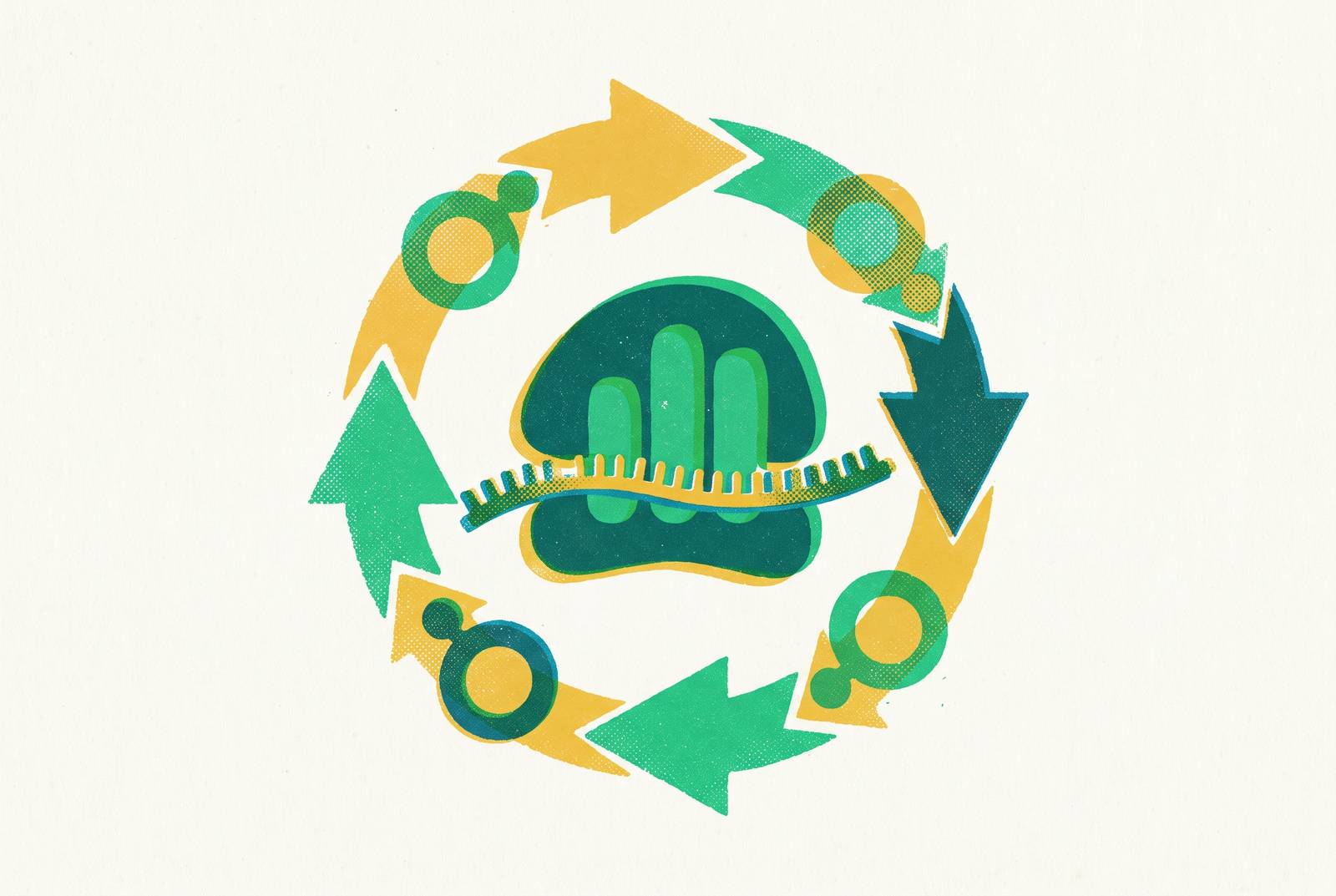
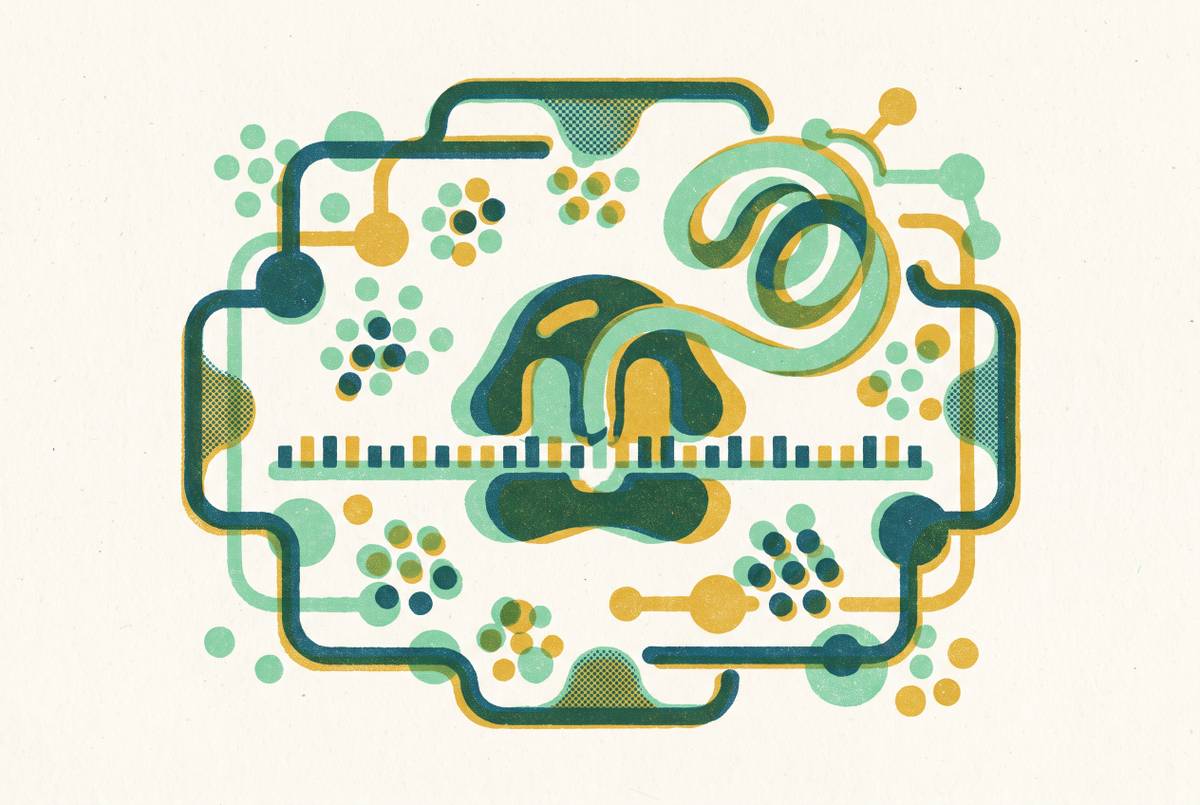
Cell-free protein synthesis strips a cell down to its parts list: extract or purified components carrying the ribosomes, tRNAs, and enzymes needed for transcription and translation, driven by a DNA or mRNA template you supply. There's no living cell to keep alive and no cloning step before you see a protein, so reactions finish in hours instead of days. You can drop a PCR product straight into the tube and walk away with milligrams by evening. The speed comes at a price, though, and the price is energy. Protein synthesis burns through ATP faster than almost anything else a cell does, and outside the cell there's no mitochondrial network, no glycolytic flux control, nothing keeping the lights on automatically.
Somebody has to regenerate ATP and the other NTPs by hand. I've spent enough years staring at failed time-courses to say plainly: how well you pull that off decides whether a reaction runs for twenty minutes or well beyond eighty.
Run out of energy mid-reaction and two bad things happen at once, not one after the other. Synthesis stops, often within tens of minutes under basic conditions with no supplementation, while the ATP donor gets consumed and inorganic phosphate piles up in the tube. That phosphate grabs free magnesium, the ion that ribosomes, NTP synthesis, and translation termination all need to work. The reaction runs out of fuel, then, and poisons its own machinery in the same breath. Nearly every classical energy source used in cell-free synthesis has this flaw baked in, which is why so much of the field's engineering effort over the past twenty years has gone into working around it rather than solving it outright.
How phosphate-donor systems work and where each one breaks down
Substrate-level phosphorylation is the oldest fix in the book. A high-energy phosphate compound hands its phosphate group to ADP and regenerates ATP directly, with no membrane and no electron transport chain involved. It's a simple mechanism, and that's exactly why it became the default two decades ago.
Phosphoenolpyruvate, PEP, is what most people reach for first in E. coli-based systems, because it works, plain and simple. It's chemically unstable, though: PEP hydrolyzes on its own into pyruvate and inorganic phosphate before an enzyme even touches it, and it's expensive enough that scaling up gets painful fast. Some labs feed PEP into the reaction in pulses to stretch synthesis time, and it does extend the run somewhat. Each feeding, though, adds more phosphate to a pool that was already climbing. The fix and the failure mode turn out to be the same molecule, which is the kind of irony you only appreciate after you've burned through a few reagent budgets learning it.
Creatine phosphate does better in eukaryotic lysates, where native creatine kinase is already sitting there ready to use it, and yields with creatine phosphate beat glucose alone by a wide margin in these systems. Consumption still deposits phosphate as it proceeds, though, carrying the same underlying problem into a system where the enzymology happens to fit a little better.
Acetyl phosphate, glucose-6-phosphate, fructose-1,6-bisphosphate: cheaper and more stable than PEP, and each has pushed efficiency forward in its own small way. Hydrolyze any of them and you get phosphate anyway. That's the flaw sitting underneath every classical donor: energy comes out, phosphate goes in, magnesium gets tied up, the reaction slows to a stop. Watch that happen across four or five substrates and it stops looking like a substrate problem; it starts looking like a design problem, baked into the whole approach of feeding phosphate to get ATP.
Next-generation substrates that extend yield and cut cost
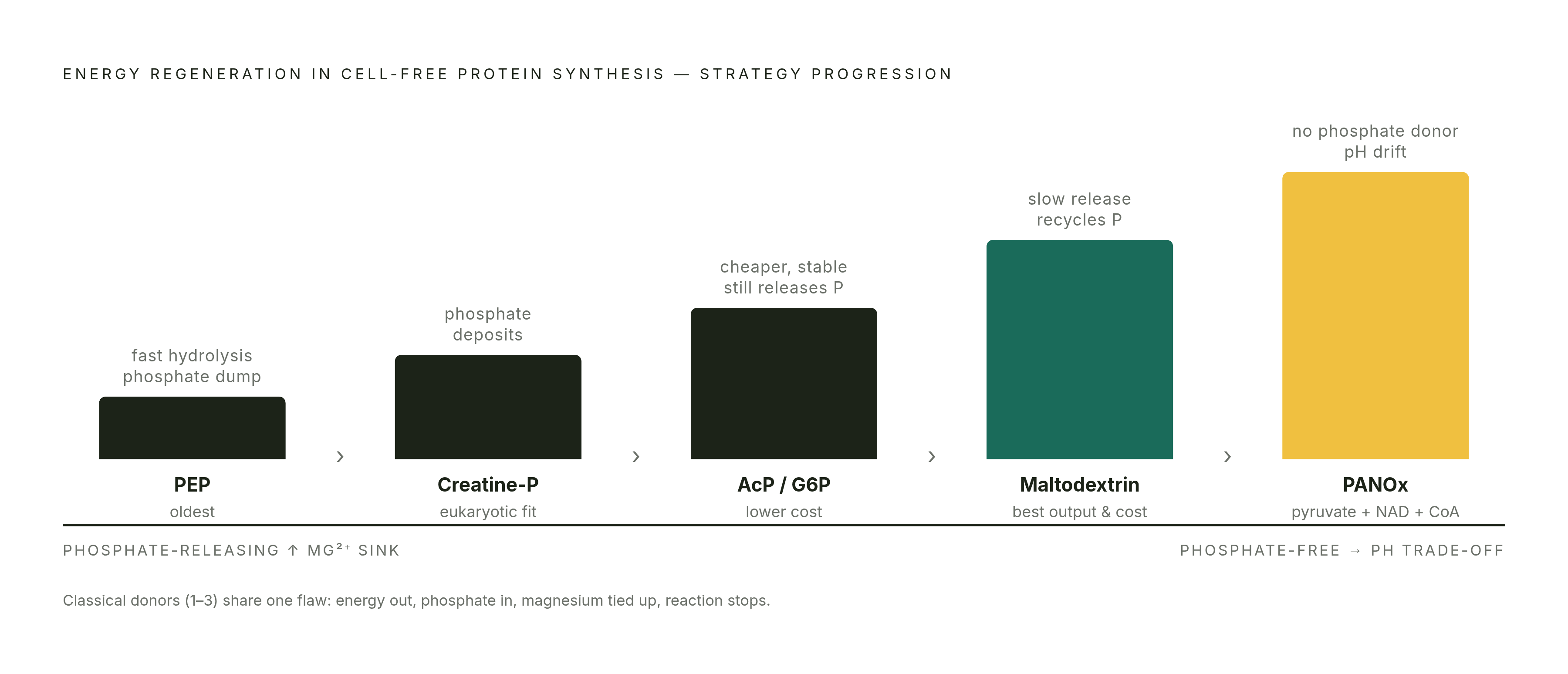
Maltodextrin answers the design problem by changing the release rate instead of the chemistry. Maltodextrin phosphorylase breaks it down gradually, producing glucose-1-phosphate and feeding glycolysis over time instead of dumping phosphate into the tube all at once. Each glucose unit pulled off maltodextrin also yields more ATP than free glucose does on its own, and the phosphorylation step recycles some phosphate instead of just releasing it. Head-to-head tests put maltodextrin ahead of PEP, glucose, and glucose-6-phosphate on protein output, and it's cheaper to buy in bulk, too, which matters once you're running plates by the hundred.
Polyphosphate is a second route, usually paired with maltodextrin rather than used alone. In one all-E. coli cell-free setup, hexametaphosphate served as the phosphate donor while maltodextrin drove glycolysis, and the combination beat either one running by itself. The same idea shows up in PURE systems: adding a bi-functional polyphosphate kinase pathway on top of the existing creatine-based setup pushed mCherry output higher than creatine alone could reach. Stacking two energy strategies beats betting on one.
PANOx takes a different angle entirely. Instead of a phosphate donor, it feeds pyruvate into central metabolism through enzymes already sitting in crude lysate, with NAD and CoA added as cofactors rather than high-energy phosphate compounds. That moves the cost structure away from expensive phosphate donors and toward cheap metabolic intermediates the lysate already knows how to handle. The trade is that PANOx produces acetate and lactate as byproducts instead of phosphate, which softens the magnesium problem but hands you a pH problem in its place. You don't escape the tradeoff; you just move which knob you have to turn.
Line up these three and a pattern shows itself: the substrates that work best release slowly, recycle part of what they consume, or get routed down a path that leaves behind less inhibitory waste. None of them kill the phosphate problem outright; they manage it better than whatever came before.
Oxidative phosphorylation and light-driven regeneration as phosphate-free alternatives
A more radical fix skips phosphate donors altogether. Eukaryotic lysates that keep their mitochondria or chloroplasts intact can regenerate ATP the way a living cell does, through oxidative phosphorylation or photophosphorylation, using the organelle's own electron transport chain with no outside high-energy substrate needed at all. The catch is real, though: this only works if the organelle survives lysis and clarification, and a lysis method harsh enough to release everything else you want usually shreds the same membranes that make oxidative phosphorylation possible in the first place. You're threading a needle every time.
Sf21 insect cell lysate gets this balance right more often than most. It keeps translationally active ER membranes, which means it can support signal peptide cleavage and N-glycosylation alongside energy regeneration, something a purely cytoplasmic extract can't touch. Wheat germ extract earns its reputation for a related reason: it solubilizes a wide range of hard proteins, membrane proteins, GPCRs, multimeric complexes, partly because its native organelle and membrane machinery handle energy supply and folding support at the same time.
Light-driven regeneration pushes further still. Thylakoid membranes combined with cell-free reactions inside microfluidic droplets can regenerate both ATP and NADPH using light, cutting phosphate donors out of the picture entirely for pathways that burn through a lot of both cofactors. Electrical-to-biological energy conversion is being explored too, though nobody's running that on a standard bench yet, and I wouldn't hold my breath for next year either.
Phosphate-free systems come with their own costs. They trade one failure mode for another: organelle stability during prep, how sensitive the lysate is to handling, real ceilings on how far the reaction scales. These systems make the most sense for labs already working with eukaryotic lysates on proteins that need eukaryotic post-translational modifications. Adapting them into an E. coli-based workflow takes real effort, and anyone treating them as a drop-in swap is setting themselves up for a bad month.
How the crude lysate versus PURE system choice shapes energy regeneration options
The energy strategy available to you gets decided before you ever pick a substrate, by whether you're working with crude lysate or a PURE system. This choice happens earlier in the process than most people realize, often before the project is even fully scoped.
Crude lysate, often called TX-TL, keeps the native metabolic enzymes of the source organism sitting alongside the ribosomes and translation factors. That background enzymology is what makes PANOx and maltodextrin strategies work at all: the enzymes needed to metabolize those substrates are already there, doing their job without being asked. Lysate is cheaper per reaction, scales more easily, and tolerates the widest range of energy substrates. The trade is batch-to-batch variability. Cell strain, optical density at harvest, lysis method, and the exact energy mixture used all shift the enzyme complement from one prep to the next, which changes how reliably a given substrate actually gets used, and this is the part that trips up people new to the field.
PURE systems take a different path entirely: roughly three dozen purified proteins, tRNAs, ribosomes, and factors, each at a known concentration, with no contaminating proteases hiding in the background waiting to chew up your product. Energy regeneration in PURE has historically leaned on creatine phosphate and creatine kinase added as purified components. Layering a polyphosphate kinase pathway on top of that base, as mentioned above, shows that even a fully defined system can be built on incrementally, and that the gains stack rather than plateau. PUREfrex 2.0's jump in protein synthesis over PUREfrex 1.0 shows how much a defined system can gain across generations of optimization, even without touching the basic architecture.
The trade-off is cost, and it's not small. PURE reagents run more expensive than lysate, and improving energy regeneration means adding another purified enzyme rather than leaning on background activity that's already sitting in the tube for free. Crude lysate gives you flexibility in energy substrate choice; PURE gives you control over composition but limits your energy toolkit to whatever you deliberately put in. Lot-to-lot standardization matters more for lysate for exactly this reason: since the energy-regenerating enzyme background shifts between preps, solid QC data on extract activity is what actually makes reproducible energy supply possible at any scale worth talking about.
Matching energy regeneration strategy to protein production goal
None of this matters in the abstract. What you're trying to produce, and why, decides the right energy system, full stop.
For rapid screening of protein variants, high-throughput, low volume per well, cost per reaction drives the decision, and reaction duration barely matters next to throughput and reproducibility here. Maltodextrin or acetyl phosphate systems in crude lysate fit well: cheap substrate, compatible with plate-format automation, and the lysate's own enzyme background handles the metabolism without adding purified components. Phosphate buildup usually isn't a real threat in this setting either, since the reactions run short and small enough that you'll read the plate before the inhibition threshold ever gets reached.
Milligram-scale production for downstream assay work asks something different. Reaction duration and sustained yield are the whole game here, and phosphate accumulation is the main thing standing in the way. A slow-release substrate like maltodextrin is a sound starting point, and a hybrid setup like polyphosphate paired with maltodextrin pushes further. If the protein needs eukaryotic folding support, an organelle-containing lysate earns its higher price tag. Magnesium management deserves real attention at this scale too; titrating Mg²⁺ against the phosphate-donor concentration is one of those unglamorous optimization steps that pays off far more than the effort it costs you.
Difficult proteins split into their own categories, and each one points somewhere different. Toxic proteins suit cell-free particularly well, since there's no cell viability to protect and the energy strategy just needs tuning to maximize yield. Disulfide-rich proteins need the redox environment, the GSH to GSSG ratio, managed first, and whatever energy system you pick has to tolerate those oxidizing conditions; a crude E. coli lysate optimized for disulfide formation with DsbC added is a proven route here. Membrane proteins point straight at eukaryotic lysates with intact ER membranes, Sf21 or wheat germ, since these give both the folding environment and, where the organelle survives prep, the energy regeneration bundled into one package. The protein decides the lysate, and the lysate then boxes in what energy strategies are even on the table.
Cost-constrained work runs on its own logic too. PEP and creatine phosphate sit at the premium end, while maltodextrin and glucose-based approaches cut substrate cost substantially without giving up yield; in some comparisons maltodextrin beats PEP on both fronts at once, which is the rare case where cheaper actually means better. Knowing exactly what energy substrate sits in your reaction, and at what concentration, is what lets you troubleshoot with real visibility into the formulation instead of guessing in the dark. Systems built around documented, disclosed formulations, where reagent compositions and lot-level QC data are published openly, hand researchers the information to tune the energy strategy on purpose rather than accept whatever the manufacturer decided behind closed doors.
There's no single best system here, and anyone who tells you otherwise is selling something. The choice sits at the intersection of protein target, production goal, throughput needs, and budget. Getting it right before you ever touch a pipette is one of the highest-leverage decisions a researcher makes in the whole process, and it's the one most often skipped in the rush to just get the reaction running.