Lot-to-Lot Variability in Cell-Free Reagent Kits
Standardized reagent prep, not extract quality, controls variability across labs.

Lot-to-lot variability in cell-free protein synthesis (CFPS) kits comes from identifiable sources, and most labs go hunting for it in the wrong place. Extract gets the blame, but it's usually fine. Once a lab figures out which layer of the reaction is actually misbehaving, the fix tends to be simple, cheap, and something most protocols already skip.
A CFPS reaction stacks several independently made parts into one tube: a cell extract, a small-molecule and cofactor mix, a DNA template, an energy source, and a bank of amino acids. Each layer is its own lot, sometimes made by different people, sometimes months apart. Treating "the kit" as one point of failure hides where the failure actually lives, and that habit, blaming the whole kit instead of isolating the layer, is the first thing worth dropping.
Two distinct problems get lumped together under the word "variability," and they don't share a fix. One is drift within a single lab: same operator, same freezer stock, results that wander a little from Tuesday to Thursday. The other is divergence across sites, when reagents or protocols move between labs and the numbers stop lining up at all. Yield sits next to both, but runs on a separate axis entirely. A low-performing but consistent system is annoying but workable, since a lab can plan around a known ceiling; a high-performing but unpredictable one is worse, because nobody knows in advance which run they're going to get. Unpredictability, more than raw magnitude, deserves the bulk of the attention here. A typical reaction carries something like 30 to 40 added parts beyond the extract, ions, nucleotides, energy substrates, tRNAs, cofactors, and every one of them is a place a lot can quietly drift off spec.
How the 2019 interlaboratory benchmark exposed where variability really comes from
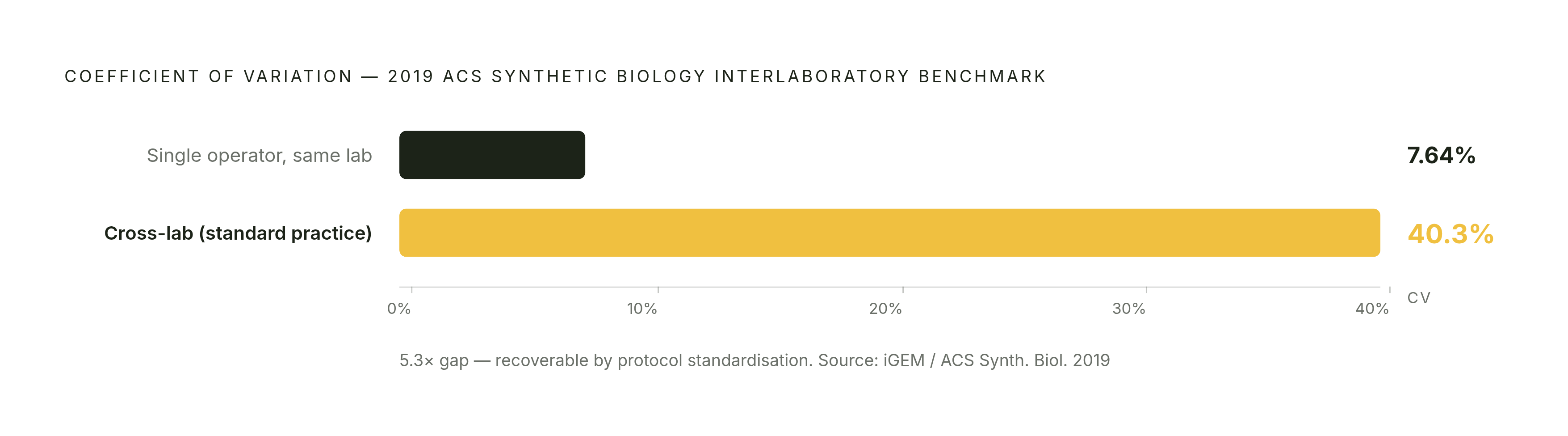
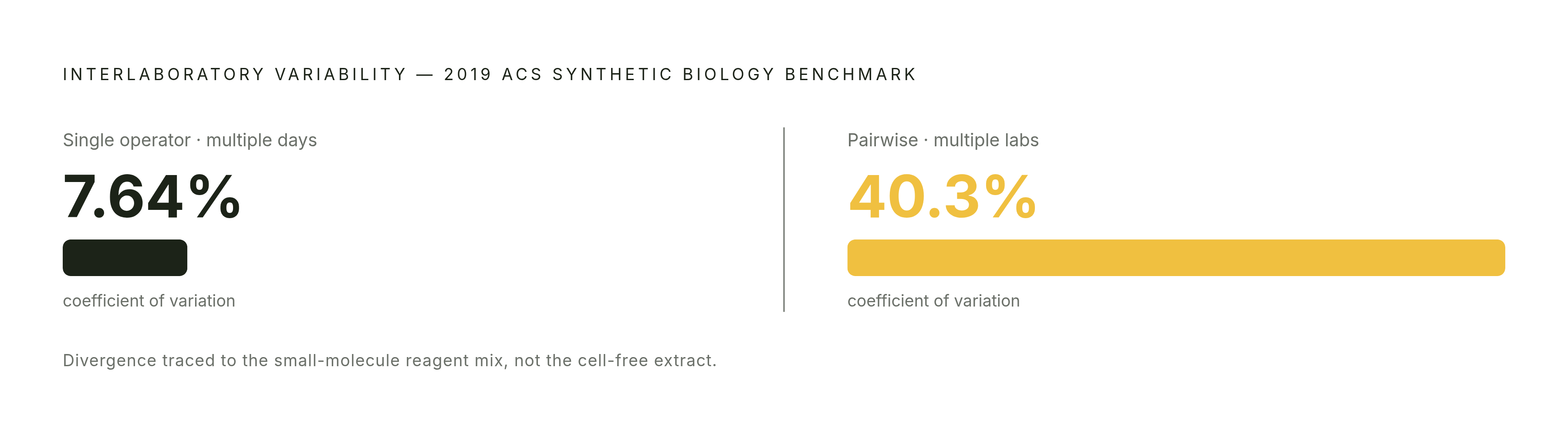
The clearest evidence for where this variability lives comes from a 2019 interlaboratory study published in ACS Synthetic Biology. One operator, running the same reaction across multiple days, produced a coefficient of variation around 7.64%, tight enough to plan a screening campaign against. Materials moving pairwise across different labs pushed that same coefficient to 40.3%.
That gap isn't a worst-case anecdote picked to scare anyone. It's what standard practice looked like across the field at the time, and that's sobering enough on its own.
What makes the finding useful, rather than just unsettling, is what it pinned down as the cause. Extract preparation, the part of the workflow most labs obsess over, did not explain the divergence, even across different labs and different operators. The small-molecule reagent mix did: the cofactors, energy components, and buffer salts most protocols treat as an afterthought next to the lysate.
Most labs spend their attention in the opposite place, and this is the part worth saying plainly: a lab that spends months optimizing extract yield and growth-phase timing, while mixing the reagent cocktail by hand from whatever stock sits on the shelf, is optimizing the wrong variable and calling it rigor. This is one dataset with a specific scope, and it doesn't mean extract quality never matters anywhere. In this benchmark, though, reagent prep dominated the variability, and the single-operator numbers show the ceiling for well-controlled CFPS is real and reachable. Getting there takes deliberate standardization at the reagent layer, not further polishing of the extract.
The specific mechanisms that introduce variability into the reagent mix
Once the reagent mix is the suspect, the mechanisms turn out to be fairly mundane, and mundane problems tend to have mundane fixes.
Pipetting error at small volumes comes first, since with 30 to 40 parts going into a single reaction, small errors at the microliter or sub-microliter scale add up across the full prep. A 5% error on one component is nothing; thirty-five components each carrying their own small error, in the same direction or not, add up to something that shows up in the final titer.
Air bubble entrapment is a specific, documented culprit, particularly in the extract fraction, where incomplete mixing changes reaction evenness across a plate. A bubble in one well is not the same reaction as the well next to it, even though both came from the same master mix.
Energy regeneration chemistry is its own sensitive axis. Whether the system runs on phosphocreatine, 3-PGA, maltose, or something else, both the choice and the concentration shift reaction longevity and yield in a nonlinear way, and small deviations here don't produce small effects.
Magnesium and potassium levels deserve particular attention, since they're the two ions most tightly coupled to ribosome activity, and their optimum depends on the extract. A Mg²⁺ concentration that worked fine for last month's extract lot isn't guaranteed to work for this month's, and skipping the re-titration step is one of the most common ways a lab bakes variability into a new campaign before the campaign even starts.
Component purity adds another layer, since small molecules from different suppliers, or different lots from the same supplier, can differ in purity in ways that hit reaction performance with no obvious warning sign.
Then there's the human factor. Manual assembly of many parallel reactions, the kind of setup where 35 reactions take two to three hours of hands-on pipetting, as documented in the i-POPFLEX automation study, brings in variability tied to fatigue, timing, and drifting technique over a long bench session.
Template quality sits on a separate axis entirely. Research on myTXTL-type systems has found that DNA extraction method and post-processing steps can affect expression titer and rate, independent of extract or reagent quality. A perfectly made reagent mix can't rescue a template prep that got rushed.
Why crude-extract and reconstituted systems face different variability profiles
Crude-extract systems, built from E. coli, wheat germ, CHO, HEK293, or Sf21 cells, all carry the same trade-off: the lysate is undefined. Its activity depends on growth phase at harvest, lysis method, and downstream processing, all of which vary batch to batch by nature. That variability is real, but per the 2019 interlaboratory data, it stays within manageable bounds. The reagent cocktail remains the bigger threat, and labs that keep chasing extract purity are chasing the wrong ghost.
Reconstituted systems, the PURE-type architectures, take a different approach by defining every protein component of the translation machinery individually, so the composition stops being a black box. That cuts lot-to-lot uncertainty in the protein machinery substantially, though it doesn't erase variability, because the ribosomes and tRNAs in these systems are still purified from E. coli, and that purification carries its own batch-to-batch swing.
The trade is cost and yield against reproducibility. Crude-extract systems can run at a fraction of a cent per microliter; commercial reconstituted kits cost substantially more. That premium is worth paying for quantitative biochemistry and genetic circuit work, where reproducibility is the entire point of the experiment. For high-throughput screening at scale, the cost gap turns prohibitive fast, and few budgets survive running thousands of PURE reactions.
Worth watching: a 2026 Nature Communications study showed that all 36 non-ribosome proteins in a PURE system can be made by PURE itself and fed back into a functional system, a path toward lower cost and less reliance on outside supply, though it isn't routine lab practice yet. Crude and reconstituted setups both leave variability somewhere in the system; each one just moves where in the workflow it shows up.
How variability corrupts high-throughput screening more than single-protein production
For a lab running single-protein production, batch-to-batch variability is visible and fixable. A bad lot shows up as low yield in the data, and the fix is a fresh lot or a re-optimization pass, which is annoying but survivable.
Screening carries a worse kind of risk, and it deserves its own scrutiny. Variability within a plate stays invisible unless every row carries its own controls, and a well-to-well difference of 10 to 15% is enough to flip the rank order of two variants that are actually close in performance. A failed experiment is easy to spot, while an experiment that looks successful and quietly reports the wrong answer does the real damage.
Consider a real create-test-learn cycle. A lab running iterative CFPS-based directed evolution might screen dozens of variants per round, with machine-learning-directed rounds building on the first, and real performance gains only emerging if the underlying data are clean. That signal only surfaces if within-plate noise stays low enough for the real differences to rise above it. CFPS is widely recognized as substantially faster than conventional E. coli expression and purification workflows, and that speed advantage is the entire reason CFPS gets used for this kind of work. Speed only pays off, though, if the data underneath it can be trusted.
Machine-learning-directed protein engineering typically needs tens to hundreds of variants to train a usable model. When a meaningful share of those data points are corrupted by reagent variability instead of real biology, the model learns the noise instead of the protein. A model trained on bad runs that nobody caught matters more than any single bad run, since it generates recommendations for round three that are chasing an artifact instead of the enzyme. The economics of CFPS-based screening, the speed, the low cost, skipping purification entirely, only pay off in practice when the reagent system holds steady enough that the resulting data actually means something.
Practical controls and workflow design choices that reduce variability
Master-mix discipline is the single highest-leverage fix available, full stop. Make one large reagent premix for every reaction in a screen, rather than per-reaction aliquots assembled one at a time. That single change collapses reagent-layer variability into one prep event instead of scattering it across dozens of separate pipetting decisions.
Magnesium and potassium titration for every new extract lot isn't optional, whatever the protocol on file says. A shift of just 1 to 2 mM in Mg²⁺ can cut yield in half, and running that titration before committing to a full screening campaign is cheap insurance against a wasted week.
Air bubble management matters more than it sounds like it should: spin the extract briefly before use, pipette it last, skip the vortex, and use positive-displacement pipettes for viscous fractions. These are small habits, but they separate an even plate from one riddled with silent dead spots.
Template normalization deserves its own step, not an afterthought tacked onto template prep: measure and normalize DNA concentration and quality, A260/A280 and A260/A230 ratios, before adding template to any reaction, and never assume one prep behaves like the last.
Every plate needs its own controls: at minimum a no-template negative and a standard reporter. sfGFP from a well-characterized plasmid works well here, catching plate-level failures and normalizing across separate runs.
Automation helps in a way that goes past convenience. The i-POPFLEX study, using an Opentrons OT-2 platform, showed roughly a 20% increase in sfGFP expression compared with manually prepared reactions, put down to less pipetting error across the full set of parallel reactions. Automation works as a reproducibility fix here, alongside a throughput one.
None of this works without documentation. Record lot numbers and prep dates for every component in every reaction, since variability traced to a specific lot gets corrected, while variability nobody tracked can't be diagnosed at all.
What lot-level transparency from a reagent supplier changes about troubleshooting
Most commercial CFPS kits ship with no lot-level QC data attached. A lab finds out about a bad lot the way it finds out about most bad news in the wet lab: an experiment fails, and only then does anyone start asking why.
Without knowing what actually changed between one lot and the next, troubleshooting turns into guesswork. Is it the energy mix? The extract's own activity level? A shift in Mg²⁺ concentration buried somewhere in the buffer? Each guess needs its own titration experiment to check, and that adds days to a diagnosis a supplier's own QC data could have answered in minutes.
Lot-level QC data, activity curves, documented Mg²⁺ optima, yield benchmarks against a standard reporter, lets a lab confirm a new lot performs within spec before it ever touches a screening campaign. Documented formulations go further still: if a component turns out to be the failure point, a lab that knows the formulation can substitute or spike-correct it. A lab running an opaque, proprietary kit has no such option and waits for the next lot, hoping for the best.
The field has already called for shared protocols, better data access, and tools that measure individual components throughout the workflow rather than just the final yield number. Published lot QC is the supplier-side answer to that call. A supplier that takes this approach directly, publishing lot-level QC data and documenting its formulations openly, becomes a credible option for labs that need to standardize across runs or troubleshoot systematically rather than write off variability as an unavoidable cost of doing business. Sepia Bio, whose OpenCFPS™ reagents come with public formulations and lot-level QC data at a price point built for high-throughput screening, is one example of that model. For labs running automation pipelines or coordinating across multiple sites, a supplier whose lots can be checked in advance removes the risk that reagent drift quietly invalidates a dataset midway through a campaign, long after the damage is done.
Choosing a path: when to optimize in-house and when to demand more from the kit
For single-protein production at milligram scale, lot-to-lot variability is manageable in-house, and paying for a premium reconstituted system to solve it is usually money wasted. Per-lot Mg²⁺ titration and master-mix discipline handle most of it, and the cost edge of crude-extract CFPS, roughly $0.03 per microliter, makes in-house optimization the better bet.
For high-throughput variant screening, the calculus flips entirely. Within-plate variability corrupts data more thoroughly than run-to-run drift ever does; a corrupted rank order does more damage than a low average yield, because it steers the next round of engineering in the wrong direction. Automation and a well-characterized, documented reagent system carry real weight here, becoming the price of admission, and any lab skipping that price is gambling with its own dataset.
For multi-site or multi-operator collaborations, treat the 40.3% interlaboratory CV as the baseline to expect if nothing gets standardized, not a worst case to hope around. Shared protocols paired with a common, lot-qualified reagent source are the only reliable route to data that can actually be compared across sites, rather than data that merely looks comparable on a slide.
For difficult targets, toxic proteins, membrane-bound proteins, unstable folds, the choice of expression system matters more than lot variability in the first place, and CFPS is often the only workable option at all. Within that constraint, crude-extract systems with documented lots leave room to add folding factors, adjust redox conditions, or bring in non-natural amino acids in ways reconstituted kits can't easily match.
The field is moving toward tighter automation, self-regenerating PURE systems, and open formulations, which suggests the variability problem is solvable rather than a permanent tax on the technology. Labs that build reproducibility into their workflow now will be positioned to benefit as those advances mature, instead of scrambling to retrofit them later. The practical minimum stays simple in the meantime: know which layer of the reaction is actually varying, document every lot without exception, and pick a reagent supplier whose QC data lets a campaign get checked before it runs, rather than autopsied after it fails.