Unnatural Amino Acid Incorporation via Cell-Free Suppression
Cell-free synthesis eliminates three barriers to unnatural amino acid incorporation simultaneously.

Site-specific insertion of chemistry that doesn't exist among the canonical twenty amino acids, things like reactive azide handles, photo-crosslinkers, non-hydrolyzable bonds, has become one of the more consequential frontiers in protein engineering. Cell-free protein synthesis (CFPS) is the most practical way to do this work, and it gets rid of three barriers that living cells impose by design, all at once instead of one at a time.
Cell-free protein synthesis (CFPS) using amber suppression is the best method for site-specific unnatural amino acid (UNAA) incorporation into proteins. The approach centers on three matched components: an orthogonal suppressor tRNA that reads the UAG amber codon as an insertion signal, an orthogonal aminoacyl-tRNA synthetase (aaRS) that charges that tRNA exclusively with the chosen UNAA, and a cell-free extract prepared from an RF1-deleted strain such as C321.ΔA, which removes the competing termination activity that otherwise truncates most product. That combination has achieved 98% or better site-specific incorporation accuracy across 40 amber sites in a single polypeptide at yields of 96 ± 3 mg/L, numbers that no intact-cell platform has matched because living cells simultaneously impose membrane impermeability, UNAA toxicity ceilings, and RF1 competition rather than letting each constraint be solved on its own terms.
Those barriers are membrane impermeability, cytotoxicity, and competition from the cell's own termination machinery. A cell defends itself for a living, so a system built for exactly that job pushes back against any attempt to smuggle in unnatural chemistry piece by piece. Fix permeability and toxicity still caps your yield; fix toxicity and the ribosome's quality control still throws away most of what you made. Pull the membrane and the living host out of the equation, and all three problems go away together instead of getting traded off one against the other. This is the argument this piece makes, and the data behind it, from RF1 knockout strains to multi-site incorporation numbers, backs it up section by section.
How amber suppression works: the codon, the suppressor tRNA, and the orthogonal synthetase
The amber codon, UAG, carries most of the weight in unnatural amino acid (UNAA) incorporation, mainly because reassigning it does comparatively less damage to the rest of the genome's coding capacity. Reassigning it does the least damage: fewer genes read through by accident, fewer truncated or extended proteins turning up where they shouldn't.
Making that reassignment work takes an orthogonal translation system built from two matched parts. A suppressor tRNA reads UAG as a signal to insert an amino acid rather than stop, and an orthogonal aminoacyl-tRNA synthetase (aaRS) loads that tRNA with the UNAA you picked, and nothing else. The pair has to stay out of the host's way completely; cross-reacting with native tRNAs or synthetases makes the whole system leak. Most of the pairs used in E. coli cell-free systems trace back to archaeal biology. The MjTyrRS/tRNA pair from Methanocaldococcus jannaschii is a well-established example, and it has been used in E. coli cell-free systems to incorporate unnatural amino acids in high yields.
These engineered aaRS/tRNA pairs are slow, two to three orders of magnitude slower at charging their tRNA than a native synthetase charges its own partner. This limitation is baked into the system, and no amount of downstream tinkering fixes it.
Global suppression is worth a mention as an alternative. It redirects native machinery to swap UNAA analogs in at every occurrence of a residue, rather than at one engineered site. Setup is easier, but you give up control over exactly where the UNAA lands in the sequence, which was the whole point of amber suppression to begin with. Either approach still needs three things: high concentrations of the orthogonal translation components, a steady supply of the UNAA, and some way to keep competing termination from winning the race at the amber codon. All three are a lot easier to deliver in a tube than inside a living cell.
Release factor 1 is the primary bottleneck, and removing it in vivo is costly
Release factor 1 (RF1) exists to recognize UAG and end translation right there, and it does the job well. That's exactly the problem. In an unmodified cell, RF1 beats the sluggish suppressor tRNA to the amber codon almost every time, so you end up with a truncated fragment instead of a full-length protein carrying the UNAA.
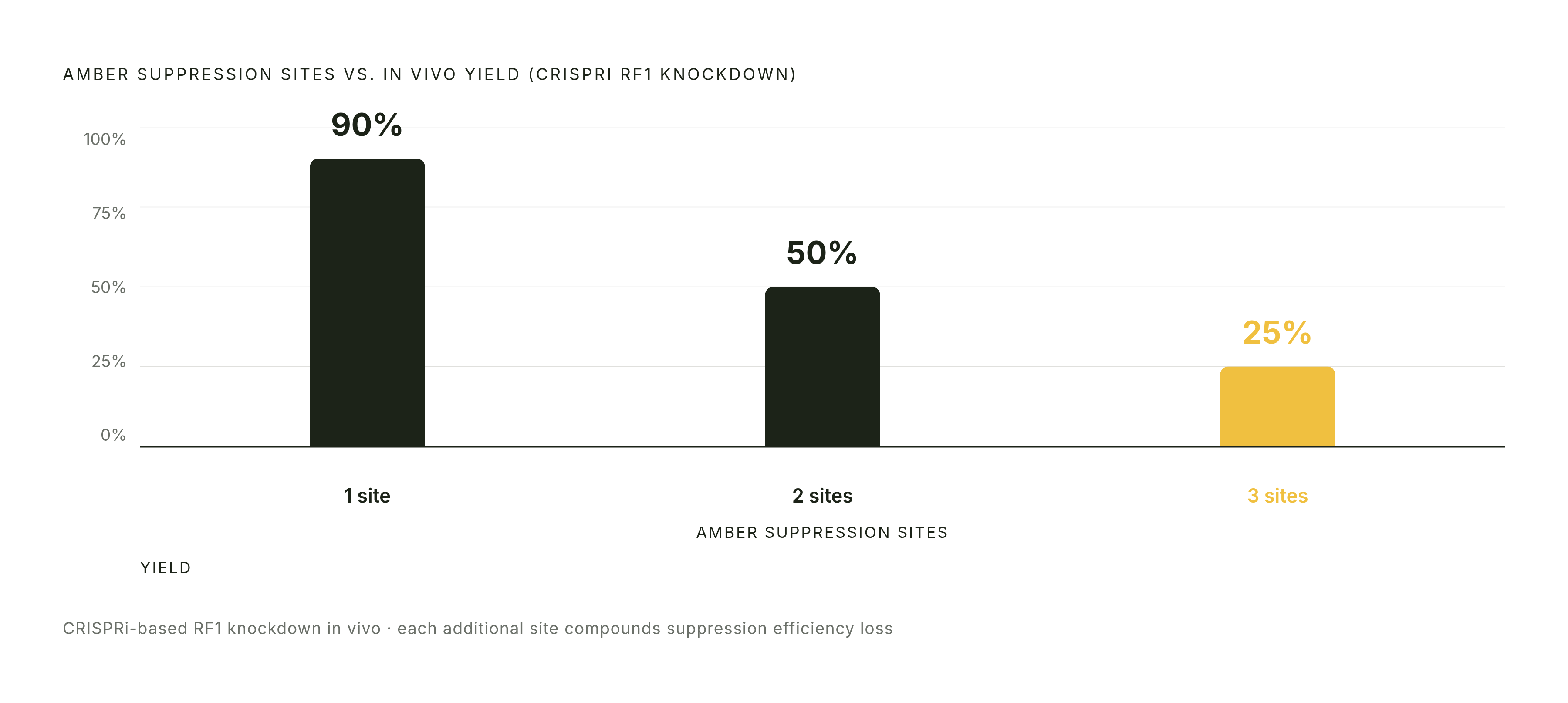
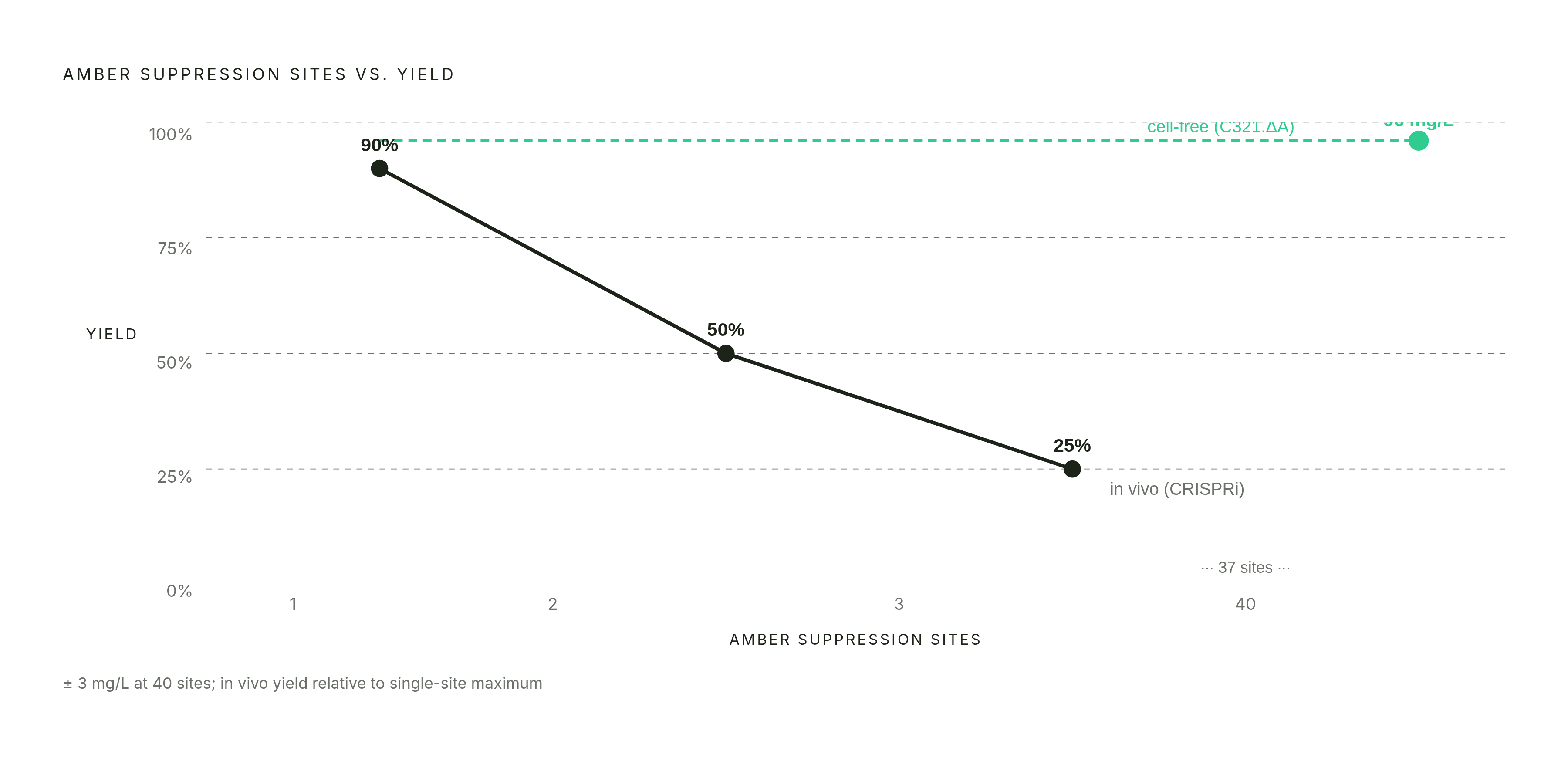
Multi-site targets make the numbers stop being ambiguous. CRISPRi-based RF1 knockdown in vivo gets incorporation yields around 90% for a single UAA site. Add a second site and yield drops to roughly 50%; a third pulls it down around 25%. Each additional site costs more than the last one did, and the curve doesn't do anyone any favors.
Two fixes exist, and both come with a cost. Genomically recoded organisms, strains that reassign every endogenous UAG to UAA and delete RF1 outright, solve the competition problem completely, but building one takes genome engineering most labs don't have sitting on a shelf. Partial RF1 knockdown is more within reach, though it only gets you partway there, and the yield penalty at multiple sites stays steep no matter which version you run. Neither approach touches membrane impermeability or UNAA toxicity. The cell is still a cell, enforcing the other two constraints no matter what's been done to RF1.
How does cell-free architecture solve the barriers to unnatural amino acid incorporation?
There's no membrane in a cell-free reaction, so the UNAA goes straight into the tube. Concentration becomes a pipetting decision, not a transport question tied to whatever channels happen to exist in the host's membrane.
No living host also means no toxicity ceiling. Antimicrobial peptides, pore-forming toxins, aggressive proteases, the kinds of proteins that would kill a cell long before enough of them built up to be useful, get made steadily in a cell-free reaction because there's no viability left to protect. The system genuinely does not care whether the UNAA or the finished protein is poisonous.
RF1 gets solved at the extract level. Extracts made from RF1-deleted strains, C321.ΔA being the reference case, carry no competing termination activity at all. That strain has produced 1,780 ± 30 mg/L of superfolder GFP in standard runs, and it's been used to install 40 identical p-acetyl-L-phenylalanine residues site-specifically into an elastin-like polypeptide at 98% accuracy or better, yielding 96 ± 3 mg/L. A different approach gets there through conditional inactivation instead: an OmpT cleavage site engineered into RF1 shuts the release factor off during lysis itself, no extra processing step required, and this has opened up approaches to IgG1 engineering that benefit from the absence of competing RF1 activity. Either way, the fix happens once, at the point the extract gets made, and it doesn't need re-engineering for every new protein that comes through afterward.
The open-reaction format is an advantage on its own, not just a convenience. tRNA, synthetase, and UNAA all get added from outside and titrated independently, at concentrations that would poison a living cell or wreck its osmotic balance but are, in a tube, just choices made at the bench. And because there's no cell culture, no transfection, no waiting around on a growth curve, a linear PCR product is enough to get started. The distance from sequence to protein shrinks to hours.
Multi-site UNAA incorporation: where cell-free systems pull decisively ahead
A single amber codon already stretches most in vivo systems thin. Ask for two or more distinct UNAAs in the same polypeptide and now you're running multiple orthogonal codon/tRNA/synthetase sets at once, none of which can cross-talk with each other or with the host's own machinery.
One route that actually works: combine TAG and TAA reassignment in the same cell-free unnatural protein synthesis (CFUPS) reaction. Work incorporating three distinct UNAAs at once (p-propargyloxy-L-phenylalanine, p-azido-L-phenylalanine, and L-4-iodophenylalanine) in a single system points to simultaneous TAG/TAA usage as the most workable path to multi-site incorporation available right now.
Reagent optimization is what actually moves the needle at this scale. Redox environment shapes how well the orthogonal translation components perform catalytically; magnesium concentration governs the protein-nucleic acid interactions running through every stage of translation. Because the reaction is open, both variables, along with the orthogonal components themselves, get tuned independently in a way that just isn't available inside an intact cell. The RF1 compounding problem from earlier mostly disappears here too: with RF1-deleted extract, adding a second or third amber site doesn't carry the steep yield penalty you'd see in the CRISPRi numbers above. That opens the door to designs that used to be off the table, things like bifunctional conjugates, proteins carrying two or three distinct chemical handles, engineered disulfide mimics built from residues nature never made.
The protein targets that make cell-free suppression practically necessary
Some proteins are hostile to their own production host, full stop, and that's where cell-free suppression becomes the only workable option. Antimicrobial peptides, proteases, membrane-disrupting proteins can all kill a host cell before enough protein builds up to be worth anything. A cell-free reaction removes the concern outright, since there's no host left to kill.
Membrane proteins bring a different headache: they don't stay soluble in water. Wheat germ-based cell-free systems handle this directly, supplying membranes, micelles, and organelle fragments right in the reaction, which keeps membrane proteins in solution without adding liposomes as a separate step.
Scale makes its own case. CFPS has produced proteins spanning roughly 10 kDa up to over 220 kDa, covering kinases, GPCRs, transporters, multimeric complexes that would each need a different expression strategy in a living cell. Stack a UNAA requirement on top of a protein that's already hard to express in vivo, and now you're solving two engineering problems inside one fragile system at once. A cell-free platform lets you work both problems in the same open reaction, instead of forcing sequential fixes where each one risks undoing the last. No single living-cell platform covers this range either: bacteria lack the machinery for a lot of post-translational modifications, mammalian cell lines are slow and expensive to run, and every host has its own ceiling on which UNAA chemistries it can even accept.
Yield expectations and what drives them in cell-free UNAA workflows
Around 1 mg/mL in a standard batch cell-free reaction is the number most labs report for ordinary protein expression. That's usually enough for binding assays, structural work, most of the downstream characterization a project needs.
UNAA incorporation adds overhead on top of that baseline. Slow acylation kinetics from the engineered aaRS/tRNA pairs, plus ongoing competition at the amber codon, both eat into per-site yield, and the overhead compounds as sites get added. RF1 deletion recovers a big share of it: that 96 ± 3 mg/L figure for 40-site p-AcF incorporation into an elastin-like polypeptide, using C321.ΔA-derived extract, is the clearest evidence yet that high multi-site incorporation and workable yield can coexist, provided the extract itself was built right in the first place.
What a researcher actually controls in CFPS, and doesn't get to touch in a living cell, comes down to a short list: independent titration of orthogonal component levels, direct control over UNAA concentration, open access to redox buffering, magnesium, and the energy regeneration system, and free choice of template (plasmid or linear PCR product), which supports fast design-test-redesign cycles. None of it requires re-engineering the underlying biology. Because CFPS reactions scale linearly, whatever works at microliter screening volume tends to carry over to bigger preparative batches without surprises.
Downstream applications enabled by site-specific UNAA incorporation
Bioconjugation is the most immediate payoff, and it depends entirely on precision. UNAAs like p-azido-L-phenylalanine (pAzF) work as bioorthogonal handles for metal-free click chemistry, reacting cleanly at the site where you put them and nowhere else. Bulk labeling, by contrast, tags whatever reactive residue happens to sit exposed on the protein's surface, with no say over how many or where.
Antibody-drug conjugates make the case concretely. Site-specific UAA insertion produces homogeneous ADCs: a fixed drug-to-antibody ratio, a linker sitting exactly where it was designed to sit. Conventional conjugation through cysteine or lysine residues produces a mixture of species with varying drug loads, and that heterogeneity is a real liability once a therapeutic product is on the line.
Beyond conjugation, the same precision shows up in FRET biosensors built with fluorescent labels at structurally defined positions, photo-crosslinkers for mapping protein-protein interactions, non-hydrolyzable analogs and backbone modifications for probing enzyme mechanism, and biomaterials like elastin-like polypeptides carrying reactive groups at regular, defined intervals (the 40-site example above is a direct demonstration of that last one). None of these applications work off mere presence of a UNAA somewhere in the protein. Placement is what they need, and placement at useful yield and throughput is what amber suppression in a cell-free system actually delivers.
Reagent requirements and practical setup for a cell-free amber suppression experiment
Running this kind of experiment means putting together five core components on the bench. A cell-free extract, ideally from an RF1-deleted or RF1-inactivated strain if multi-site or high-efficiency single-site work is the goal. An energy regeneration system and amino acid mix, with the canonical amino acid left out for residue-specific replacement. A DNA or mRNA template carrying UAG at the target site or sites. An orthogonal tRNA/synthetase pair matched to the UNAA's chemistry. And the UNAA itself, added from outside at a concentration that's been optimized rather than guessed at.
Three variables do most of the work once those pieces are in hand. Orthogonal component ratios need separate titration, since tRNA and synthetase concentrations each have their own sweet spot, and too much is just as bad as too little. Magnesium affects translation fidelity and orthogonal system performance at the same time, so tuning one means watching the other. Redox environment matters most when the target protein carries disulfide bonds, or when the UNAA chemistry itself is sensitive to oxidation.
None of this needs exotic hardware. Standard plate formats, pipetting automation, a normal incubator, equipment most protein expression labs already have sitting around. What actually matters is knowing what's in the extract and the energy system from the start, because a researcher who knows the exact composition can adjust orthogonal components on purpose, by reasoning through it, instead of guessing and re-guessing to compensate for variables nobody wrote down. A reagent system with lot-verified, transparent composition, OpenCFPS™ being one example from Sepia Biosciences, a cell-free expression reagent supplier that publishes its formulations openly, makes that kind of deliberate optimization repeatable, both within one lab's own work and when results need to move between labs. Verification at the end isn't optional either: mass spec confirmation of UNAA incorporation at the intended site is standard practice, and the 98%-plus accuracy seen in optimized RF1-deleted extract systems is the bar a properly built setup ought to clear.