Wheat Germ and Rabbit Reticulocyte Systems vs. Bacterial CFPS
Bacterial extracts work for most proteins; pick eukaryotic systems only when folding demands it.

Cell-free protein synthesis runs on three extract types, and most labs pick the wrong one by defaulting to whatever's cheapest or whatever the last paper used. Bacterial extract, wheat germ extract, and rabbit reticulocyte lysate answer the folding question in three different ways, at three different price points, and the right pick depends on what the target protein actually needs to fold correctly. Get the match wrong and no amount of downstream troubleshooting fixes it: the extract is the whole biological context the protein gets built in.
Most methods sections won't say this outright, so here it is: bacterial CFPS should be the default for nearly everything, and reaching for a eukaryotic extract without a specific, identifiable folding reason is the single most common way labs waste money on this decision. Most targets don't have that reason. The rest of this piece works through why, and where the real exceptions live.
Why bacterial CFPS leads on yield and cost, and where that advantage ends
E. coli extract wins for plain, mechanical reasons. Prokaryotic ribosomes translate fast, the extract is cheap to make in bulk, and none of it depends on sourcing animal tissue. Optimized bacterial systems hit batch yields well above what eukaryotic extracts typically deliver, which puts milligram-scale production within reach of a standard bench setup instead of a specialized facility with a dedicated tech running it.
That mix of speed, cost, and scale makes bacterial CFPS the right call for cytoplasmic proteins, enzymes, binding domains, and intrinsically disordered proteins. None of these need a eukaryotic chaperone system or any post-translational dressing, so the premium a eukaryotic extract charges buys nothing back.
The limits show up the moment a target needs something a bacterial cell doesn't naturally carry. There's no eukaryotic chaperone environment, so multi-domain proteins and disulfide-rich proteins misfold or clump far more often than they would in a eukaryotic system. Glycosylation machinery is absent by default; adding it means real engineering, not a buffer tweak. Toxic proteins are the one place bacterial CFPS clearly beats in-cell expression, since there's no living cell around to kill, but even there, a prokaryotic reaction can't hand a eukaryotic protein the folding context it evolved around.
Bacterial CFPS is where a project should start, and only a specific, identifiable folding requirement should knock it off that spot. Platforms built for this tier compete on documented formulations and lot-level QC, and the cost difference adds up fast for anyone running variant screens where cost per well is the whole budget conversation, suppliers like Sepia Bio, which publishes its reagent formulations openly and prices for screening scale, are built around exactly that calculation.
What wheat germ extract brings that no other eukaryotic system matches on yield
Wheat germ extract solves a problem that looks, on paper, unsolvable: how to get eukaryotic ribosomes without paying the yield penalty eukaryotic systems usually carry. WGE comes from plant embryos, and embryo tissue holds almost none of the endogenous mRNA that would otherwise compete with the target transcript for ribosomes. Nearly every ribosome in the extract sits free to work on the protein being made. That's the whole trick.
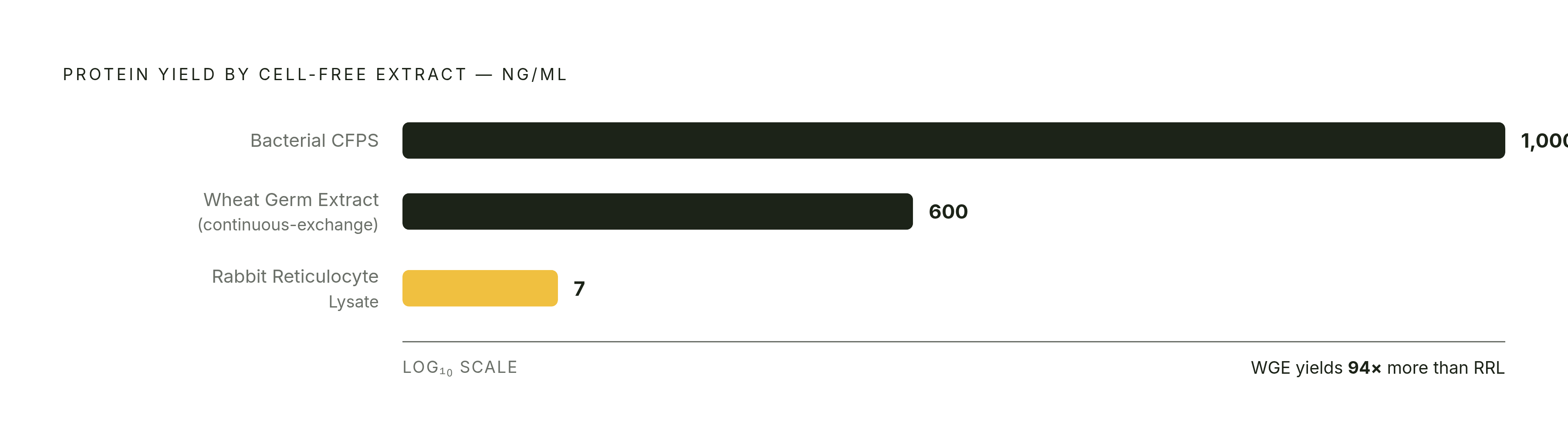
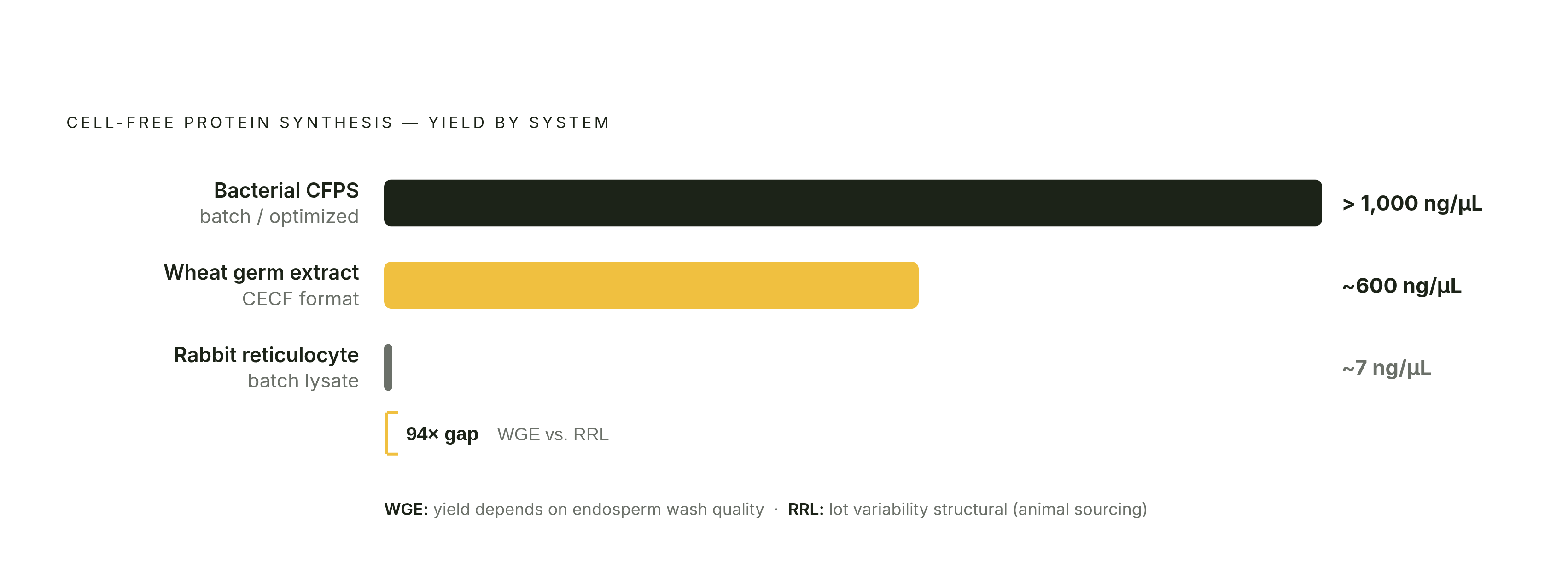
The yield numbers back this up directly. In continuous-exchange cell-free format, wheat germ extract has been measured at roughly 94 times the yield of rabbit reticulocyte lysate, with manufacturer figures putting wheat germ around 600 ng/μL against 7 ng/μL for RRL. Some optimized batch systems report yields above 1 g/L, closing a gap with bacterial CFPS that no other eukaryotic extract comes near.
The throughput case was made early and hasn't been overturned since. Sawasaki and colleagues, writing in PNAS in 2002, showed that one person could translate 50 different genes in parallel over two days, pulling 0.1 to 2.3 mg of protein per construct, with the extract staying productive across 14 days. Few eukaryotic platforms have matched that benchmark since. It's part of why WGE fits so naturally into proteomics-scale screening workflows where parallel translation across many constructs is the goal.
Success depends entirely on careful extract prep, though. Wheat endosperm carries inhibitory enzymes and other translation-suppressing compounds that shut down protein synthesis at trace concentrations. The washing step that strips embryo tissue clean of endosperm contamination is the entire ballgame. Skip it, or shortcut it, and the extract fails quietly instead of dramatically, which is worse: a loud failure gets caught, a quiet one gets published. Sourcing from a supplier who documents that wash step is a real quality question, not a paperwork formality.
What rabbit reticulocyte lysate offers and what its animal origin costs you
Rabbit reticulocyte lysate comes from cells that evolved to do one thing: churn out hemoglobin at enormous volume. That specialization carries straight into RRL's strengths as a cell-free system. It offers a mammalian chaperone environment, the closest folding context available to human and mammalian proteins outside a living cell, and it supports cap-independent translation. Microsomal membrane supplementation can extend RRL's modification capabilities, at the cost of overall yield. For studying cotranslational folding, protein-protein interactions, or eukaryotic biogenesis in something close to native context, RRL has a long track record, and nothing else on this list replaces it there.
The yield problem is structural, not a fixable inefficiency. Manufacturer data puts RRL yield around 7 ng/μL, roughly 94-fold below wheat germ CECF. Workarounds exist: adding influenza A virus NS1 protein alongside an EMCV IRES sequence in the target mRNA can boost RRL yield more than tenfold, but that stacks complexity onto an already complex system and doesn't generalize to every construct. At baseline yield, RRL suits small-quantity structural or functional studies and gets hard to justify once the goal shifts to milligram-scale production. Treat it as a microscope, suited to close observation rather than bulk output.
Lot-to-lot variability is the other cost, and it's one that plant and bacterial extracts simply don't carry. Each batch of RRL reflects the biology of the donor animals it came from, so activity swings lot to lot as a built-in consequence of using animal tissue as a source, not as a manufacturing defect. That makes standardizing RRL across experiments, labs, or time genuinely hard. Cell line-derived alternatives were developed to address this variability, though each comes with its own tradeoffs. Stack the yield ceiling on top of the lot variance and the typically higher per-reaction cost, and RRL's niche narrows to exactly the applications where its mammalian folding context is worth all three tradeoffs.
Post-translational modifications: where the systems actually diverge for complex targets
PTM capacity depends on which modification a target needs and how much engineering a lab is willing to do to get there. It's a matter of degree across these three platforms, not a yes-or-no checkbox.
Bacterial CFPS sits at the simple end: no native glycosylation machinery, no eukaryotic kinases, and disulfide bond formation only when a redox buffer gets deliberately added to the reaction. What bacterial CFPS gives up in modification range, it makes up in how predictable the limitation is. Nobody expects an E. coli extract to glycosylate anything, so there's no false hope to manage and no time wasted chasing it.
Wheat germ extract does more than the field assumed a decade ago, and this is where expectations have shifted the most. Research has shown that WGE can support phosphorylation of viral membrane proteins at sites consistent with native infection contexts. Disulfide bond formation is achievable too: mFIZZ1, a protein that needs five disulfide bonds to fold correctly, has come out soluble, correctly folded, and biologically active in WGE when the reaction gets supplemented with human quiescin sulfhydryl oxidase, hQSOX1b. Adapted WGE formats have also been applied to challenging membrane protein targets to improve yield. Glycosylation remains the one gap WGE hasn't closed: N-linked and O-linked glycosylation aren't available without further engineering stacked on top of the base system.
RRL still holds the mammalian PTM advantage overall. Its folding environment sits closest to native for human proteins, glycosylation can be approached through membrane supplementation strategies, and cotranslational modification generally is well supported.
The decision logic follows cleanly from there. Glycosylation on a mammalian target points toward RRL with membranes, or toward insect-cell CFPS as a separate option outside this comparison. Disulfide bonds without glycosylation point toward WGE with oxidative supplementation, which beats RRL on yield in that exact scenario. When no PTM is required at all, bacterial CFPS wins on every other axis that matters, full stop.
How to match platform to protein target in practice
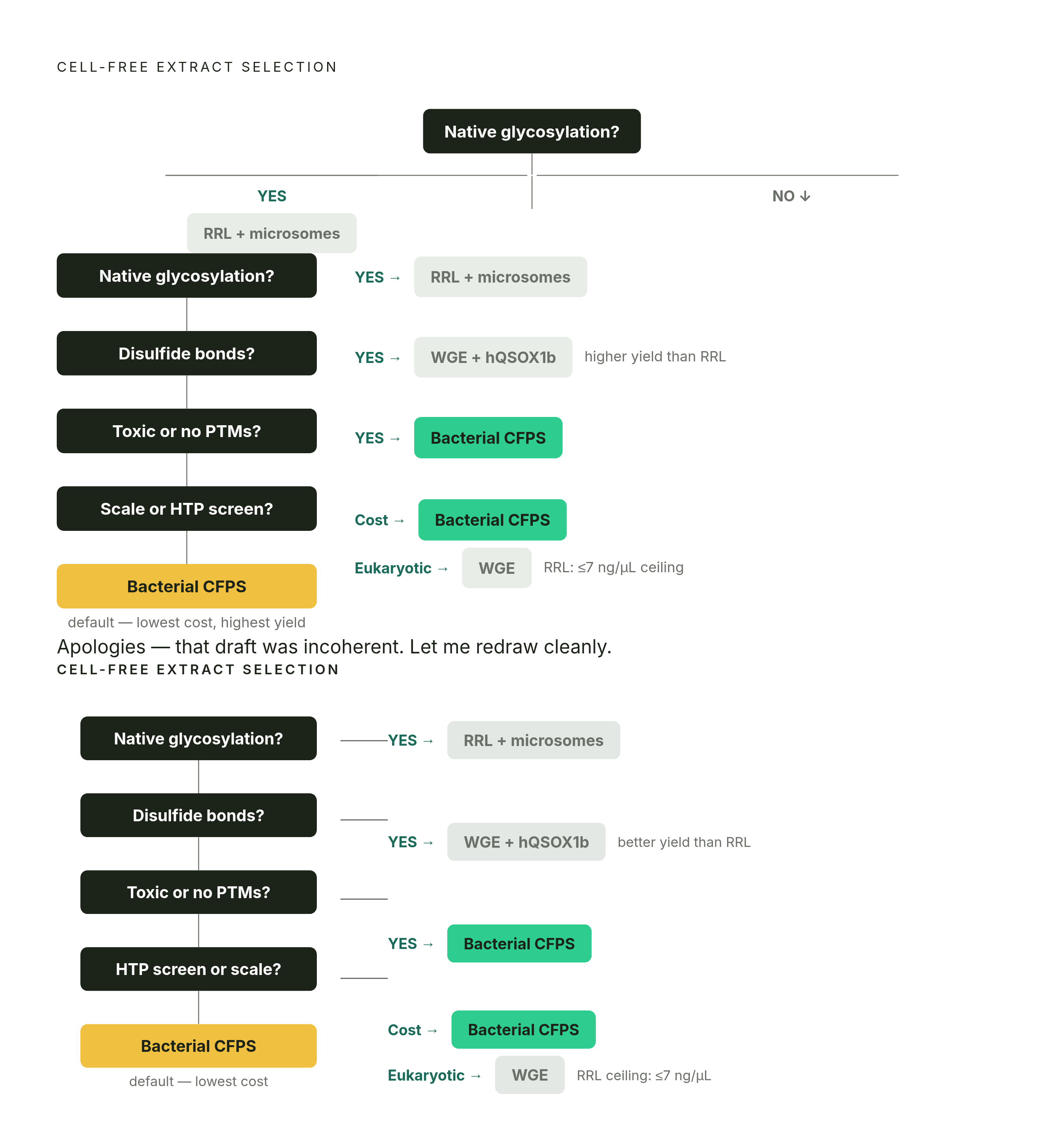
Each platform is built around a different tradeoff, and the right pick comes from working backward from what the target protein actually requires, not from ranking the three systems in the abstract.
Start with PTMs. If the protein needs native-form glycosylation, both bacterial CFPS and WGE require engineering workarounds that add real cost and risk, so RRL with microsomal membranes remains the conventional route. If disulfide bonds are needed but glycosylation isn't, WGE with oxidative supplementation is the strong option, and it beats RRL on yield in that exact use case. If the target is toxic to living cells, all three cell-free platforms beat in-cell expression by default, and bacterial CFPS is usually the first choice there unless the folding context specifically demands eukaryotic machinery.
Membrane proteins point toward WGE's specialized formats, which have been applied to this protein class, with RRL plus membrane supplementation as the fallback. High-throughput variant screening, tens to hundreds of constructs, favors WGE for its demonstrated parallel translation capacity and bacterial CFPS for its cost structure; RRL's yield ceiling and lot variability make it a poor fit for screening at any real scale. Milligram-scale production favors bacterial CFPS first, with WGE competitive when the target needs eukaryotic context; RRL is impractical at that scale for most labs, full stop.
Reproducibility deserves its own line item, separate from yield or cost, because it's easy to ignore until an experiment can't be replicated six months later. RRL's animal sourcing makes lot variability structural, and that matters for any work requiring comparability across batches. WGE quality depends critically on how rigorously endosperm contaminants are removed during preparation, so sourcing from suppliers who document that process and publish lot-level QC data is genuine due diligence, the difference between a working extract and one that fails without warning. Bacterial CFPS made from defined strains offers the steadiest baseline of the three, provided the formulation is documented and the QC data actually gets shared.
Cost closes the loop. RRL costs the most per reaction and scales the worst. WGE commercial kits carry a real premium, though in-house prep is possible for labs willing to manage extract quality themselves. Bacterial CFPS, including open-formulation systems that compete on price, makes high-throughput screening affordable without forcing a lab into kit-scale budgets. No platform wins across the board, so pretending otherwise wastes money and delays the work. The job is knowing which biological constraint the target protein imposes first, letting that constraint eliminate whatever can't meet it, and optimizing cost and throughput within whatever's left.