Cell-Free vs. Cell-Based Protein Expression Decision Framework
A structured framework helps scientists pick the right protein expression system every time.
Choosing between cell-free and cell-based protein expression is a structured decision. Protein biology, screening scale, timeline, and cost each push toward one system or the other, and a scientist who runs through those four criteria in order will land on the right answer almost every time. Most labs skip the exercise anyway.
The decision runs through four criteria in sequence: protein biology first, then screening scale, then timeline, then cost. Protein biology alone resolves many cases outright, toxic proteins, membrane proteins requiring co-translational solubilization, targets needing non-natural amino acids, and unstable proteins default to cell-free, while therapeutic glycoproteins requiring mammalian post-translational modifications default to cell-based mammalian lines. When biology doesn't eliminate one system, throughput enters: if the variant count outpaces what cloning and culture can realistically handle in the available time, cell-free becomes the only workable path. Timeline breaks ties when the first two criteria point neither way clearly, since cell-free can produce detectable protein within hours of a DNA template rather than days; cost, measured as total project cost rather than reagent list price, is the final arbiter when the first three criteria are roughly balanced.
Most labs inherit an expression system the way they inherit a centrifuge. It was there, someone used it last year, it became the default, and nobody revisits the choice until something breaks. The cost of that inertia is real: weeks spent troubleshooting a toxic protein in E. coli that a cell-free reaction would have produced in an afternoon, or a cell-free run priced out for a bulk protein that a fermenter handles at a fraction of the per-gram cost once scaled. Each system is better for a specific class of problem, and the market is already voting with its feet: cell-free protein synthesis, or CFPS, was valued at roughly $217.2 million in 2025 and is projected to reach about $308.9 million by 2030, a 7.3% compound annual growth rate, according to MarketsandMarkets. That growth signals a real reconsideration of default choices across the field, but it doesn't tell any one scientist, at any one bench, when to switch. This piece lays out the criteria that do. The scope here is the primary expression decision itself, CFPS versus cell-based; downstream purification and formulation are a separate conversation.
How the two systems actually differ at the mechanistic level
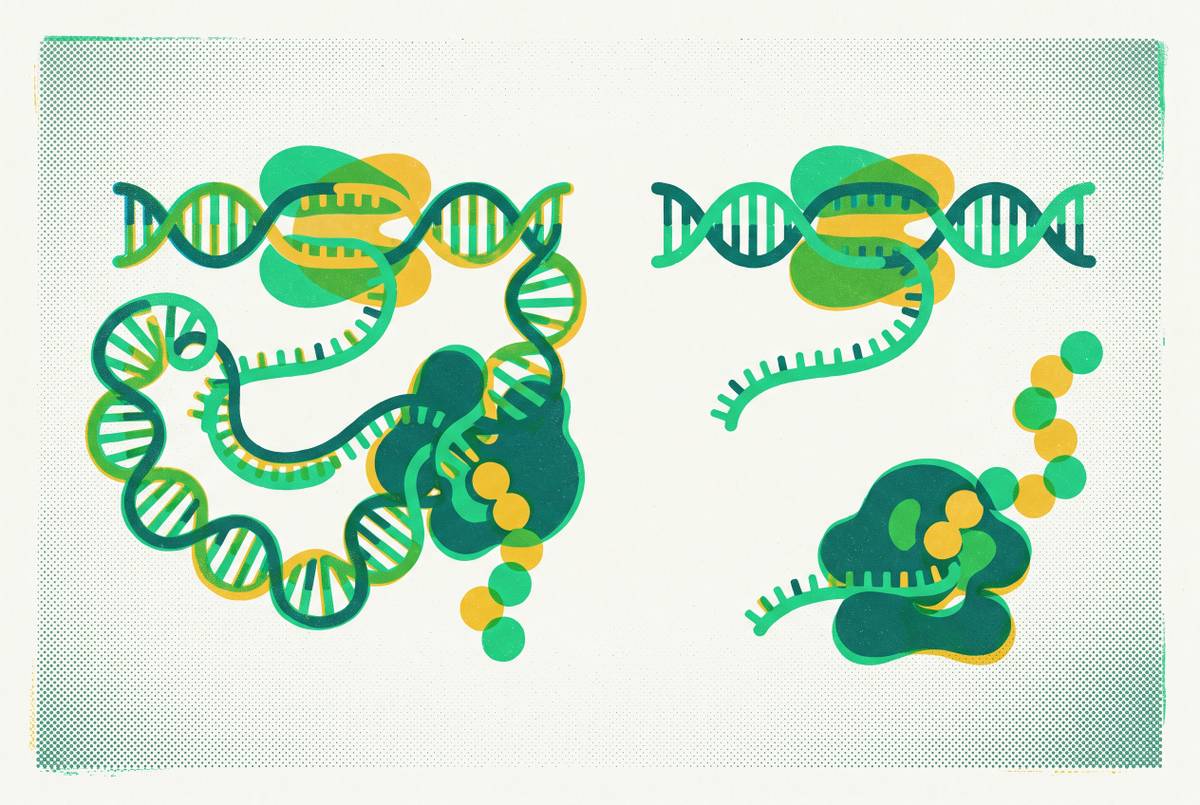
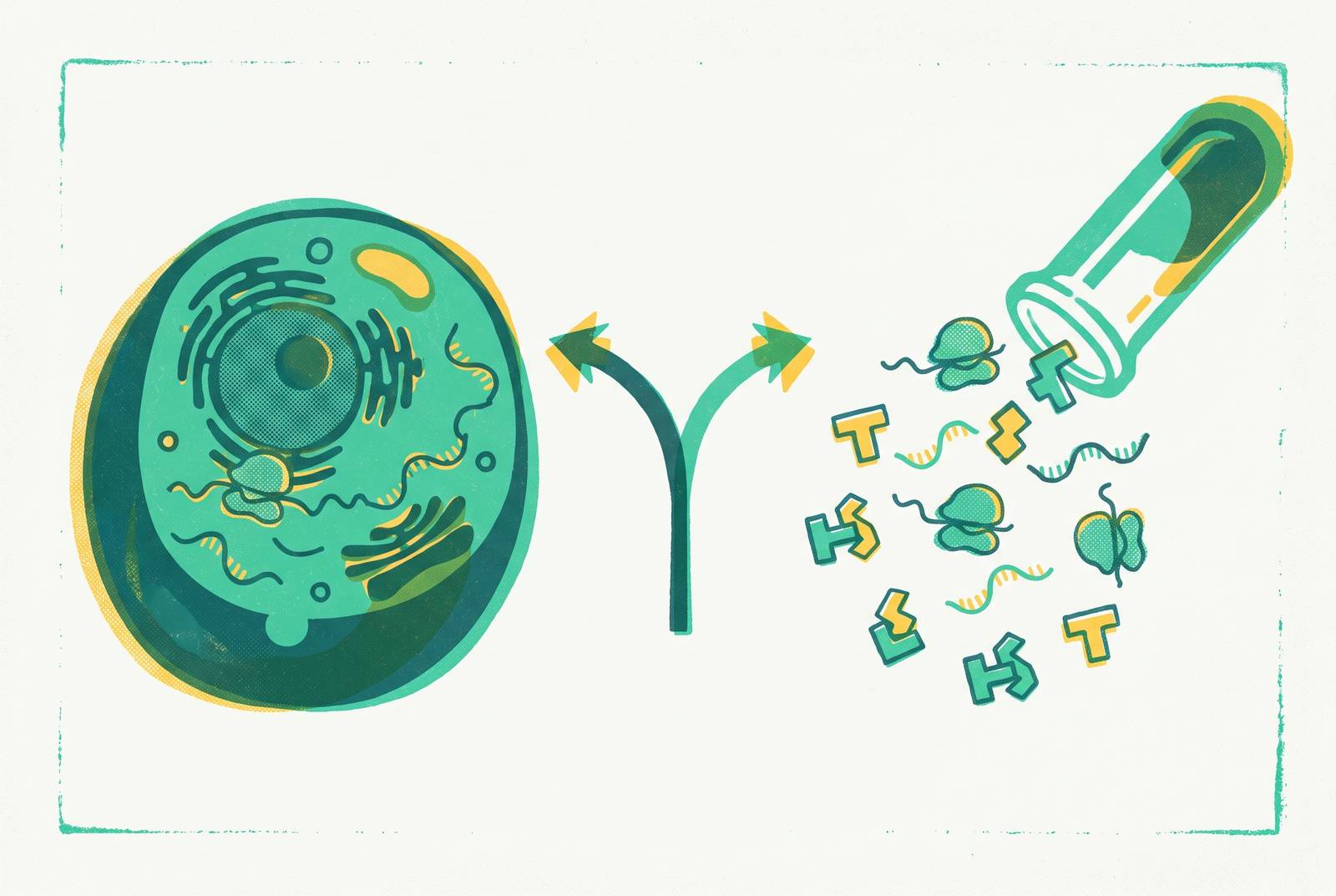
Cell-based expression happens inside a living cell. The protein gets made, but only within the limits of what that cell can tolerate: its growth rate, its metabolic load, its own regulatory machinery deciding what gets transcribed and when. CFPS runs on cell extracts or purified transcription and translation components working outside any living cell, so there's no viability constraint and no host metabolism quietly vetoing the reaction.
The practical payoff is direct access to the reaction environment itself. Temperature, redox state, cofactor concentration, amino acid mix, all of it sits in the researcher's hands rather than behind a cell membrane. Template flexibility follows the same logic: CFPS runs off mRNA or DNA, whether that's a plasmid or a linear PCR fragment, with no cloning into an expression vector and no transformation step in the way.
CFPS systems vary considerably, and the differences matter for the decision that follows. E. coli crude lysate systems are the workhorse: cheap, high-yield, prokaryotic, and usually the first thing a lab reaches for. Eukaryotic lysates, drawn from wheat germ, rabbit reticulocyte, or insect cells, give a friendlier folding environment for eukaryotic proteins, at a higher cost per reaction. PURE, or reconstituted, systems go further still, built from fully defined components with no background metabolic activity, which buys maximum transparency and reproducibility at the highest reagent cost of the three. One more split worth tracking: coupled transcription-translation systems, which run both steps in a single reaction, held the largest share of the CFPS market in 2024, mostly because folding two steps into one collapses the workflow.
On the cell-based side, the host landscape breaks down about how anyone in the field would expect. E. coli is fast and cheap but adds no post-translational modifications. Yeast adds some PTMs and secretes protein into the medium. Insect cells, usually via baculovirus, handle more complex PTMs. CHO and other mammalian lines produce human-like glycosylation, at the highest cost and complexity of the group. These mechanistic differences aren't background information; they're the lens the rest of this framework looks through.
When protein biology alone should make the call
For some proteins, biology overrides every other item on this list, and no amount of process optimization changes that. No tweak rescues a genuinely toxic protein expressed inside a living cell, because the cell dies or stalls before useful yield accumulates. That single fact eliminates entire host categories before throughput or cost ever enters the conversation.
A handful of protein classes default to CFPS purely on biological grounds. Toxic proteins, antimicrobial peptides, proteases, membrane-disrupting proteins, kill or cripple the host cell in a cell-based system long before production reaches a useful scale; in CFPS, there's no cell to damage, so the toxicity question simply doesn't apply. Membrane proteins benefit from co-translational solubilization, adding detergents, nanodiscs, or liposomes straight into the open reaction as translation happens, something no living cell permits. Proteins that need non-natural amino acids at a specific site are, in practice, a CFPS-only proposition at meaningful scale; the researcher supplies the modified amino acid and a reprogrammed codon directly into the reaction, and it works. Unstable or fast-degrading proteins face constant protease exposure inside a cell; here, that protease activity can be dialed down or removed, and the reaction conditions tuned to keep a fragile product intact.
The reverse also holds, and it holds hard. Proteins that need complex mammalian post-translational modifications, specific glycosylation patterns, precise disulfide bonding at scale, sit beyond the reach of prokaryotic CFPS systems, full stop. Mammalian cell lines, CHO in particular, remain the only practical route for therapeutic-grade glycoproteins. Multi-subunit complexes that depend on chaperone-assisted folding during translation still lean toward eukaryotic cell environments for the hardest cases, though eukaryotic CFPS lysates have narrowed that gap considerably.
Before consulting throughput, timeline, or cost, two questions resolve a surprising share of these decisions on their own: does the protein harm a host cell, and does it need PTMs that only a eukaryotic cell can supply? Answer those, and the expression system often picks itself.
How throughput requirements and screening scale tip the decision
Protein engineering and directed evolution campaigns routinely call for testing anywhere from tens to thousands of variants. The expression system decides whether that campaign takes weeks or drags into years, and the two paths diverge sharply once volume climbs.
CFPS has a structural advantage here that cell-based systems cannot close. No cloning is required, a PCR fragment or linear template is enough, which collapses the design-build-test cycle from days of transformation, colony picking, and culture down to a few hours. The reaction format also happens to match the infrastructure most labs already own: microplate wells, standard incubators, liquid-handling robots built for plate-based work. Dozens to hundreds of variants can run in parallel in a single plate, each well its own controlled condition, and because reaction volumes stay small, reagent cost per variant stays manageable even as the library grows into the hundreds.
Cell-based screening hits a ceiling that CFPS doesn't. Every variant needs its own transformation or transfection, its own colony selection, its own individual culture, steps that resist parallelization below a serious capital investment. Turnaround per variant in E. coli runs a few days at minimum; in mammalian transient expression, longer. High-throughput cell-based screening does exist, robotic colony pickers and miniaturized culture systems among them, but that kind of infrastructure rarely sits at the bench level of a typical academic or biotech lab.
The threshold question is simple: if a project needs more variants than a team can realistically clone and culture inside its timeline, CFPS stops being an alternative and becomes the only workable path. Worth noting, too, that these systems often work in sequence rather than competition. Once a lead variant clears screening, cell-based production frequently takes over for bulk scale-up. CFPS and cell-based expression are, on a lot of real projects, partners handing off the baton rather than rivals fighting for the same slot.
Timeline as a decision variable: when speed is the constraint
CFPS can produce detectable protein within hours of a DNA template landing on the bench. Cell-based workflows need culture establishment, induction, and a harvest cycle, and that adds up to days at minimum, sometimes longer once scale-up logistics get involved.
A few situations make timeline the deciding factor outright: rapid antigen production for assay development in diagnostics or biosensors, on-demand synthesis at the point of need (CFPS reactions can be freeze-dried and rehydrated right when needed, which opens the door to distributed or field-deployable production), and prototype validation, where a construct gets expressed in CFPS first just to confirm it works before anyone commits to a full cell-based campaign. The no-cloning advantage matters here in very concrete terms: skipping vector construction and transformation saves roughly one to two weeks per construct, and for a team running iterative design cycles, that adds up fast across a project.
Cell-based systems take the timeline advantage back in exactly one scenario: steady-state, continuous production. A CHO or E. coli fermentation running around the clock produces protein on a schedule that a batch CFPS reaction can't match, unless the lab runs continuous-exchange setups (CECF) built specifically to extend reaction life. Timeline is rarely the single deciding criterion on its own, but when protein biology and throughput don't clearly point one way, it's often what breaks the tie.
Cost structure: where the economics of each system actually differ
The assumption that CFPS is the expensive option is historically fair and increasingly out of date. Reagent economics have moved, and the real comparison depends entirely on what cost is being measured, not on a single number pulled off a reagent catalog.
Cell-based systems keep a genuine edge at bulk scale: once a cell line is established and the process optimized, per-gram cost at fermentation scale is hard for a batch CFPS reaction to touch. Labs with cell culture infrastructure already in place also face a lower marginal cost for each new campaign, since the equipment and expertise are already sitting there.
CFPS pulls ahead on a different axis, and the gap is not close. There's no cell culture consumables, no incubator time spent waiting for growth, no antibiotic selection, no colony screening, and per-variant cost in a screening campaign tilts toward CFPS by a wide margin. Reagent formulation work has also been closing the bulk-production gap faster than expected: a 2026 study in Nature Communications documented a roughly 95% reduction in cost per gram of protein produced, from around $4,080 down to about $60, using reformulated CFPS reagents. Pricing in the field has followed as reformulated reagent approaches move closer to commercial adoption.
There's a cost that rarely shows up on a spreadsheet but should: failed cell-based expression. A protein that eats three rounds of construct redesign and two months of troubleshooting in E. coli before yielding nothing carries a real cost, even though no line item says so. Risk of that kind runs highest precisely in the protein classes, toxic, membrane-bound, labile, where CFPS already has the biological edge. Comparing systems on reagent list price alone misses this; the honest comparison is total project cost, including the probability the first approach doesn't work at all.
How do the four criteria interact when making the call between cell-free and cell-based?
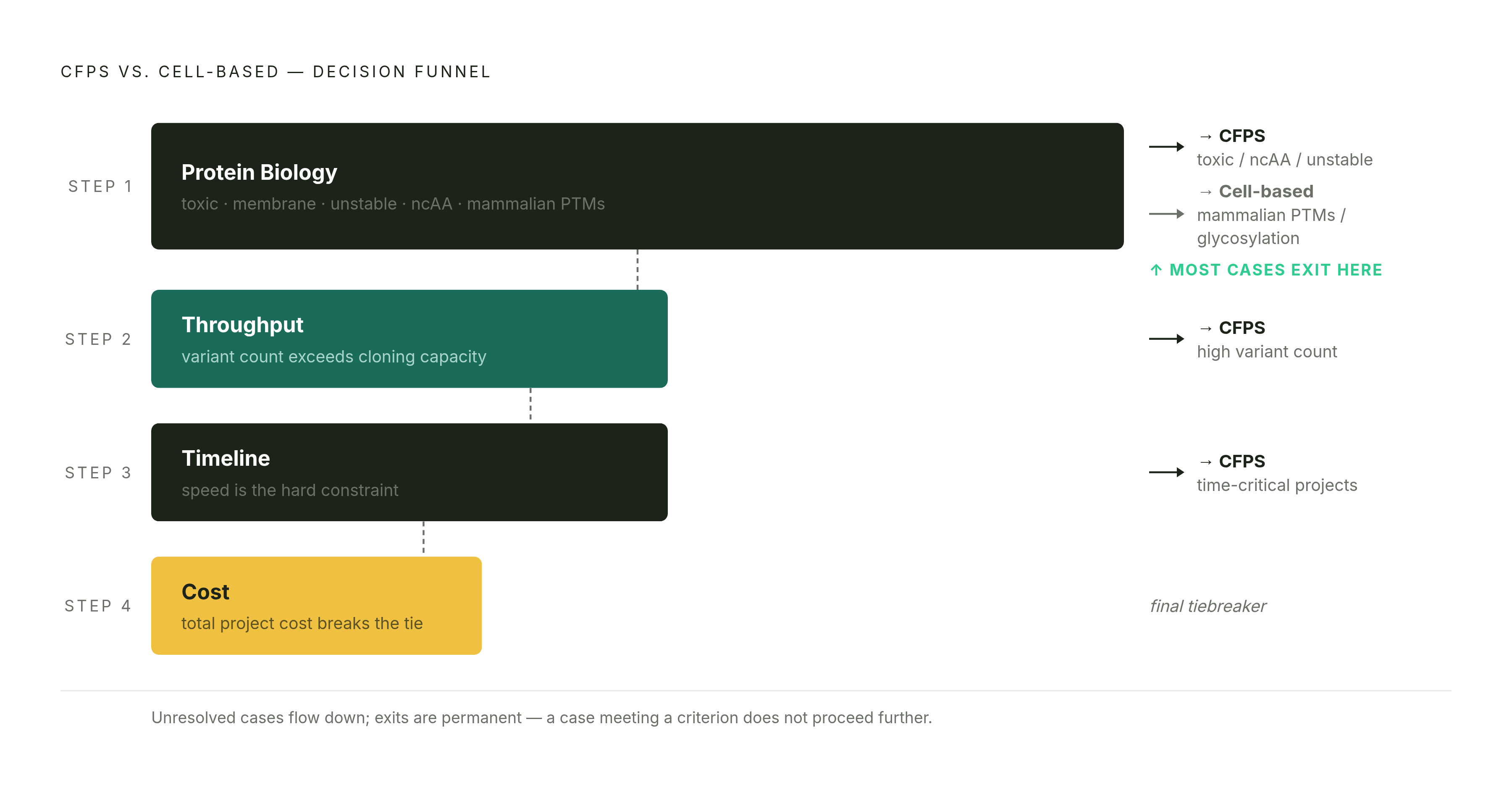
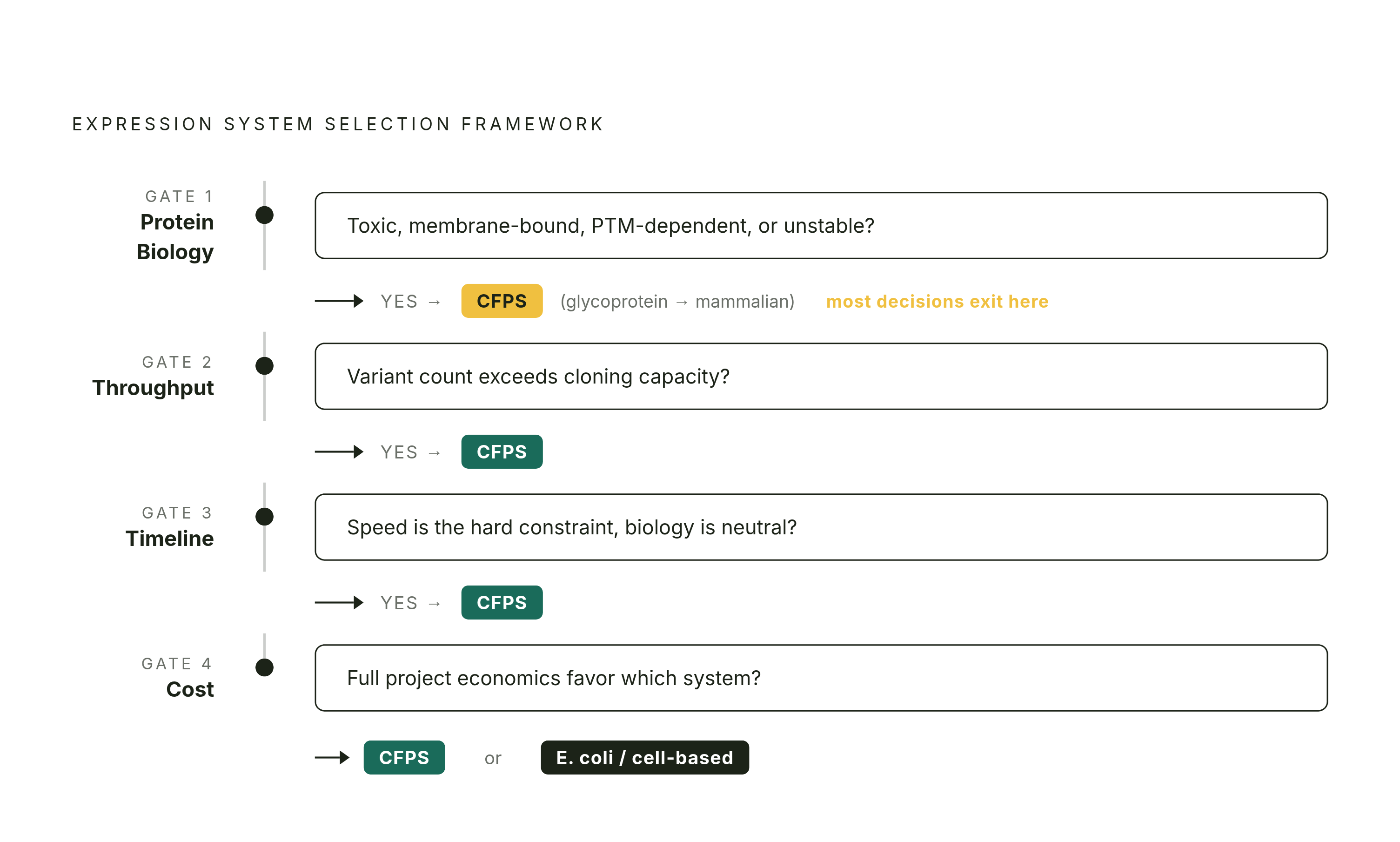
Run the criteria in this order, and most decisions resolve without much ambiguity. First, protein biology: if the protein is toxic, PTM-dependent in a way only a eukaryotic cell provides, membrane-bound, or unstable, that answer stands on its own and nothing downstream changes it. Second, throughput: if the variant count outpaces what cell-based cloning and culture can realistically process in the available time, CFPS becomes the default, full stop. Third, timeline: when speed is the hard constraint and biology doesn't rule out either system, CFPS wins. Fourth, cost: only once the first three are roughly balanced does full project economics, not sticker price on a reagent kit, break the tie.
A few scenarios play out predictably. A toxic or membrane protein goes to CFPS regardless of scale. A therapeutic-grade glycoprotein needing mammalian PTMs goes to a mammalian cell line, with CFPS used at most for early construct validation. A protein engineering campaign running 50 to 500 variants on a four-week timeline goes to CFPS for screening, then cell-based for scaling up the winning lead. Bulk production of a stable, well-behaved, non-toxic protein goes to cell-based systems at scale, full stop. On-demand or field-deployable applications default to CFPS. A stable protein needed in small quantity, on short notice, in a lab with no cell culture setup on hand, also defaults to CFPS.
The sequential case deserves its own mention, because it's easy to treat CFPS and cell-based systems as mutually exclusive when they often aren't. Validating fast in CFPS, then transferring the confirmed construct to cell-based production, is a legitimate workflow, and an increasingly common one.
One thing this framework doesn't settle: which CFPS extract to use, prokaryotic lysate, eukaryotic lysate, or PURE. That's a second-order decision, driven by the protein's folding demands and the lab's tolerance for reagent cost, and it only comes up once CFPS has already been chosen as the expression route.
Putting the framework to work: extract choice, reagent transparency, and reproducibility
Once CFPS is the chosen path, the extract still matters. E. coli lysate covers cost and productivity for most routine work, eukaryotic lysates handle folding-sensitive eukaryotic targets, and PURE systems offer the tightest compositional control when that control is worth the added cost.
One factor rarely shows up on a vendor datasheet, yet it can quietly derail a months-long project: lot-to-lot consistency. CFPS yield is sensitive to extract quality, and a lot change that shifts yield by even a modest margin can invalidate a prior round of screening data without anyone noticing until the numbers stop making sense. Published, lot-level QC data, not just data available on request, is the only real way to judge whether a reagent system is stable enough to build a reproducible workflow on top of. A vendor who won't publish that data is asking a lab to take reproducibility on faith, and faith is not a control.
Formulation transparency matters for the same reason. Knowing exactly what's in the reaction buffer is what makes troubleshooting and systematic optimization possible in the first place; a sealed, undocumented kit formulation turns every unexpected result into a guessing game. Sepia Biosciences built OpenCFPS™ around these constraints: documented formulations, published lot-level QC data, and reaction formats built for plates and automation from the start. That combination addresses the reproducibility gap that has kept a lot of scientists cautious about leaning on CFPS for anything beyond a quick screen, and closing that gap is what makes CFPS a credible option for production-grade work rather than just an early-stage shortcut.