DNA Template Design for Maximizing CFPS Yield
Optimize DNA templates before blaming reagents for weak cell-free protein synthesis.
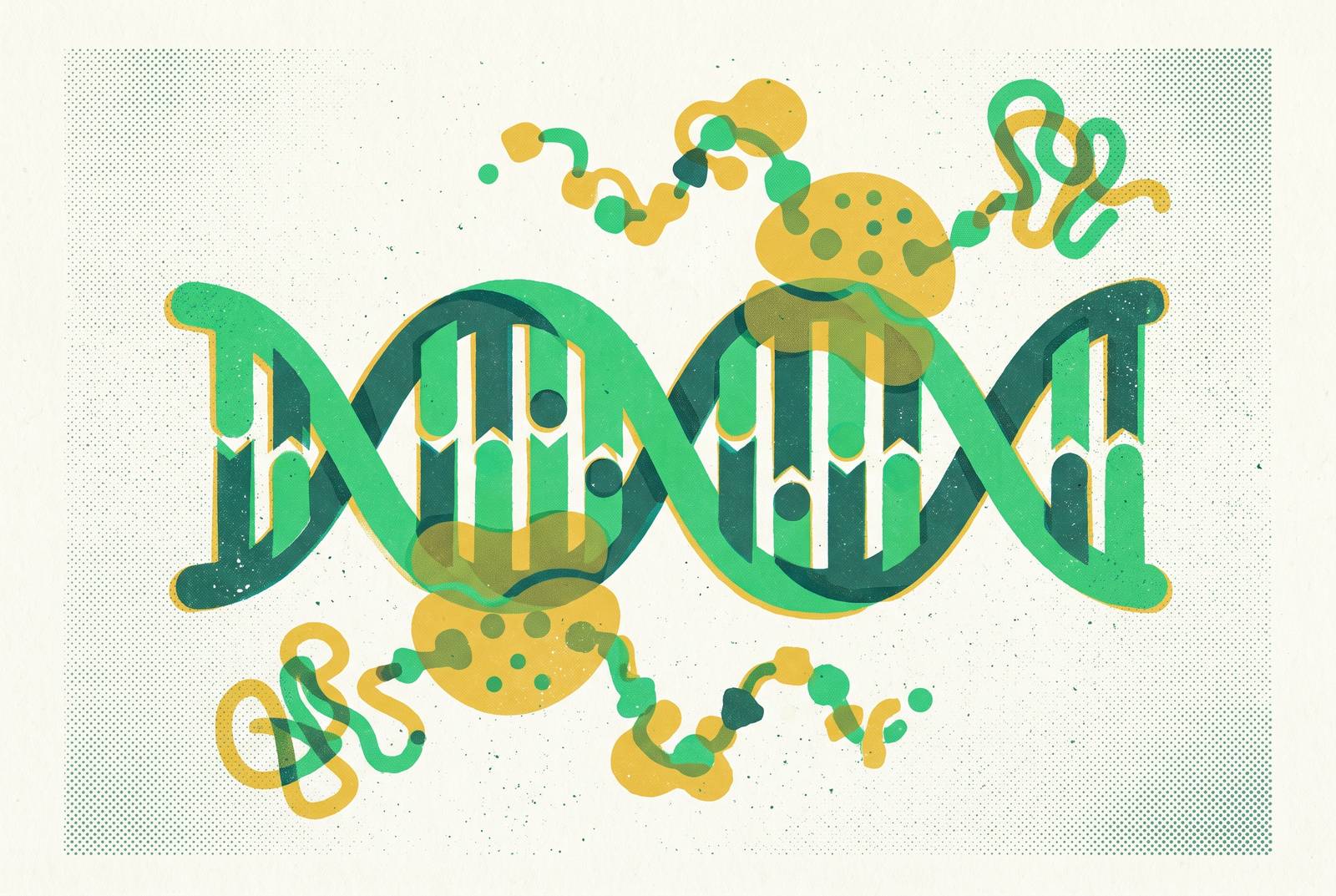
Cell-free protein synthesis skips cloning, culture, and colony picking: feed a DNA template into a transcription-translation extract, and hours later, protein comes out. When yield disappoints, most people blame the reagents first: old lysate, a degraded energy mix, an off buffer. That instinct is wrong more often than not, and chasing it wastes the one advantage CFPS actually offers, which is speed. The template itself, promoter, 5' UTR, coding sequence, terminator, is the variable the researcher controls completely before the reaction ever starts, and it deserves far more scrutiny than the lysate usually gets.
The four regions that matter most are the T7 promoter, the 5' UTR containing the RBS, the coding sequence, and the T7 terminator. The promoter sequence (5'-TAATACGACTCACTATAGGG-3') must appear exactly as written, with roughly 100 base pairs of spacing to the ATG start codon to accommodate the 5' UTR elements. The RBS should sit 5 to 8 base pairs upstream of the ATG, with its strength chosen to match the target protein's folding tolerance rather than defaulted to the strongest available option. After those elements are set, the coding sequence should be codon-optimized for the lysate's host organism, predicted mRNA secondary structures near the first 30 to 50 nucleotides of the CDS should be resolved by synonymous substitution, and a T7 terminator should be placed immediately downstream of the stop codon to prevent runoff transcription from wasting finite energy and nucleotide pools.
Template design failures don't announce themselves. A weak RBS, a hairpin folded over the start codon, a missing terminator: none of these trigger an error message. The reaction runs, something gets made, and the yield number just sits lower than it should, indistinguishable on paper from a bad lysate prep. CFPS produces a result no matter what, so bad template design hides inside a mediocre number that looks exactly like a reagent problem. What follows works through each part of the template in order, starting with the most basic decision of all: what kind of DNA to build from.
Linear vs. plasmid templates: which format to build from and when
Two formats dominate CFPS work: circular plasmid DNA and linear expression templates, or LETs. Most groups default to plasmid out of habit, and that habit costs them for the majority of what CFPS is actually good at. If the question is "does this variant work at all," a LET answers it in hours. Plasmid suits the construct that has already won the argument; a LET suits the one still being tested.
Plasmid DNA holds up well in crude lysate, since its circular structure resists exonuclease attack. It stays intact at lower concentrations and drives efficient transcription over long reaction times. For a finalized construct, one that will run the same way across many reactions or scale into production, that stability makes a strong case for using it.
LETs trade durability for speed, and for screening work, that trade wins almost every time. Generated by PCR straight from a linear fragment, they skip cloning, transformation, and the overnight culture that plasmid prep demands. What takes multiple days with plasmid prep takes hours with a LET; a promoter tweak, an RBS swap, a codon change gets tested the same day it's designed, with no cloning commitment sunk into a sequence that might not even work.
The catch is real, and it is the reason LETs sat underused for years despite the obvious speed advantage. Linear DNA is exposed at both ends, and crude lysate extracts are loaded with exonucleases that chew into those ends and degrade the template mid-reaction. A few protective strategies have changed that calculus. Exonuclease inhibitor proteins, GamS, Chi, and Ku among them, block degradation by occupying or disabling the nuclease itself, while small-molecule inhibitors such as CID 697851 and CID 1517823 offer a chemical route to the same end. Structural protection works too: Tus-Ter complexes bind specific sequences and physically cap the template's ends. One useful design detail: the 5' Ter protection site can sit immediately upstream of the T7 promoter without meaningfully hurting transcription efficiency, so protection and expression are not in tension at that junction.
Plasmid earns its place for stability and repeatable output at scale, while LETs earn theirs for fast iteration, but only with exonuclease protection designed in from the start. A disappointing run bolted together without that protection may turn out to be a degraded template rather than a design flaw, and there is no way to tell the difference after the fact. Either way, the design principles that follow, promoter spacing, RBS placement, codon choice, terminator use, apply the same regardless of which format carries them.
The T7 promoter and the spacing that controls transcription initiation
Most E. coli-based CFPS systems run on T7 RNA polymerase, an enzyme that recognizes only its own promoter and ignores the host's native promoters entirely. That specificity isolates the reaction's transcriptional output to whatever sequence the researcher designed in, with no crosstalk from the lysate's residual regulatory machinery.
The sequence itself is fixed and unforgiving: 5'-TAATACGACTCACTATAGGG-3'. It has to appear exactly as written, since a dropped base or a single substitution reduces polymerase recognition or kills it outright. There is no partial credit for a near-miss sequence.
Spacing between the promoter and the ATG start codon is where most designers stop paying attention, and that inattention often proves more consequential than any single base swap elsewhere in the construct. The working target is around 100 base pairs, and that distance is not arbitrary; it has to accommodate the 5' UTR elements, the RBS and its flanking spacer, that sit somewhere between the promoter and the start codon. Too short, and the ribosome machinery crowds the promoter region during initiation. Too long, and the transcript carries dead weight: unnecessary length and more opportunity for secondary structure to form before translation ever begins.
For anyone building LETs by PCR, this spacing lives entirely in the upstream primer. The full promoter sequence plus the spacer region has to sit in a single oligonucleotide, in the correct order, and any error introduced at this stage propagates into every variant built from that primer. Worth checking twice, not once. What sits inside that spacer, the 5' UTR, is where the next layer of control happens: ribosome recruitment.
Engineering the 5' UTR: RBS positioning, spacing, and the pre-initiation complex
The 5' UTR runs from the transcription start site to the AUG codon. It never gets translated into protein, but this region decides whether and how efficiently the ribosome engages the message at all.
The Ribosome Binding Site does the recruiting, through direct base-pairing complementarity between the RBS sequence and the 3' end of the 16S rRNA in the small ribosomal subunit. The strength of that pairing determines how readily the 30S subunit locks onto the mRNA before it ever reaches the start codon. In E. coli-based systems, the canonical Shine-Dalgarno sequence is a short purine-rich stretch complementary to the 3' end of the 16S rRNA.
Distance from the RBS to the ATG functions as a hard constraint rather than a soft guideline, with 5 to 8 base pairs upstream of the start codon as the functional window. Crowd the RBS too close to the ATG, and steric clash keeps the ribosome from seating properly. Push it too far away, and the ribosome binds but drifts out of register with the AUG, which lowers initiation frequency even though binding itself still occurs. A 5' spacer of roughly 5 to 10 bases between the first transcribed nucleotide and the ATG gives the 30S subunit physical room to land and scan; skip that spacer and initiation efficiency collapses even with a strong RBS sequence sitting right there.
Here is the part that trips people up, and it runs against the instinct almost everyone starts with: a stronger RBS does not reliably mean a better outcome. Chasing the strongest possible RBS on the assumption that more ribosome binding always means more protein is a bad default. Some proteins misfold when translated too fast, so a deliberately weaker RBS that slows the ribosome down can improve the fraction of protein that folds correctly, even at the cost of a lower raw initiation rate. Yield is not only a question of how much protein gets made; it is a question of how much of that protein is actually usable. Computational RBS design tools let a designer set a target initiation rate before ordering anything, which turns this element into something quantifiable rather than a matter of trial and error at the bench.
An RBS recruited flawlessly will still stall if the coding sequence itself throws up roadblocks.
Codon usage and mRNA secondary structure as rate-limiting factors in the coding region
Synonymous codons are not translated at the same speed, and treating codon choice as a cosmetic detail is one of the more expensive mistakes in template design. tRNA abundance varies across the genetic code, and rare codons, ones whose cognate tRNA is scarce in the cell or in the lysate derived from it, cause the ribosome to pause. Pausing raises the odds of ribosome drop-off or misincorporation, both of which cut into functional yield even when transcription itself is running fine. In E. coli-based CFPS, the usual offenders are codons whose cognate tRNAs are scarce in the host organism's tRNA pool. Codon optimization means swapping these for synonymous, high-frequency alternatives matched to the tRNA pool of whatever organism the lysate was made from. Wheat germ-based systems are a real exception, tolerating high-A/T or high-G/C sequences without this kind of optimization, which matters a great deal for anyone expressing genes from organisms with unusual codon bias.
Separately from codon choice, the transcript folds on itself, and stable hairpins can physically block the ribosome's path along the mRNA. Hairpins near the 5' end of the coding sequence, roughly the first 30 to 50 nucleotides, do the most damage, since they can occlude the start codon entirely or stall the ribosome the moment it initiates. Computational prediction tools let a designer scan for high-ΔG hairpins before committing to a synthesis order. Synonymous substitutions can often dissolve a problem hairpin without touching the protein sequence, but the substitution that fixes a hairpin and the substitution that fixes codon usage are not always the same one. The two have to be checked against each other, never assumed to align by default.
There is a second class of error worth screening for on any LET or plasmid design: cryptic ATGs sitting in-frame or out-of-frame within the coding sequence, and alternate stop codons that truncate the reading frame early. These do not stop the reaction from producing protein; they produce the wrong one, or the right one at the wrong length, an outcome that can be worse than a low-yield failure, since it passes undetected in a crude yield measurement that only counts total protein. Simulation-based modeling of translation kinetics can predict the throughput effect of a given codon profile before synthesis, sparing a wasted round just to learn a sequence underperforms. The order matters here, and getting it backwards costs real time: optimize codons for the lysate's host organism first, then check predicted mRNA folding, then scan for cryptic regulatory sequences. Reverse that order and cycles get burned chasing a hairpin fix that a later codon change undoes anyway.
The T7 terminator and why transcript length past the stop codon is not harmless
The terminator tells T7 RNA polymerase to stop. Skip it, and the polymerase reads straight through the coding sequence, continuing into whatever DNA sits downstream and producing a transcript longer than the one intended. Treating the terminator as a nice-to-have rather than a functional requirement is a mistake that shows up as unexplained yield loss weeks later, long after anyone remembers checking for it.
That extra length carries a real cost. Runoff transcripts carry extended 3' sequences that can fold into secondary structures of their own, structures capable of destabilizing the entire message or interfering with ribosome transit near the 3' end of the coding region, right where translation is trying to finish cleanly. Meanwhile, RNA polymerase stays engaged on the template longer than it needs to, consuming energy and nucleotide pools that would otherwise go toward making more of the intended transcript. In a reaction where every ATP and every free nucleotide is a finite resource, that consumption is a real cost.
For LET construction, the terminator cannot be assumed present, because linear templates do not carry the surrounding genomic context that a well-annotated plasmid vector supplies automatically. It has to be explicitly built into the sequence instead. Placement is straightforward: immediately downstream of the stop codon, with no benefit to leaving extra buffer sequence between the two in most CFPS designs. For LETs using Tus-Ter protection, the terminator sequence provides the transcriptional stop signal at the 3' end of the template, in the same region where end protection is also needed.
The terminator protects the yield that is already there, by shutting the door on the losses, wasted energy, wasted nucleotides, a destabilized transcript, that accumulate steadily in its absence.
What order should I follow when putting all four template elements together before synthesis?
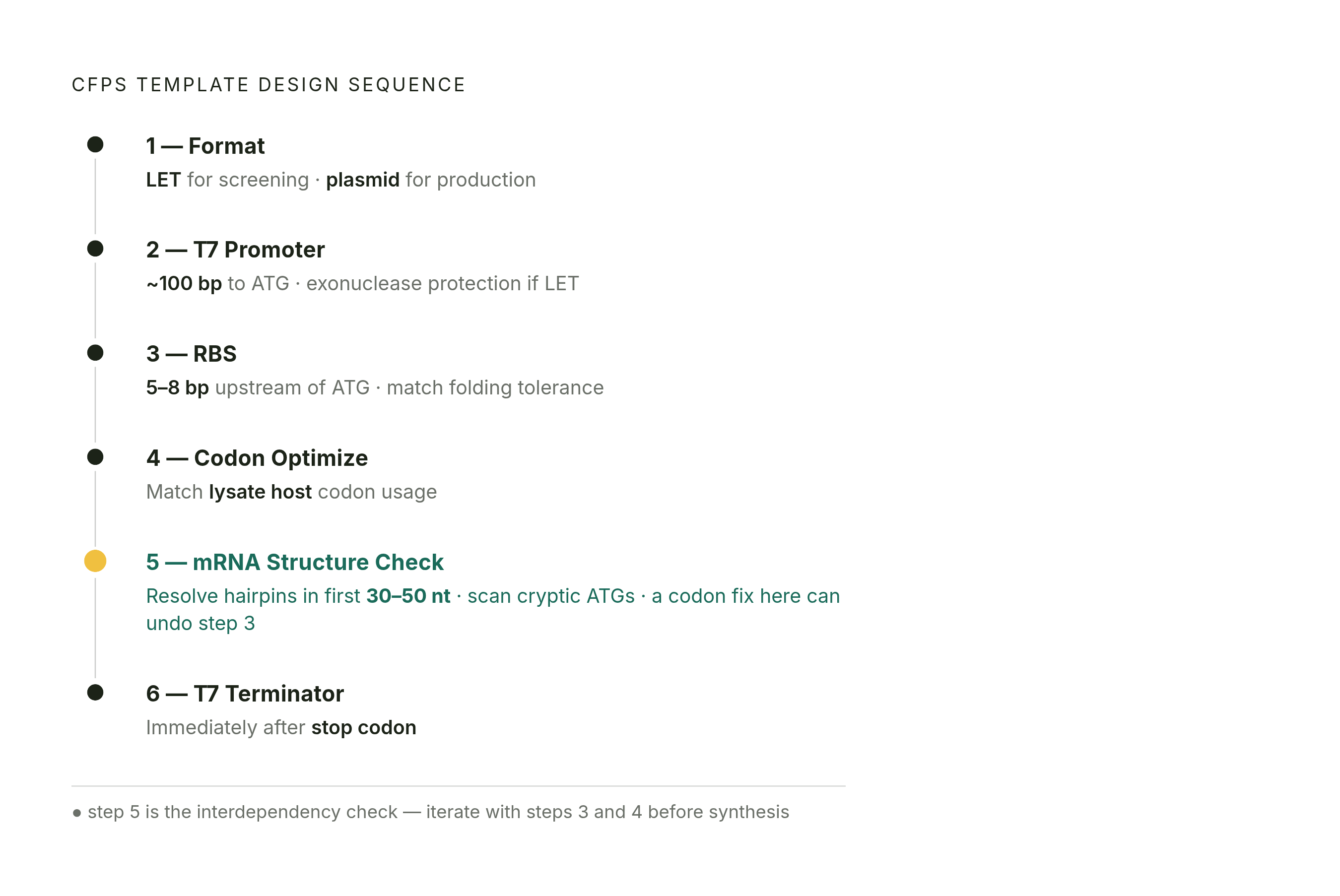
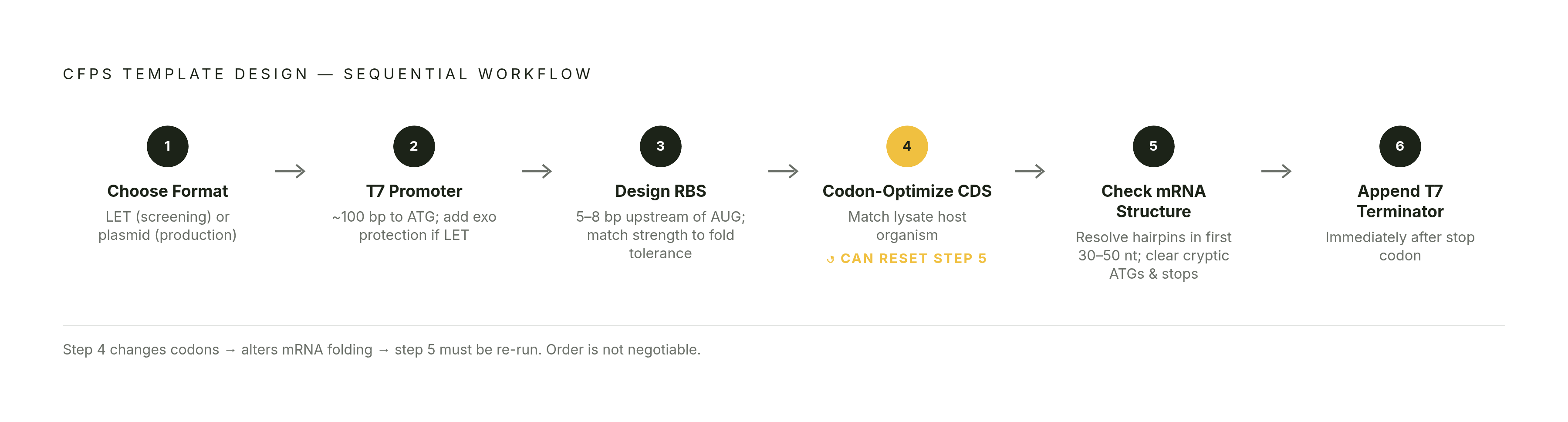
None of these four regions, promoter, 5' UTR, coding sequence, terminator, operates on its own, and treating them as independent checklist items is where most template designs go wrong. A decision made in one region reaches forward or backward into the others: promoter-to-ATG spacing sets the physical room available for the 5' UTR. A codon substitution made to dissolve a coding-region hairpin can shift the secondary structure right at the 5' edge of the transcript, which means the RBS accessibility has to be rechecked, never assumed safe just because it checked out earlier. The exonuclease protection strategy chosen for a LET constrains what sequence can legally occupy the 5' and 3' termini.
A workable order of operations, before anything gets sent off for synthesis, looks like this. Choose the template format first: LET for rapid variant screening, plasmid for standardized, repeatable production. Lock in the T7 promoter next and set spacing to roughly 100 base pairs to the ATG, building in exonuclease protection at this stage if the format is a LET. Then design the RBS at 5 to 8 base pairs upstream of the start codon, choosing RBS strength to match the target protein's folding tolerance rather than defaulting to the strongest option on the shelf. After that, codon-optimize the coding sequence for the lysate's host organism, predict the resulting mRNA secondary structure, and resolve any high-ΔG hairpins sitting near the 5' end of the CDS. Check the fully assembled sequence for cryptic initiation codons and unintended stop codons, then append the T7 terminator immediately after the stop codon.
CFPS rewards this kind of upfront rigor because the feedback loop is so short. A reaction that runs in hours means a well-designed template shows its results fast, and a poorly designed one gets caught just as fast, without burning a week on colony picking and plasmid prep to find out. OpenCFPS reagent systems accept both LET and plasmid inputs in standard plate-based formats, so a template designed against this specification moves directly into high-throughput screening without protocol rework standing in the way.
Template design is close to zero-cost iteration, and skipping it in favor of running the reaction and hoping is one of the more avoidable expenses in the whole workflow. Every fix caught in silico, a hairpin resolved before synthesis, a spacing error corrected in the primer design, saves a reaction, a day, and the reagent cost of finding the same mistake empirically. Most of the cheapest optimization in the entire CFPS workflow happens on a screen, not in a tube. With the same lysate, the same equipment, and the same researcher, the yield difference comes down to one variable: what sequence gets loaded into the reaction, the one thing fully within the designer's control before the experiment even starts.