Magnesium and Potassium Optimization in CFPS Reactions
Free magnesium matters more than total magnesium in protein synthesis reactions.

A cell-free protein synthesis reaction is a controlled chemical system: extract, energy source, template, amino acids, cofactors, all doing what a cell does, minus the cell. Magnesium and potassium are the two variables researchers reach for first, because both ions sit at the crossroads of ribosome structure, enzyme activity, and energy metabolism. Get either one wrong and the failure is total: ribosomes fall apart, enzymes stall, the energy system collapses, and yield drops to near zero.
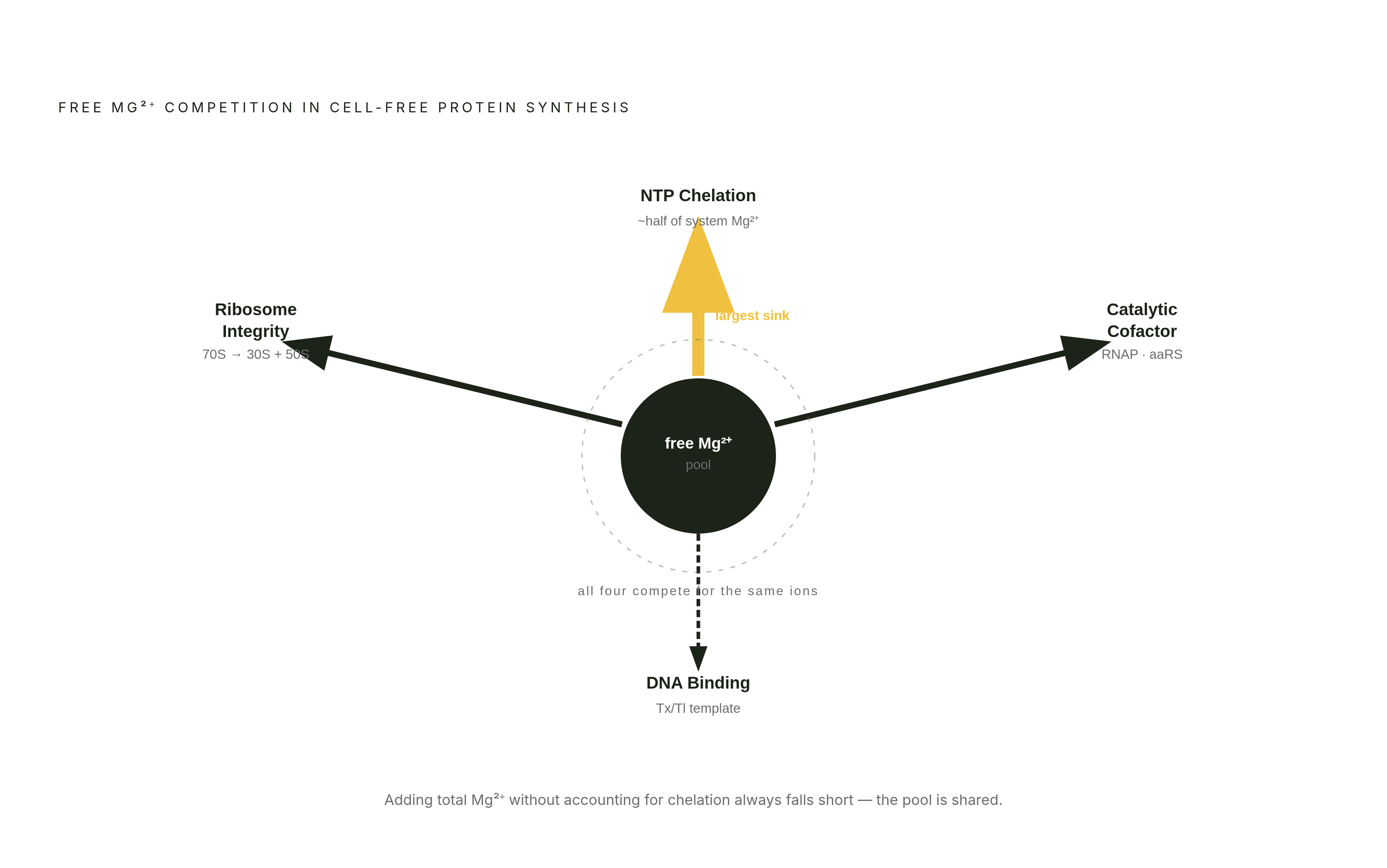
Magnesium has at least four jobs in this system, and it does them all at once, pulling from the same limited pool of ion. That last part is easy to miss on a first read, and working through why changes how the rest of this holds together.
A substantial portion of the magnesium floating in the cytoplasm holds the ribosome together directly. Take it away and the 70S ribosome splits into its 30S and 50S halves; translation stops, because there's no whole machine left to run it. Nearly half the magnesium in the system is bound to nucleotide triphosphates, mostly ATP, and this isn't some minor side detail. ATP works, biochemically, as Mg·ATP, a magnesium-bound complex rather than a free-floating nucleotide. Any enzyme in the transcription-translation chain that burns ATP is really burning magnesium-ATP; without magnesium present, the reaction doesn't move, no matter how much ATP you think you've added to the tube.
RNA polymerase and the aminoacyl-tRNA synthetases pile on a third demand, since both need Mg²⁺ as a catalytic cofactor separate from their nucleotide substrates. In coupled transcription-translation systems running straight off a DNA template, Mg²⁺ also helps the polymerase grip that template, a fourth job stacked on the first three. For labs working with freeze-dried or shelf-stable kits, magnesium also helps protect enzymes from inactivation during co-lyophilization, which tells you its stabilizing role reaches past wet, active conditions into structural backup across more than one physical state.
All four jobs draw from the same pool, and tracing that shared draw down is what exposes where most optimization goes wrong. Dumping in more total Mg²⁺ to prop up the ribosome does nothing if something else in the tube is pulling free Mg²⁺ out of circulation at the same time, which is exactly what happens once the reaction starts running. Free [Mg²⁺] is the number that matters more than total [Mg²⁺]. Sit with that distinction long enough and it becomes clear: researchers who titrate against total concentration are optimizing the wrong variable, and that one distinction runs through the rest of this piece.
The phosphate chelation trap and why free magnesium is what actually matters
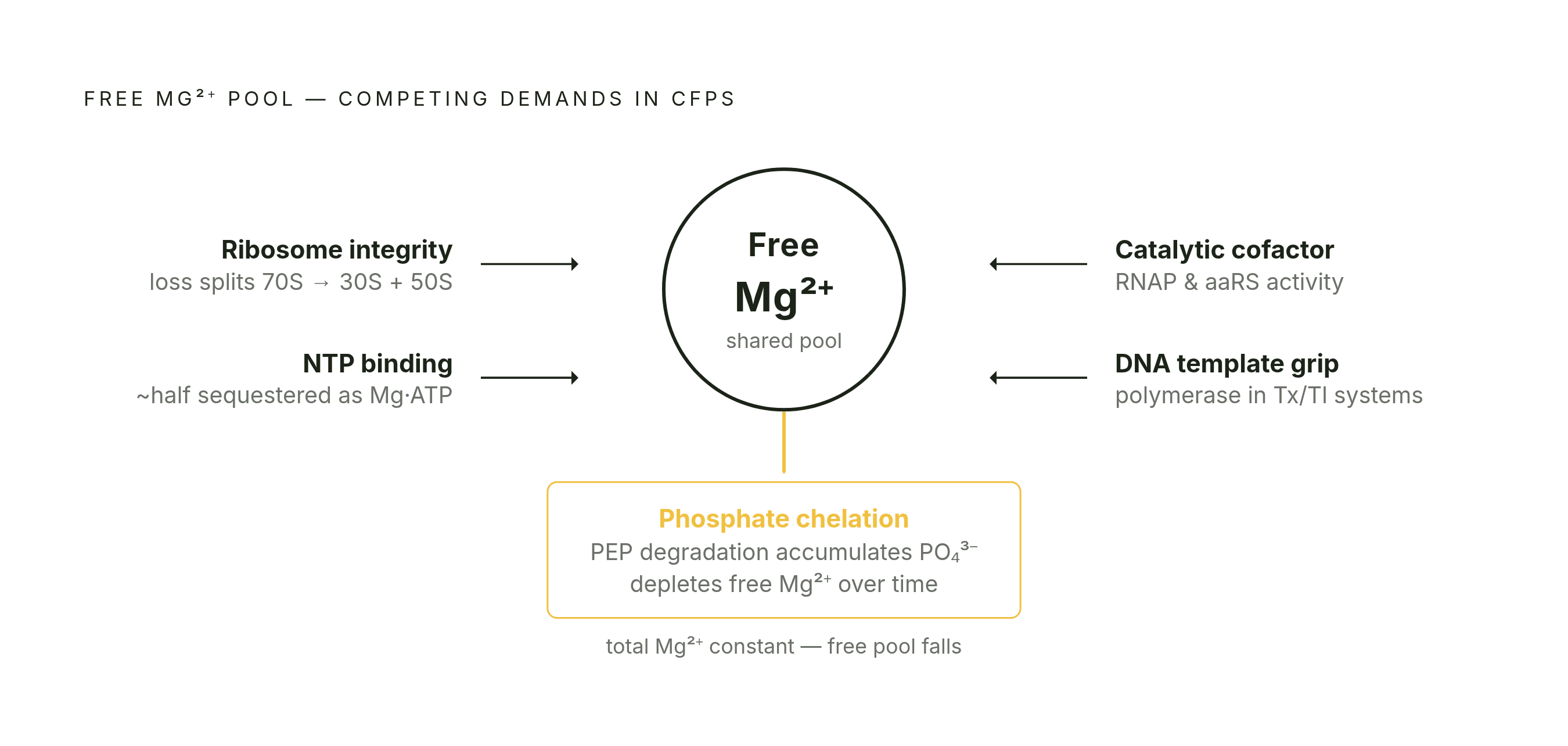
Phosphoenolpyruvate, PEP, is one of the most common energy sources in CFPS reactions, mostly because it's cheap and easy to get relative to the alternatives. It also carries a cost that doesn't show up until the reaction is already running, and working out that sequence is what explains why so many labs lose yield without ever figuring out the cause.
Here's the sequence. Cell lysate keeps some phosphatase activity even after extraction. Over the course of a reaction, that activity chews through PEP and dumps inorganic phosphate into solution. Phosphate grabs magnesium; as it builds up, it strips free Mg²⁺ out of the pool that ribosomes, NTPs, and enzymes all draw from, even though the total magnesium you added at the start hasn't budged. Phosphate buildup is a known inhibitor of protein synthesis in cell-free systems, and the mechanism runs through magnesium starvation more than any direct toxic effect on translation itself.
So the Mg²⁺ level that's optimal at the start of a reaction is not the level you're sitting at an hour or two later. The free pool drifts down as phosphate builds up, which means a fixed magnesium concentration is, by design, always a little wrong for some stretch of the reaction. Optimize Mg²⁺ against one yield measurement taken at a single timepoint, and you're chasing a moving target while calling it fixed.
The field has answered this problem a few different ways, and weighing them against each other shows they are not equally good, whatever the vendor catalogs might suggest. Adding more Mg²⁺ up front is the simplest fix and the one most labs try first, but it's a blunt tool: push too hard early, before phosphate has had time to build up, and you overshoot the ribosome's tolerance before you ever needed the extra buffer. Switching energy systems entirely, to maltose, maltodextrin, or glucose, goes after the root cause, since each releases phosphate more slowly than PEP does, though each brings its own tradeoffs in cost, yield kinetics, or how well it plays with a given extract. A third route is adding a molecular crowding agent, PEG8000 in particular, at concentrations up to roughly 4.5% weight/volume, which changes the effective ionic activity of the solution and can partly offset the chelation problem; one study in Frontiers in Bioengineering and Biotechnology documented large effects on phage synthesis yield tied to exactly this kind of crowding supplementation.
Weighing the three against each other, fix the energy source first. Treating it as one option among equals is the mistake worth calling out directly. Titrating magnesium upward treats a symptom that keeps coming back every time more phosphate accumulates; switching to a slower-releasing energy source goes after the problem closer to where it starts. "How much magnesium should I add" doesn't have one answer, because the energy source driving the reaction decides how fast free Mg²⁺ disappears.
What potassium does, and why it is mechanistically different from magnesium
Potassium's job differs from magnesium's in kind, not just degree. Where magnesium holds the ribosome together, high potassium pushes the subunits apart, an effect that behaves mechanistically like raising the reaction's temperature. K⁺ controls how readily the ribosome comes apart and comes back together.
That gives potassium a two-sided failure mode worth sitting with. Too little, and ribosomes may never open up enough to engage mRNA productively. Too much, and the subunits fall apart faster than they can reassemble, so intact 70S particles get lost faster than they form. The structural evidence here is concrete: 16S rRNA needs roughly 20 mM Mg²⁺ to fold into the shape that exposes its protein-binding sites, while it takes roughly 360 mM KCl to loosen that same RNA enough to make those sites accessible again. Magnesium and potassium act on the same structure, pulling in opposite directions, and the ribosome needs both to work at all.
Counterion choice matters too. K⁺ usually comes as potassium glutamate or potassium acetate rather than potassium chloride, because these salts sit closer to what the cytoplasm actually looks like ionically, and the counterion shifts osmolarity on its own, separate from the K⁺ concentration itself.
There's a system-dependent wrinkle worth flagging. In translation-only reactions, K⁺ usually gets fixed once and left alone. In coupled transcription-translation systems, especially ones built on prokaryotic lysate, K⁺ titration is often still worth doing, because the potassium carried over from the extract itself varies batch to batch and doesn't always get accounted for. Magnesium gets eaten up by chelation with energy intermediates as the reaction runs; potassium's free concentration, by contrast, holds steady across the timeline. Once you find the right window, potassium is the easier of the two to leave alone. Magnesium demands ongoing attention, and treating the two as equally low-maintenance is how reactions drift without anyone catching it.
Established concentration ranges across major CFPS systems
These ranges are starting windows drawn from published work, not fixed constants. The right value for any given lab depends on extract prep, energy source, and whatever else is in the tube, so treat what follows as a place to start a titration, not an answer to copy.
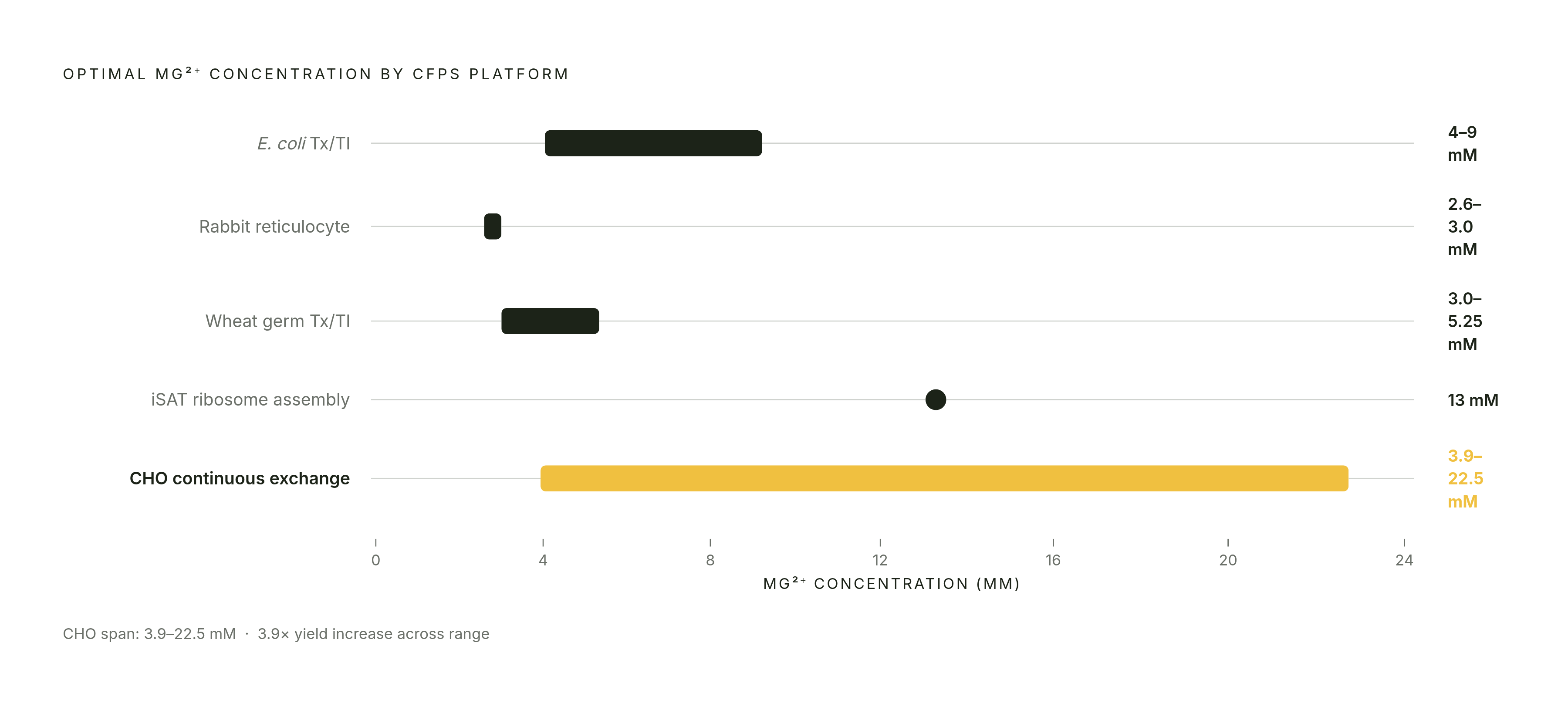
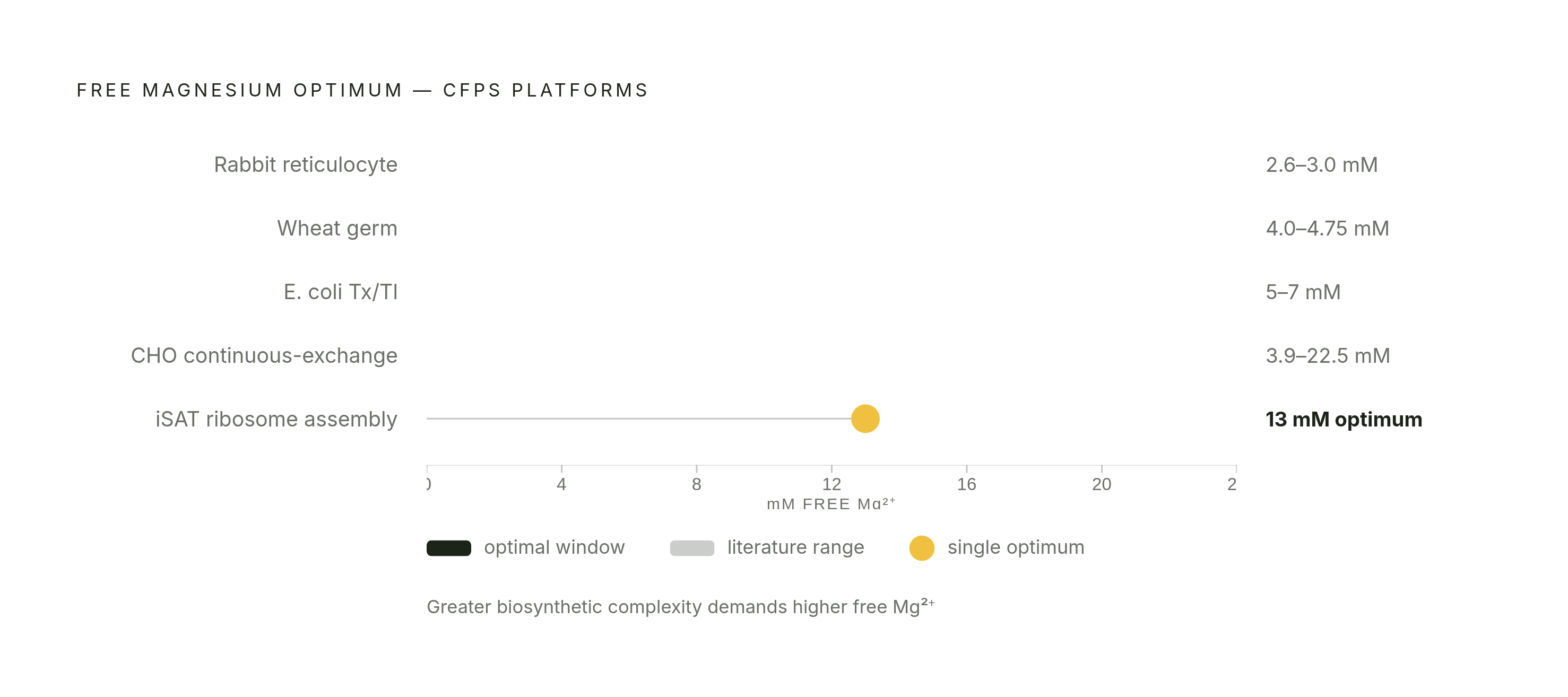
E. coli-based coupled transcription-translation is the dominant CFPS platform, holding an estimated 47.1% share of the market as of 2024 according to Persistence Market Research. The broad literature range for Mg²⁺ in these systems runs from 1 mM to 50 mM, but the range that actually delivers useful yield is much tighter: typically 4 to 9 mM, more often cited as 5 to 7 mM. One luciferase reporter study found 7 mM Mg²⁺ optimal for a two-hour coupled reaction, but that optimum dropped to 5 mM once polyamines (1 mM putrescine, 0.5 mM spermidine) were added to the mix. That's not a footnote. Adding polyamines resets the Mg²⁺ optimum rather than just adding to it, and a lab that adds polyamines without re-titrating magnesium is very likely running suboptimally without knowing it.
Rabbit reticulocyte lysate behaves differently, with a much narrower optimal window, generally cited as greater than 2.5 mM but less than 3.5 mM, often tightened further to 2.6 to 3.0 mM. The narrower window reflects the different buffering capacity and endogenous magnesium content built into mammalian extract, compared to bacterial lysate.
Wheat germ extract, run as coupled Tx/Tl, prefers MgCl₂ or magnesium acetate in the range of roughly 3.0 to 5.25 mM, with a sweet spot around 4.0 to 4.75 mM. Potassium behaves differently here too: potassium acetate around 59 mM is the established target, and pushing K⁺ higher buys only marginal further gain. This is one of the clearest documented ceiling effects for potassium in any CFPS system.
CHO-based continuous exchange cell-free systems tolerate a strikingly wider Mg²⁺ range. One study published via link.springer.com found that raising Mg²⁺ from 3.9 mM to 22.5 mM produced a 3.9-fold jump in EGFR yield, a spread far wider than anything E. coli systems tolerate, likely reflecting the bigger buffering capacity and different ribosomal architecture of mammalian machinery.
Ribosome assembly reactions, iSAT systems in particular, sit at the far end of the spectrum: 13 mM magnesium glutamate is the reported optimum for the MRE600 strain, well above standard Tx/Tl requirements, because the system is building ribosomes from scratch on top of running protein synthesis. Line these systems up against each other and a pattern holds across all of them, worth stating plainly: the optimal magnesium concentration tracks the complexity of the task. Pure translation needs the least, coupled transcription-translation needs more, and ribosome biogenesis needs the most. Anyone assuming a single "standard" Mg²⁺ number carries across platforms hasn't looked at the data.
Running a matrix optimization: how to find the right window for your system
The field standard is a matrix, run across conditions rather than in a strict sequence, and running it any other way is a mistake worth naming directly. Vary Mg²⁺ and K⁺ independently across a grid of conditions, measure yield with a fluorescent or luminescent reporter (GFP and luciferase are the usual picks), and find the peak.
It has to be a matrix, because Mg²⁺ and K⁺ interact directly at the ribosome. Change the K⁺ concentration and the Mg²⁺ optimum moves with it. Optimize magnesium first and potassium second, one variable at a time, and you risk locking onto a local maximum that isn't the real peak for the system: you'd walk away thinking you'd found the ceiling when you'd actually found a plateau. A 2025 eLife-reviewed preprint on simplifying prokaryotic eCFPS systems makes this explicit, using matrix-based Mg²⁺/K⁺ optimization as a foundational early step in the process.
A few rules keep the matrix manageable. Start from literature ranges for your extract type as the boundaries of the grid rather than scanning from zero; the ranges above exist precisely so you don't have to rediscover them from scratch. Hold energy source, template concentration, and incubation conditions fixed during the ion screen itself, so you're not mixing variables together. Run the PEG8000 screen separately, as a follow-up co-optimization, since PEG changes effective ionic activity and shifts wherever the Mg²⁺ optimum lands. Small-volume plate formats, 10 to 25 microliter reactions, keep the whole grid affordable in reagent and time.
One caveat on reporter choice, and it's a real trap: luciferase activity can itself be sensitive to reaction conditions, so a yield curve built with a luciferase reporter may measure more than one thing at once, with transcription-translation efficiency and the reporter's own sensitivity to reaction conditions potentially tangled into a single number. That curve may not carry over cleanly to a different protein of interest. Where you can manage it, a follow-up run with the actual target protein is worth the extra plate.
A 2025 bioRxiv study illustrates the underlying point clearly. Researchers built a simplified CFPS system by starting with thirty-five components and pulling them out one at a time. Mg²⁺ and K⁺ stayed in every single base condition through the entire process. That's the field treating these two ions as fixed anchors, the things everything else gets optimized or stripped away around. Some vendors have started publishing lot-level QC data and documented starting formulations for their CFPS kits, which gives researchers a real baseline to start a matrix from instead of piecing together conditions from scattered papers. That documentation cuts down the number of grid conditions needed to land on an optimum, which matters when reagent cost and bench time are both limited.
How polyamines, crowding agents, and energy source choice shift the ionic optimum
Three variables move the magnesium optimum around, and none of them move it independently of the others. Treat them as one connected decision, or the optimization will mislead you.
Polyamines, putrescine and spermidine specifically, carry positive charge that stabilizes both ribosomes and nucleic acids, which means they partly cover one of magnesium's core jobs. Add polyamines without going back to check the Mg²⁺ concentration, and you push the system past its real optimum, into a range that's now too high for a polyamine-supplemented reaction. The 7 mM to 5 mM shift in the luciferase reporter data cited earlier isn't a curiosity; it's the clearest quantitative proof on hand that this interaction is real and big enough to matter.
PEG8000, used to mimic the crowding of the cytoplasm, changes the effective concentration of every ion in solution, not just magnesium. A cooperative relationship between PEG8000 and Mg²⁺ has been documented directly, which is why the two call for a joint optimization screen rather than two separate, sequential ones. Treat them independently and you risk missing the real peak altogether.
Energy source choice sits upstream of both, and belongs locked in before either of the other two variables gets touched at all. PEP drives heavy phosphate release, which drives progressive Mg²⁺ depletion over the reaction timeline, as covered above. Maltodextrin or glucose release phosphate more slowly, so free [Mg²⁺] holds up better over time and the total Mg²⁺ you need to hit the same effective concentration is lower. Picking an energy system is, in effect, picking a magnesium requirement, even though the two look like unrelated decisions on paper.
When yield drops unexpectedly, the fastest diagnostic is asking what changed most recently among polyamines, crowding agent, and energy source, rather than running a fresh Mg²⁺/K⁺ matrix from zero. That's usually where the real answer is hiding.
Batch-to-batch variability in extract Mg²⁺ and K⁺ content and what it means for reproducibility
Cell extract is not a defined chemical reagent, whatever the certificate of analysis might imply. It carries its own endogenous magnesium and potassium, inherited from whatever the source cells held before lysis, and that carryover shifts batch to batch depending on cell growth conditions, harvest timing, and lysis method. This matters more than it looks, because the Mg²⁺ and K⁺ a researcher deliberately adds are not the total concentrations the reaction actually sees.
A matrix optimization run against one extract batch gives you the right answer for that batch. The same answer isn't guaranteed for the next prep, especially if the new batch carries a different endogenous ion load, and working through that gap is what exposes one of the more underappreciated sources of the reproducibility problem that shows up when protocols move between labs, or even within the same lab across extract batches made months apart. Two labs following an identical published protocol, with identical added Mg²⁺ and K⁺, can land on meaningfully different yields if their extracts differ in what they were already carrying before either researcher added a single microliter of buffer.
The fix isn't complicated, though it is tedious: re-run the Mg²⁺/K⁺ matrix, or at least a narrowed version of it, whenever a new extract batch comes online, rather than assuming last time's optimum still holds. Skipping that step is the single most common reason a protocol that worked beautifully in one batch quietly stops working in the next, and no amount of downstream troubleshooting fixes a problem that started back at the extract. Extract characterization, whether through direct ion measurement or a quick reporter-based screen, is what turns a one-time optimization into one that actually lasts.