Coupled vs. Uncoupled Transcription-Translation in CFPS
Coupling transcription and translation boosts protein yield by loading ribosomes before mRNA folds.
Cell-free protein synthesis works because you take a cell extract, strip out the genomic DNA and the endogenous mRNA, and keep everything else: ribosomes, tRNA, aminoacyl-tRNA synthetases, initiation and elongation factors, an energy system that keeps ATP and GTP topped up. What's left will make protein from whatever template you feed it. The real question is what to feed it, and when: do transcription and translation happen together in one pot, or do you make the mRNA first and add it in separately? That choice, coupled versus uncoupled, changes your yield, changes what template format you can use, and changes which proteins you can even attempt to make.
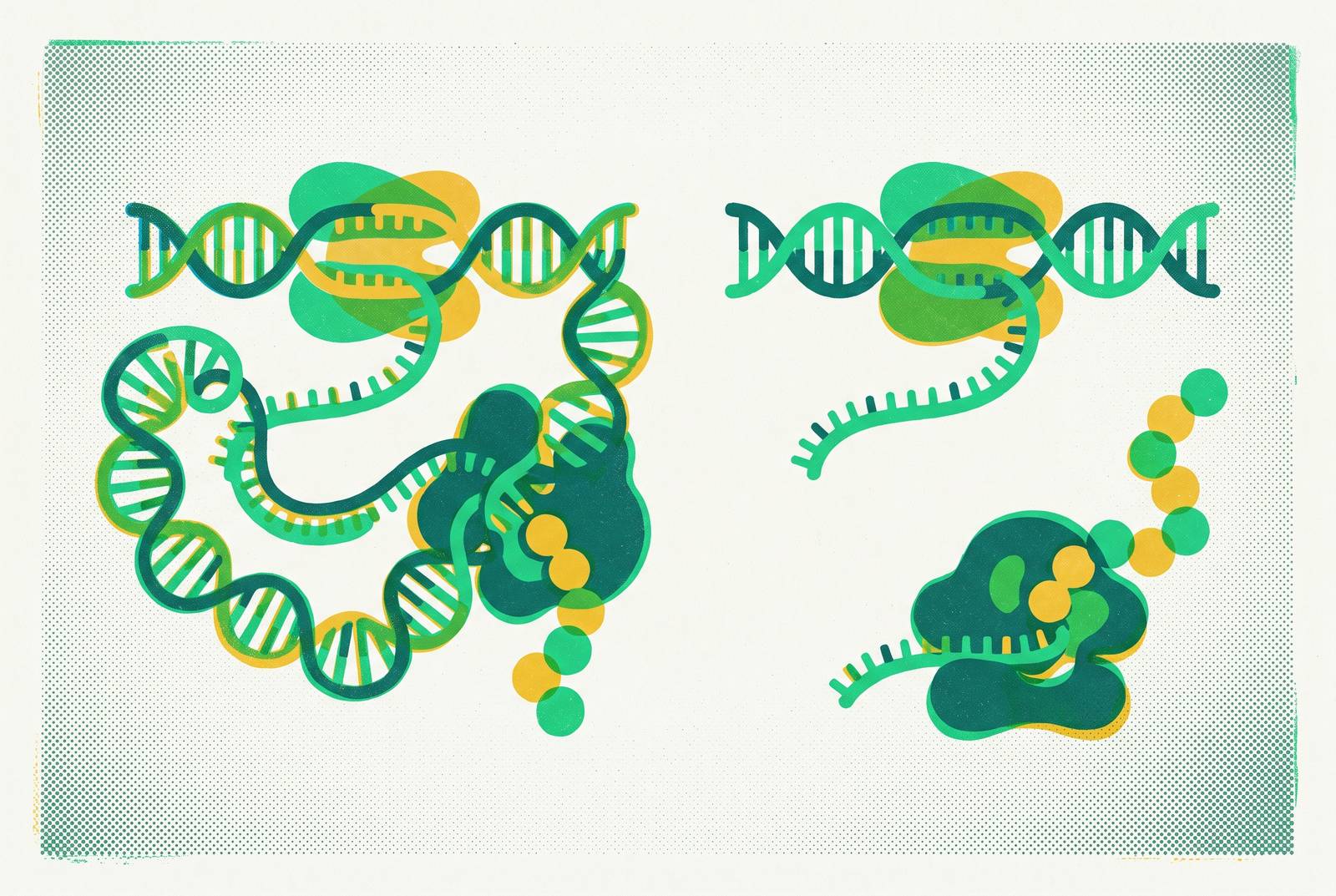
In an uncoupled reaction, the full mRNA molecule is present in solution before any ribosome reaches it, giving secondary structures time to fold over the Shine-Dalgarno sequence and lock out translation entirely. A coupled reaction runs on a different clock: ribosomes can load onto a transcript while RNA polymerase is still synthesizing it, grabbing the ribosome binding site before downstream folding has a chance to seal it shut. That co-translational loading edge is not a marginal effect; if a stem-loop closes over the Shine-Dalgarno before a ribosome arrives, that transcript is dead for translation purposes. For prokaryotic templates in E. coli extract, where the Shine-Dalgarno entry mechanism is native and structured 5' UTRs are a common failure point, coupled mode carries the built-in mechanical advantage.
Coupled reactions add DNA straight into the tube. A phage polymerase, usually T7 or SP6, transcribes mRNA in the same pot where ribosomes are translating it, often within seconds of a transcript showing up. Uncoupled reactions split the job in two: mRNA gets made first, either transcribed separately or bought pre-made and purified, then dropped into a translation-only extract. These are two different reaction setups with two different sets of failure modes, and the extract you run them in, E. coli, wheat germ, rabbit reticulocyte, mammalian, sits underneath as its own variable. Get the extract right and still pick the wrong coupling mode, and yield suffers anyway. A structured 5' UTR that folds before a ribosome arrives is enough to kill yield entirely, even in an otherwise well-prepared E. coli extract.
How does mRNA secondary structure affect the coupled vs. uncoupled choice in prokaryotic systems like E. coli?
mRNA doesn't sit still, and it folds fast, throwing up stem-loops, pseudoknots, and G-quadruplexes the moment the molecule exists in solution. If one of those structures closes over the ribosome binding site, translation stalls before it starts.
In an uncoupled reaction, the whole mRNA molecule sits in the tube, fully made, before any ribosome gets near it. That gives secondary structure all the time it needs to fold over the Shine-Dalgarno sequence and lock the ribosome out. A coupled reaction runs on a different clock: ribosomes can load onto the message while RNA polymerase is still transcribing it, grabbing the ribosome binding site before downstream folding has a chance to seal it shut. This isn't a marginal effect, either. If a stem-loop closes over the Shine-Dalgarno sequence before a ribosome arrives, that transcript is dead for translation purposes, full stop.
For prokaryotic templates, especially ones with structured 5' UTRs or a ribosome binding site prone to folding shut, coupled mode carries a built-in mechanical edge, one that comes straight out of how RNA folding speed collides with ribosome loading timing. Eukaryotic systems complicate the picture, though, because mRNA processing needs can outweigh the folding advantage entirely. That's where uncoupled mode starts to make sense again.
Where uncoupled reactions recover the advantage: eukaryotic templates and controlled reaction conditions
Eukaryotic mRNAs often need processing that a T7 polymerase reaction just doesn't replicate: capping, sometimes splicing, occasionally an IRES element standing in for cap-dependent initiation. In vitro transcription can approximate some of this, co-transcriptional capping reagents exist, but none of it recreates the nuclear processing pathway a transcript would actually see inside a eukaryotic cell. When a target's translation efficiency hinges on getting that processing right, making the mRNA separately and controlling its state before it enters the reaction gives you a level of control one-pot coupling just can't match.
This approach carries a real cost, though. Uncoupled reactions need far more mRNA input than the equivalent mass of plasmid DNA would need in a coupled setup, because exogenous mRNA starts degrading the moment it hits the reaction and nothing replaces it. Coupled transcription keeps making fresh message the whole time the reaction runs; uncoupled mode hands you one batch, and from there it's a race against RNase. That gap in required input isn't small — evidence puts it at roughly 20–30-fold more mRNA than the equivalent plasmid DNA to achieve comparable translation output.
What you get back is independence. Transcription and translation each have their own preferred temperature, ion concentration, cofactor mix. Run them coupled, and both processes sit in the same buffer at the same time, so one is always compromising for the other. Run them uncoupled, and you can tune each step on its own terms, which matters a lot when a target's translation conditions and its transcription conditions just don't line up.
Uncoupled mode also isn't locked to one extract. Swap DNA for mRNA and you can run an uncoupled reaction in any CFPS platform you'd otherwise run coupled. The tradeoff shows up in handling: mRNA is fragile, easy prey for RNase contamination, and harder to store and pipette reliably than a plasmid prep or a PCR product. That instability is a tax coupled reactions never have to pay.
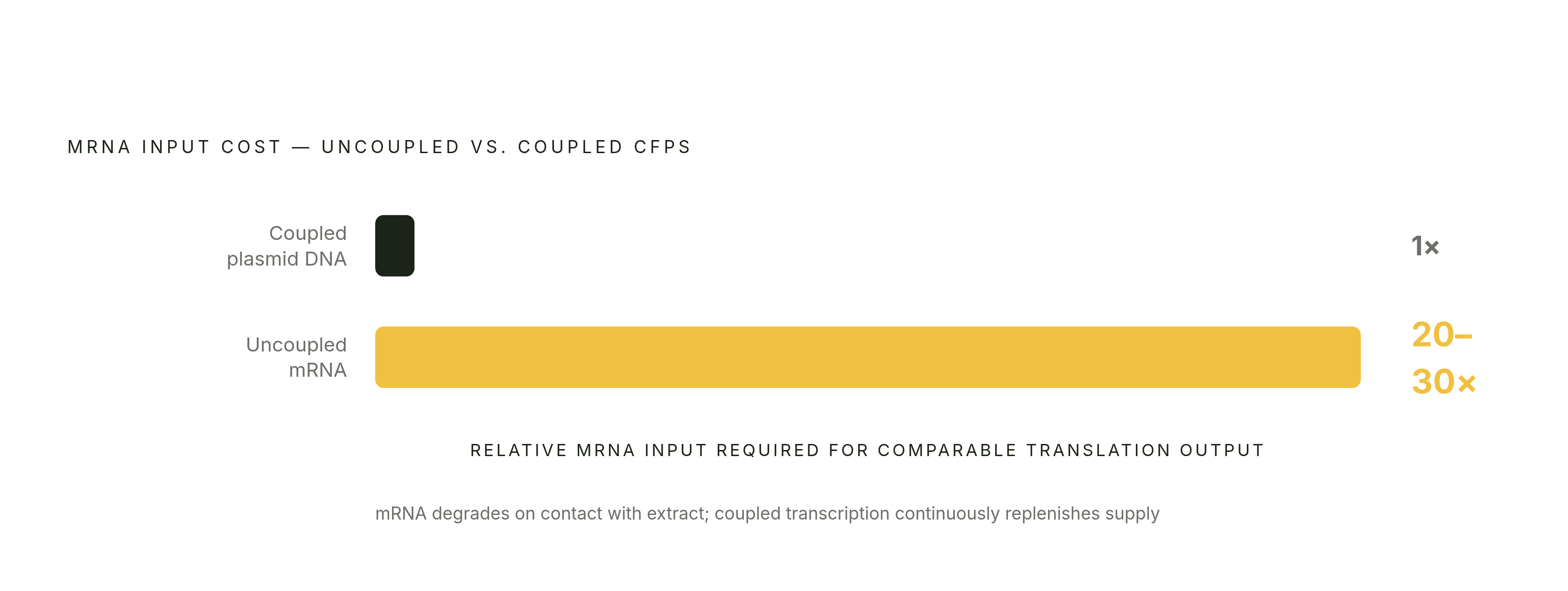
Yield differences between the two modes and what drives them
Across both prokaryotic and eukaryotic platforms, coupled reactions tend to make more protein, though how much more depends on the system and the target. A few things stack on top of each other here.
mRNA never runs dry in a coupled reaction, since transcription keeps churning out more of it faster than translation eats it up, so ribosomes aren't sitting around waiting for template. Add the co-translational loading edge from the folding argument above, and a bigger share of every transcript actually gets translated instead of sitting there mis-folded. There's no gap between synthesis and use for degradation to chew through before translation even starts.
In eukaryotic coupled systems, skipping the separate in vitro transcription step also means skipping the cap analog reaction, itself a known source of batch-to-batch mess. Capping efficiency swings around, and when it's low, a chunk of the mRNA pool is translationally invisible from the start. Cutting the step out removes a whole failure point, not just a yield bump.
None of this makes coupled mode unbeatable, though. Optimize uncoupled conditions specifically for one transcript, tune temperature, ion concentration, and timing to that molecule, and the yield gap narrows fast. The 5' UTR sequence pulls hard on expression in either mode, and the optimization doesn't carry over between platforms; what works in wheat germ extract won't necessarily work in E. coli. So here's the rule I use: if yield is what's limiting you and the template is a standard prokaryotic construct, default to coupled. Reach for uncoupled when separating reaction conditions, or meeting a eukaryotic processing requirement, matters more than squeezing out the last bit of protein.
Template format and how it shapes the practical workflow in each mode
Coupled reactions run off either a circular plasmid or a linear PCR product, and that flexibility changes the day-to-day workflow more than people expect walking in. A PCR product needs a strong T7 promoter in the 5' UTR, a Shine-Dalgarno ribosome binding site, and a T7 terminator downstream, and that's the whole requirement list. There's no cloning, no transformation, no picking colonies off a plate and waiting on an overnight culture. The coding sequence goes from a PCR tube straight into the reaction.
That matters a lot if you're screening variants. A library of point mutants, truncations, or domain swaps can go out as separate PCR products and get tested the same afternoon, with no cloning bottleneck standing between the design and the data. A dozen constructs can run in parallel without the multi-plasmid cloning slog that would otherwise eat a week.
Uncoupled reactions don't get that shortcut. mRNA has to be transcribed, and in most eukaryotic setups capped and purified, before it ever touches the translation reaction. That's a whole extra prep step stacked on top of the instability problem already mentioned. What you buy with it is control: if the experiment genuinely needs a defined, characterized mRNA, say a study of translation regulation where the transcript itself is the variable, uncoupled is the only format that gives you that.
For high-throughput screening, coupled mode with linear PCR wins on speed, no contest. Uncoupled workflows earn their place when the mRNA itself is what you're studying, or when eukaryotic processing isn't optional. That PCR-straight-into-a-coupled-reaction speed is where the format's value becomes clearest during a screening campaign.
How the extract source interacts with the coupled/uncoupled choice
E. coli extract gives the highest protein yields of any common CFPS platform, costs less to make, and holds up well from batch to batch, and suppliers of documented E. coli-based CFPS reagents, such as Sepia Bio, have leaned into that consistency as a design priority. It's also the native home of the Shine-Dalgarno ribosome entry mechanism, which is exactly why coupled reactions run cleanest here: the folding-versus-loading dynamic from earlier plays out on its home turf. Its weak spot is post-translational modification and eukaryotic-style folding, which rules it out for complex eukaryotic targets no matter which coupling mode you pick.
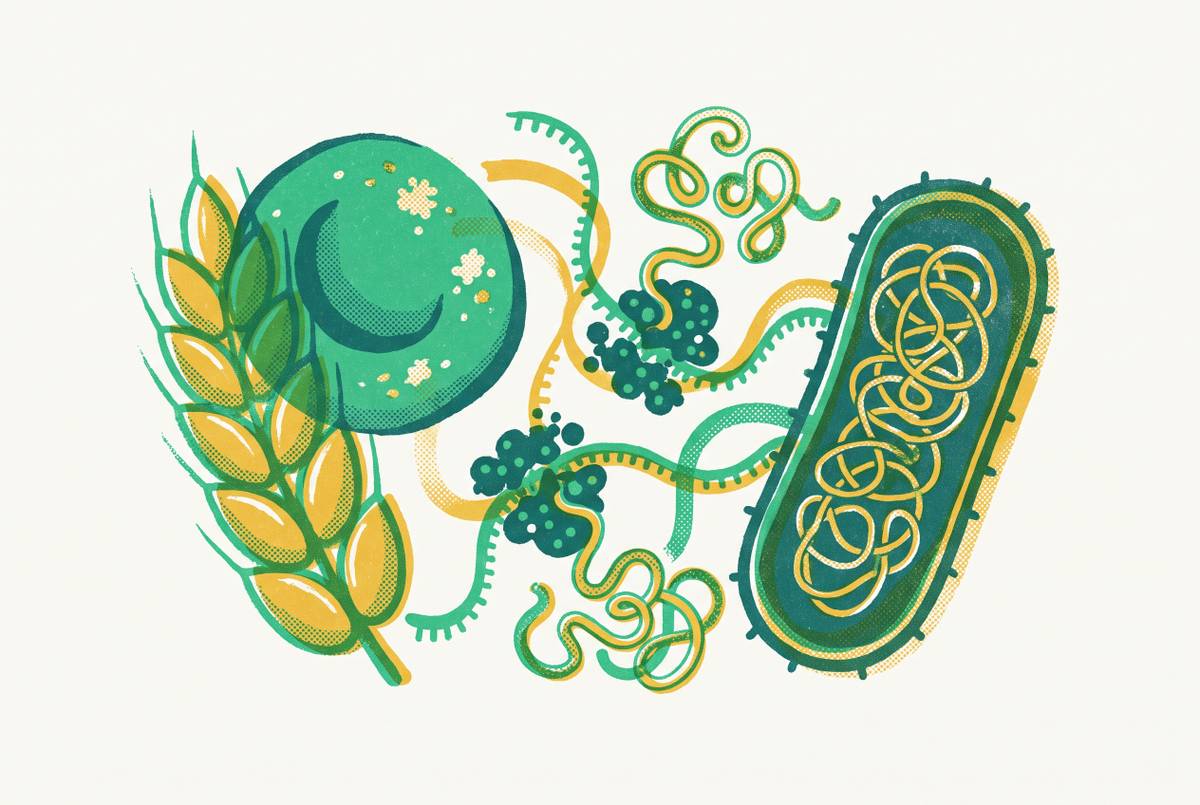
Wheat germ extract brings eukaryotic translation machinery, low nuclease and protease background, and the ability to fold complex 3D structures, though it can't glycosylate anything unless you supplement it with microsomes. It handles large proteins well too. There's a supply-side wrinkle worth knowing about: wheat germ ribosomes are sensitive to tritin, a protein naturally present in wheat endosperm, and even trace contamination shuts synthesis down cold. That makes reliable extract prep technically demanding and keeps commercial supply tighter than it is for E. coli. Uncoupled reactions are more often used in eukaryotic CFPS platforms, including wheat germ, where mRNA processing needs drive the choice.
Rabbit reticulocyte lysate runs rich in translation factors and works well for small amounts of highly active protein, but its overall translation rate is slower than E. coli, so yields land lower too. Mammalian lysates, from HEK293, CHO, or HeLa cells, come closest to matching human folding and modification machinery, and engineering work has started to expand what these lysates can do, closing some of the gap with prokaryotic and simpler eukaryotic platforms.
Put together: coupled mode hits its stride in E. coli extract. Eukaryotic extracts still lean uncoupled more often than not, because native transcript processing matters, though lysate engineering keeps closing that gap year over year. In practice, the extract decision comes first, driven by the target's biological origin and its PTM and folding needs, and the coupling mode gets picked inside whatever room that extract choice leaves.
Difficult protein targets: where the coupling mode decision carries the most weight
Toxic proteins make the clearest case for cell-free expression generally. In vivo, they kill or arrest the host cell before you get a useful yield; restriction endonucleases and cell-division-disrupting proteins are the classic examples. CFPS sidesteps the problem entirely, since there's no living cell around to kill. Coupled mode with linear PCR products sharpens the advantage further: skip transformation, and the toxic sequence never has to survive inside a cell at all, not even briefly.
Membrane proteins make up roughly a third of a typical cellular proteome, and they're a known bottleneck for in vivo overexpression: toxicity, aggregation, poor efficiency, often all three at once. Cell-free reactions let you drop in detergents, nanodiscs, or liposomes directly, something a living cell will never tolerate. You can even assemble multi-subunit membrane complexes by mixing separately made components, or by making the limiting subunit first and adding the rest afterward to stabilize things. Coupling mode here usually just follows the extract decision: mammalian extract for human membrane targets, uncoupled mode brought in whenever authentic mRNA processing is part of the job.
Unstable, fast-degrading proteins benefit from coupled mode's continuous supply; a steady stream of fresh protein can outrun degradation in a way a single dose of exogenous mRNA in uncoupled mode can't. Multi-domain eukaryotic proteins depend on co-translational folding, so eukaryotic extract paired with either coupled mode or a carefully tuned uncoupled setup becomes the default, with PTM needs steering which extract you reach for.
Across all these targets, the common thread is that the cell-free format itself is usually the real prerequisite for success. Coupling mode is a second-order decision, one that fine-tunes performance once you've already cleared the bigger hurdle of getting the protein made at all.
A decision map for choosing between coupled and uncoupled CFPS
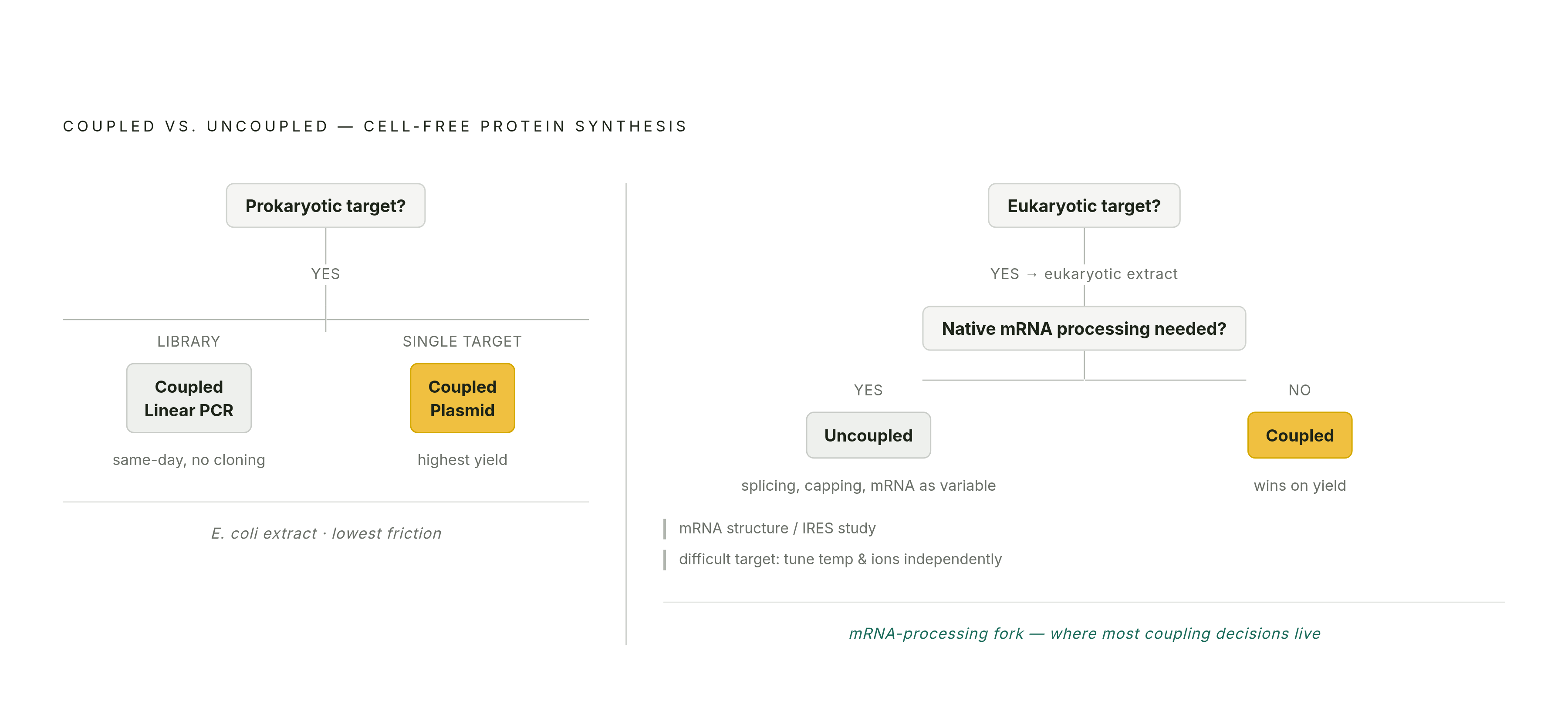
Start with the protein. A prokaryotic target with an ordinary structure and no PTM requirement points straight to E. coli extract, coupled mode, plasmid or linear PCR: the highest-yield, lowest-friction combination on the table. A eukaryotic target with complex folding or PTM-dependent activity means eukaryotic extract, and then one real question follows: does this transcript need native mRNA processing? If yes, go uncoupled. If not, coupled still wins on yield. A toxic target calls for CFPS no matter what else is going on, and coupled mode with linear PCR strips out every in-cell step. A membrane protein points to CFPS too, with a lipid or detergent environment added straight into the reaction, and extract plus coupling mode following from whatever organism the protein came from.
Then layer in the experimental context. Screening a large variant library favors coupled mode with linear PCR products every time: no cloning overhead, results the same day, plate-ready from the start. Optimizing conditions for one stubborn target is where uncoupled mode earns its extra mRNA-handling cost, since independent control of transcription and translation conditions can be the difference between a working reaction and a dead one. Studying translation regulation, mRNA structure, or IRES-driven initiation only works in uncoupled mode, because the mRNA has to be the variable you're controlling directly. Milligram-scale production of a prokaryotic protein calls for coupled mode in E. coli extract, with the 5' UTR tuned for that platform specifically.
Tuning the 5' UTR is always worth doing, in either mode, and skipping that step isn't something you can afford if yield actually matters to the experiment. The rest comes down to matching the tradeoff, yield against control, speed against flexibility, to what the experiment actually needs; the better choice between coupled and uncoupled moves depending on the target and the goal, and no single rule covers every case. OpenCFPS runs both modes, with lot-level QC data and documented formulations behind each, so someone troubleshooting a low-yield reaction is working from data instead of guessing at a black box.