Membrane Protein Expression in Cell-Free Systems
A technique that eliminates living cells finally cracks how to produce functional membrane proteins.

Cell-free protein synthesis has moved from a niche academic curiosity to a working answer for one of biology's oldest production problems: making membrane proteins in usable quantities, correctly folded, without a living cell getting in the way. The rest of this piece lays out how CFPS solves that problem, where the technique still runs into real limits, and what to do with it right now.
CFPS eliminates the constraint that kills cell-based membrane protein expression: there is no living cell to keep alive. In a cell-based system, a membrane protein that disrupts ion gradients, floods insertion machinery, or triggers stress responses will impair or kill the host before yield ever builds up. In a CFPS reaction, the lysate keeps synthesizing protein whether or not that protein would be lethal to a living cell, so toxicity to a host organism simply stops being a variable. That also removes the upstream strain engineering, colony screening, and induction-timing work that cell-based approaches require just to keep the host tolerant of what it is being asked to express.
What cell-free protein synthesis is and why its open architecture matters for membrane proteins
CFPS makes recombinant protein in a cell lysate instead of inside a living cell. Transcription and translation run in an extract stocked with amino acids, an energy source, and a DNA or mRNA template, and the machinery does the same basic chemistry a cell does, minus the cell. The extract can come from a few different sources: E. coli, wheat germ, rabbit reticulocyte lysate, insect cells, human cell lines, or a fully defined PURE system built from purified recombinant proteins plus E. coli ribosomes and tRNAs.
Most commercial setups run coupled transcription-translation, meaning both steps happen in one pot. That cuts process time and means a researcher can express straight from a PCR product, no cloning step needed.
The real structural difference from cell-based expression, though, is what's missing: there's no living cell to keep alive, no homeostatic constraints, and no host membrane that a foreign protein has to muscle its way into. Reaction conditions sit fully open to the person running the experiment. Since there's no membrane being colonized, a protein that would be toxic to a living cell, or one that scrambles a host's signaling cascades, can still get made without wrecking a culture. Temperature, redox potential, ionic strength, additive levels: all of it can be adjusted mid-experiment in ways that are simply off the table when a cell has to survive the process. This is a core benefit. It's the actual mechanism that lets CFPS get around the problems membrane proteins cause in cells.
How does CFPS let you express membrane proteins that are toxic to living cells without killing the host?
In a cell-based system, the cell doing the expressing has to stay alive long enough to make something useful. A membrane protein that disrupts ion gradients, sets off stress responses, or floods the insertion machinery past capacity will impair or kill the host before yield ever builds up. CFPS sidesteps that problem completely: the lysate keeps synthesizing protein whether or not that protein would be lethal to a living cell.
That removes a whole category of upstream work. No strain engineering to make a host tolerate the target, no screening through transformed colonies hoping one survives, no fiddling with induction timing across growth phases. Synthesis completes in a compressed timeframe, turning what used to be a lengthy culture-and-purify cycle into something closer to a rapid optimization loop. Chaperones, disulfide isomerases, or other folding aids can go straight into the reaction, something that would require genetically modifying a host organism in a cell-based setup.
A 2025 PubMed review on cell-free systems and membrane proteins notes that CFPS sidesteps aggregation and solubility problems common to modified E. coli strains, where membrane protein overexpression can produce material that's difficult to purify and often not worth the effort. A separate 2025 chapter (PMID 41688133) makes a similar case: CFPS gives an open, repeatable, high-yield route to transmembrane protein production that gets around a lot of what limits expression inside a living cell.
The role of membrane-mimetic additives in obtaining folded, functional membrane proteins from CFPS
Removing the cell doesn't remove the underlying physics: a transmembrane domain is hydrophobic, and it still needs something lipid-like around it to fold properly. What CFPS changes is where that lipid environment comes from. Instead of whatever the host membrane happens to offer, the researcher can supply a defined membrane-mimetic directly into the reaction, at a composition chosen for the target.
Three main approaches cover most of the field, and they suit different downstream goals.
Detergent micelles are the simplest option, added straight into the reaction to solubilize the protein as it's synthesized. It's the lowest-effort entry point and plays well with a lot of downstream assays, but detergents can denature sensitive targets, particularly ones whose function depends on specific lipid contacts rather than just a hydrophobic shell.
Lipid nanodiscs take a different route: preformed nanoscale bilayer discs, wrapped in a membrane scaffold protein, get added to the reaction, and the protein inserts into them as it's made. No detergent touches the protein at any point, and because nanodiscs stay soluble, the resulting protein is compatible with biophysical and biochemical techniques that need a native-bilayer-embedded, soluble sample. Published work on bacterial membrane proteins illustrates why this matters: for some targets, nanodisc-based cell-free expression has produced functionally folded protein where detergent-based approaches fell short. GPCRs tell a similar story. A detergent-free cell-free method produced pharmacologically active receptor in around two hours by inserting the nascent protein co-translationally into nanolipoprotein particles, and a model construct, β2AR-T4L (the β2-adrenergic receptor with its third intracellular loop swapped for T4 lysozyme), only expressed in active form when nanolipoprotein particles were present.
Compare that to how nanodisc reconstitution works starting from a cell-based system: express in the host membrane, extract with detergent, mix with scaffold protein and lipid, then slowly strip the detergent out using hydrophobic beads. Four steps, four places for things to go wrong. CFPS folds all of that into a single reaction. Lipid composition itself is tunable too: DMPC, DMPG, POPC, and POPC/DOPG nanodiscs have all been tested side by side for how well they support folded, soluble expression.
Liposomes and supported lipid bilayers make up the third route. Liposomes can go straight into a CFPS reaction as a membrane environment for insertion, and supported lipid bilayers are especially useful for ion channels, since the lipid mix is adjustable and the format plays nicely with electrophysiology recording setups.
A fourth option is synthetic polymer nanodiscs made from styrene-maleic acid or related polymers, which pull membrane proteins straight out of a bilayer without any detergent involved. These are gaining ground for structural and functional work where detergent exposure has to be avoided entirely, and they matter most when expression yield is already low and every denaturing step risks losing the sample.
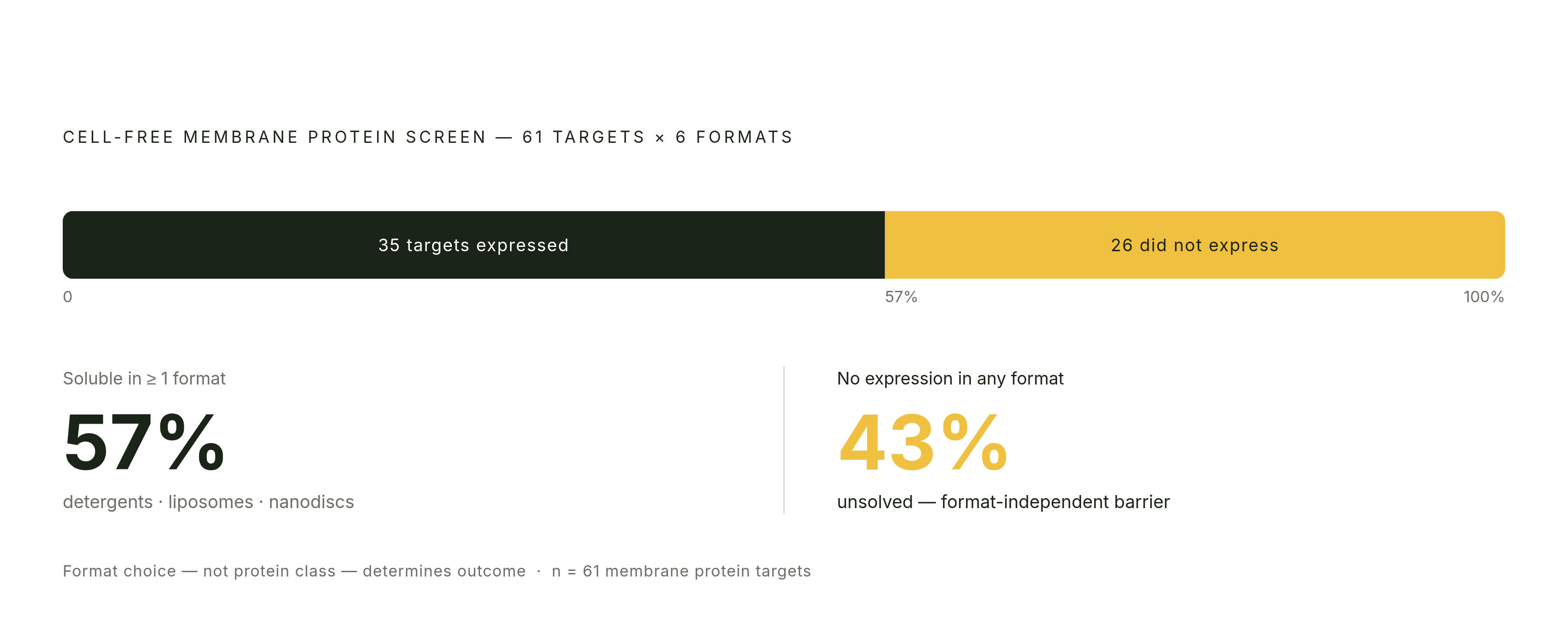
One benchmark experiment puts real numbers behind all this: a high-throughput cell-free screen tested 61 membrane protein targets across detergents, liposomes, and nanodiscs, and got soluble expression for 57% of them in at least one format. That result says something specific: the format matters more than the protein class. Testing several lipid environments side by side, without re-engineering a cell line for each one, is a throughput advantage that cell-based expression simply cannot match.
Choosing the right cell-free extract and platform for the membrane protein target at hand
Which extract to use isn't a minor detail. It decides what post-translational processing is even possible, what background proteins are floating around in the reaction, and how well the system tolerates the membrane-mimetic additive chosen for the target.
E. coli extracts give the highest yields in most head-to-head comparisons, cost the least, and are the best-characterized option out there. The tradeoff: no glycosylation, and disulfide bond formation needs redox-adjusted conditions or an engineered extract to work reliably. That makes E. coli extract a strong fit for bacterial membrane proteins, single-pass proteins, or eukaryotic targets that don't depend on glycosylation to function.
Wheat germ extract brings eukaryotic translation machinery to the table, which suits eukaryotic membrane proteins with more demanding folding needs, and it is generally regarded as a good fit for unstable targets. Rabbit reticulocyte lysate, also eukaryotic, supports signal recognition particle-mediated co-translational targeting, which matters directly for getting membrane insertion right.
Insect and human cell-free systems sit closest to the native environment for human membrane proteins, and they're the right call when eukaryotic post-translational modifications or a specific chaperone complement actually matter for the target. A range of hard-to-express proteins, including ion channels, integral membrane receptors, and GPCRs, have been produced successfully in CHO cell-free systems.
PURE systems are fully defined, with no competing background reactions muddying the results, which makes them the right tool when the goal is mechanistic clarity about folding or insertion rather than raw output. The tradeoff is yield: PURE systems involve greater complexity and cost to assemble, a real consideration when milligram quantities are the goal. Hybrid and microfluidic formats are also starting to show up, combining extract types or shrinking reaction volumes down for high-throughput topology and function screening.
The decision tree, in short: target class and required post-translational modifications narrow the extract choice first, and the downstream application, whether that's structural biology, a functional assay, or drug screening, decides which membrane-mimetic format gets paired with it.
High-throughput screening of membrane protein variants in cell-free systems
Cell-based workflows make every variant expensive in time. Each one needs its own transformation, selection round, culture, and induction cycle, and that loop runs on a scale of weeks per round, not days.
CFPS breaks that cycle open. It accepts PCR products directly as templates, so multiple variants can be expressed side by side straight from linear DNA, no cloning, no transformation. The 61-target study mentioned earlier is a working example of what that throughput looks like in practice: multiple membrane proteins screened across multiple lipid formats in one campaign, something that would have required a mountain of live-cell engineering to attempt any other way. Plate-based and automated liquid-handling formats fit CFPS reactions naturally, opening up parallel variant screening at a scale cell culture just can't match.
For GPCR variant work specifically, the cell-free approach turns what used to be a slow production process into a fast optimization loop: construct variants, fusion tags, truncations, loop swaps like the β2AR-T4L design mentioned above, can all be tested for expression and activity within hours of each other rather than days.
There's a diagnostic upside as well. Because the reaction is open, a failing variant can be traced to a specific stage, transcription, translation, solubility, or functional folding, rather than that failure getting buried inside the complexity of a living cell (Thornton et al., Protein Science, 2024, addresses failure-mode identification for protein designs broadly, across transcription, translation, solubility, and structure or function, though not framed specifically as per-variant diagnosis).
None of this works, though, if the reagent system is built for something other than automation and plate-format use from the start. It's a design requirement, not an afterthought. OpenCFPS™ from Sepia Biosciences is priced at $25 per mL, low enough that running a large variant library stops being a budget decision and just becomes part of the workflow.
What still requires careful planning: the genuine limitations of cell-free membrane protein expression
None of this makes CFPS a universal fix, and pretending otherwise does the field no favors.
Glycosylation is the sharpest limit. Prokaryotic CFPS systems can't do it at all, and eukaryotic systems only manage it to a limited degree, which is a genuine constraint for any membrane protein whose folding or ligand binding depends on N-linked or O-linked glycans. Scaling is a separate headache: CFPS shines at small-scale production and screening, but pushing a eukaryotic membrane protein to gram-scale output by cell-free methods is still technically hard and remains an active area of development, not a solved problem.
Getting a protein into a nanodisc also doesn't guarantee it landed in the right orientation. Confirming correct topology for a multi-pass protein still needs orthogonal methods, protease protection assays, functional reconstitution, EPR, HDX-MS, run alongside the expression itself. And on cost: energy components and amino acid supplementation make CFPS pricier per reaction than fermentation at large scale, so the economics favor it at the screening and small-batch stages, not necessarily at full manufacturing volume.
Picking the right additive is still mostly trial and error. Nobody can reliably predict ahead of time which detergent, which lipid mix, or which nanodisc scaffold will work best for a given target. The 57% success rate across formats in the 61-target study cuts both ways here: it means format scouting genuinely pays off, but it also means roughly 43% of targets didn't express successfully in any of the six formats tried, and per-format failure rates run well above that overall number. PURE systems carry their own tradeoff too: the mechanistic clarity is real, but it comes bundled with greater reagent complexity and cost, and that tradeoff needs weighing against what a defined background is actually worth for the experiment at hand.
None of these are dead ends. They're engineering problems being worked on right now, through hybrid extract systems and ongoing work on in vitro glycosylation,ols, and modular membrane platforms, and each one is narrowing steadily.
Where cell-free membrane protein expression is headed and how to apply it now
The direction of travel is toward closing exactly the gaps described above: better in vitro glycosylation, hybrid extracts that combine the yield of crude lysate with more of the control PURE systems offer, and membrane-mimetic platforms that need less trial and error to land on a working format. None of that requires waiting, though. The technique already outperforms cell-based expression for the two jobs that matter most at the discovery stage: screening variants fast, and getting a folded, functional protein for a target that would kill or cripple a host cell.
The practical move for a lab evaluating a difficult membrane protein target is straightforward: pick an extract based on the post-translational demands of the protein, test multiple membrane-mimetic formats rather than committing to one without data, and treat the topology and functional checks as mandatory steps, not optional ones. The folding environment the protein is placed in plays a critical role in whether expression succeeds, and for the first time, that environment is something a researcher can build on purpose instead of just hoping a cell provides it.
Sources
- Cell-Free Systems and Their Importance in the Study of Membrane Proteins - PubMed
- Cell-free systems for expression of transmembrane protein - PubMed
- Improving Cell-Free Expression of Model Membrane Proteins by Tuning Ribosome Cotranslational Membrane Association and Nascent Chain Aggregation | ACS Synthetic Biology | ACS Publications
- Membrane Augmented Cell-Free Systems: A New Frontier in Biotechnology | ACS Synthetic Biology | ACS Publications