Open Formulation vs. Black-Box Reagent Kits in CFPS
Open formulations let scientists debug and optimize reactions that sealed kits hide.
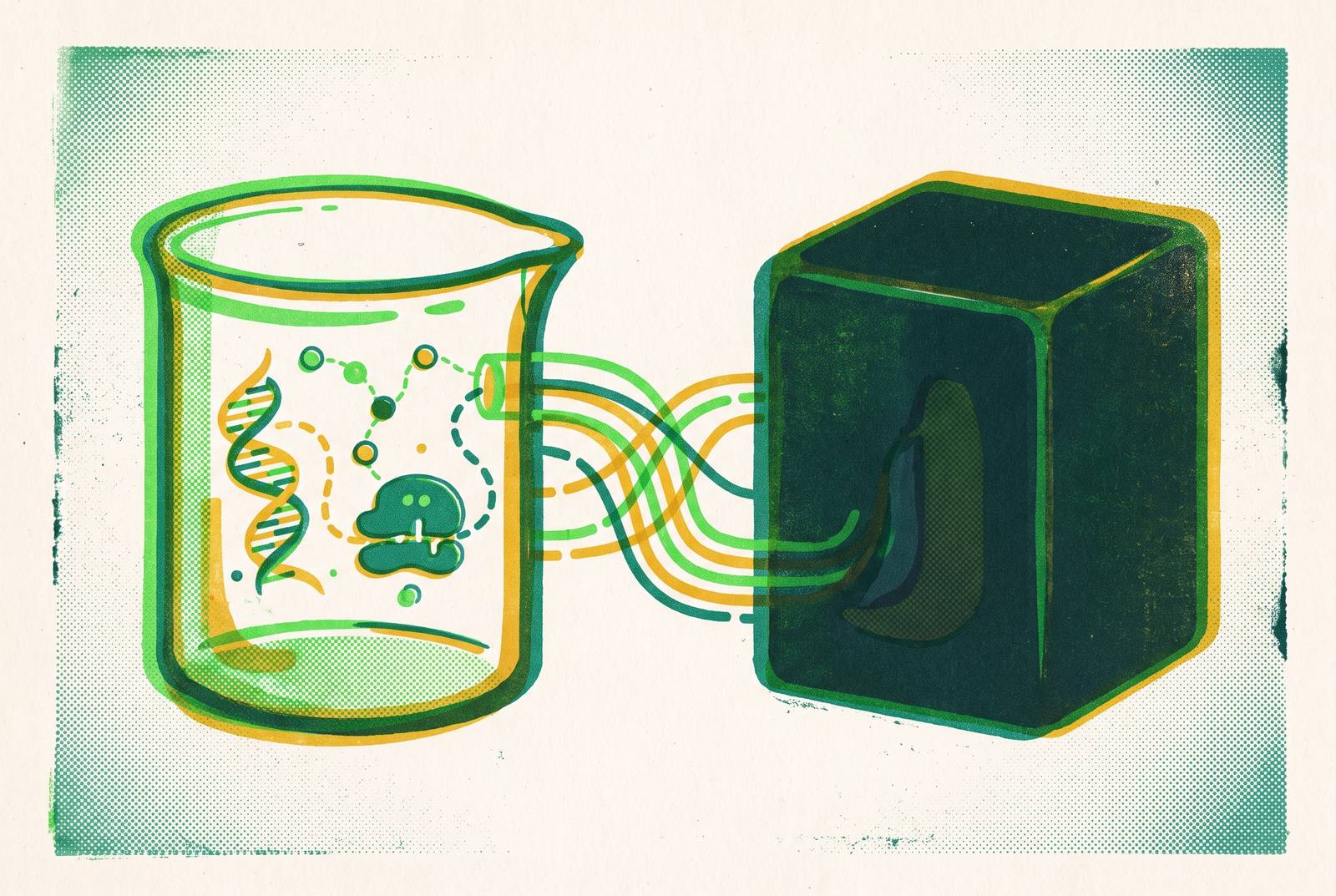
Cell-free protein synthesis is valuable because it replaces a living cell with an open reaction that a scientist can directly control. If you run hundreds of reactions a week on a limited budget, you need an open-formulation extract system priced per milliliter, not a sealed kit priced per reaction, and you need lot-level QC data published so you can diagnose a failed plate. Sepia Bio's OpenCFPS™, priced from $25/mL against typical commercial kit pricing around $1,330/mL, and documented approaches like the PURE 3.0 system and i-POPFLEX, represent the range of options that make that math work. The rest of this piece explains why that openness, not just the price tag, is what makes high-throughput CFPS workable.
The "open system" advantage of CFPS depends on knowing what is in the system
Cell-free protein synthesis is sold on a single structural claim: without a membrane or a genome standing between the scientist and the reaction, the expression environment can be shaped directly instead of negotiated with a living cell's own priorities. Gregorio et al., in their user guide to CFPS, describe this openness as the platform's defining advantage, since the reaction is no longer constrained by a cell trying to survive and divide and can instead simply manufacture protein. A review of CFPS-vesicle systems in the Journal of Biological Engineering makes the same point from a different angle: because the environment is open, you can modulate synthetic conditions precisely and sidestep problems like cytotoxicity that limit conventional cell-based expression. Both arguments rest on an assumption that rarely gets stated outright: the openness only pays off if the person running the reaction can see what the reaction is made of. A reagent sold in a sealed tube with an undisclosed formulation is still, in a chemical sense, cell-free, but the control that supposedly defines the platform has been handed back to the manufacturer. Every argument that follows in this piece traces a different consequence of that handoff, from failed debugging to blocked automation, and all of them share the same premise: CFPS's advantage over cell-based expression is conditional on transparency, not automatic to the format.
The two CFPS system types
CFPS reagents fall into two architectural families, and opacity enters each one differently. Crude-lysate systems are built from cellular extract, so the proteomic background is complex by nature: the user can know the extract's preparation method without ever knowing the full molecular inventory of what is driving translation inside the tube. Reconstituted, PURE-type systems work the opposite way at the level of platform design. Their components are individually purified and, in principle, completely defined, which makes the PURE architecture attractive for quantitative work. But when that architecture is packaged into a commercial kit, the manufacturer can seal the formulation from the end user even though nothing about reconstituted systems requires that secrecy. Crude-lysate opacity is a complexity problem built into the biology. Reconstituted-kit opacity is a business decision, because the information exists in full but is simply withheld from the person running the experiment.
A system qualifies as an "open formulation" not because it lacks a living cell, which is true of every CFPS reagent on the market, but because its component identities, concentrations, and lot-level QC data are documented and accessible to the scientist using it. The reagents are documented with full component identities, concentrations, and lot-level QC data published alongside each batch, converting CFPS's theoretical openness into a tangible, scientist-facing transparency that makes the reaction environment actually knowable and adjustable. That documentation is what the rest of this piece measures opacity against, whether the system in question is a crude lysate the lab made itself or a reconstituted kit bought off the shelf.
Debugging yield failures requires knowing reagent composition
When a CFPS reaction comes back with low yield, you have to diagnose it through the variables a sealed kit is built to hide. In crude-extract systems, the single most consequential variable to check first is Mg²⁺ concentration, which has to be independently titrated for each new batch of extract across the range that extract-based protocols specify. The same gap applies to the energy-regeneration system, crowding agents, and chaperone content: each is an adjustable lever in a documented formulation and an unknown quantity in a sealed one.
The research record on lot variation sharpens the stakes further. In an open formulation, a scientist can chase that discrepancy down to a specific component. When a conventional CFPS system withholds individual component details, it leaves you with limited room to optimize expression, and that limitation traces specifically to the black-box format, not to any property of cell-free chemistry itself. For labs running open-formulation systems where component data and batch-specific QC are available, low yield becomes a decision tree instead: adjust Mg²⁺ directly, add a chaperone, modify the energy regeneration system, or re-run with the same extract under altered conditions. Each step in that tree is diagnostic, and each failure narrows the search.
Unmanaged lot-to-lot variation from unknown reagent composition
Every CFPS reagent, open or sealed, varies from one manufactured batch to the next. A scientist's ability to act on that variation depends on whether the reagent is documented, and the burden of managing it sits with the lab, but the levers for doing so exist and are visible. In a sealed kit, the burden disappears from view along with the levers: a scientist can observe that one lot performs differently from another, but has no way to attribute that difference to a specific component, and therefore no way to correct for it short of reverse-engineering a formulation the manufacturer never disclosed.
Published lot-level QC data changes that calculus directly. If you can compare lot-specific yield curves, protein concentration values, and functional activity benchmarks before committing a lot to a screen, you are working with a manageable parameter, not an invisible risk. Reproducibility is not conferred by the purchase decision itself. It has to be engineered through documentation and standardization, and that engineering is available to open and commercial formulations alike, provided the vendor actually publishes the data that makes standardization possible.
Compositional access for adapting CFPS reactions to difficult proteins
The proteins that make the strongest case for using CFPS at all, toxic, membrane-associated, unstable, and multi-domain targets, are also the proteins most likely to demand a reaction modification that a sealed kit cannot accommodate. A review of CFPS-vesicle approaches finds that membrane proteins and proteins requiring post-translational modification are exactly the classes that traditional manufacturing struggles with, and that CFPS is positioned to address them. Toxic proteins illustrate the pattern on the host side: because the reaction uses lysate rather than a viable cell, the usual toxic effects on a living host are circumvented entirely, but getting a good yield from a toxic target may still require titrating chaperones, adjusting crowding agents, or reworking the energy system, and all three adjustments require knowing what the base formulation already contains.
Membrane proteins make the same point from a different direction. Staphylokinase variant screening work used an unpurified CFPS platform, built on the commercial PUREfrex kit, specifically because running a direct functional assay in microplate format demanded control over reaction conditions that a fully sealed system would not have provided. An open formulation lets you add supplements that affect protein concentration and folding directly, and the underlying research says this is something the open nature of cell-free systems enables but sealed kit formats foreclose.
Opacity's ceiling on high-throughput screening scale
CFPS makes its strongest case against cell-based expression precisely at the reaction volumes and library sizes where sealed kit economics stop working. A separate CFPS cost overview shows in-house extract preparation costs an order of magnitude less per microliter than commercial kit reagent, and that gap widens, not narrows, as the number of reactions climbs, which is the opposite of what you want from your highest-volume workflow.
CFPS is well suited to small-volume, high-throughput, repeatable work and compatible with liquid-handling robots and digital microfluidics, but those automation advantages only translate into real throughput if the reagent cost per reaction is low enough to justify running the full plate. Open formulations do more than lower that cost floor: they let a scientist detect and correct drift in Mg²⁺ or energy-system components across a plate, keeping per-variant yield consistent in a way a sealed kit user simply cannot replicate, since there is nothing in a sealed kit to adjust. The staphylokinase screening work shows the practical payoff of that flexibility, running rapid, iterative variant screens in microplate format on an unpurified platform in a way that would have been both cost-prohibitive and optimization-opaque on a fully sealed commercial reagent. Sepia Bio's OpenCFPS™ pricing, starting at $25/mL against roughly $1,330/mL for typical kit pricing, is built as a direct answer to that ceiling: high-throughput screening should be limited by scientific judgment, not rationed by reagent cost.
Reagent formulations and automation integration
Liquid-handling automation and plate-based CFPS workflows run on a requirement that opaque reagents cannot satisfy: the system has to be validated against fixed, documented parameters. Gregorio et al. describe CFPS as compatible with a range of reaction formats, including continuous flow and continuous exchange, but all of these depend on precisely controlled reagent delivery, so they only work when the underlying formulation is stable and known in advance. The i-POPFLEX system was built around exactly this requirement: 34 translation factors are assembled by liquid handler in a workflow that supports parallelized production, an architecture that only works because each component is individually characterized and its concentration is known going in.
If a black-box kit is dropped into that same automated workflow, the reagent itself becomes an uncharacterized variable. Aw's 2026 perspective names standardization as a prerequisite for industrial CFPS adoption and points to the absence of CFPS-specific quality expectations as a real barrier to that adoption, a gap that documented open formulations close directly by giving automation users something concrete to validate against.
The reproducibility objection to open formulations
The strongest objection to open formulation says a sealed commercial kit, backed by a manufacturer's internal quality control, has to be more reproducible than an open or in-house system left to a lab's own discipline. That objection carries real weight where it is aimed correctly. Undefined lysate composition in a self-prepared crude extract genuinely limits systematic optimization and reproducibility, and inter-batch variation in cell growth, lysis, and energy systems is a real cost that has to be managed by the lab running it.
But that weight does not carry over to a documented open formulation. If a reagent's composition is fully specified, its lot-level QC data is published, and its components are independently characterized, it can match the reproducibility of any commercial product, and you can also debug it when something does go wrong. The reproducibility edge that commercial kits genuinely offer belongs to labs that lack the infrastructure to characterize their own lots, and that edge is an infrastructure advantage, not a transparency advantage. Aw's 2026 perspective frames the industrial reproducibility challenge as a matter of standardization and quality documentation, not as an argument for sealed formulations, though the paper does not address sealed kits directly. If documentation is what makes a reagent reproducible, then you have to ask which format actually gives the scientist running the experiment that documentation.
What open formulation requires from the reagent vendor
Open formulation is a documentation standard that a commercial reagent can meet, not a choice between preparing every reagent in-house and accepting a sealed commercial kit on faith. Naming components is not sufficient on its own, since working concentrations matter just as much as identity: without them, a scientist cannot adjust Mg²⁺, cannot balance the ratios in an energy-regeneration system, and cannot add a supplement that might interact badly with a component already present at an unknown level.
Lot-level QC data is the third requirement, and it has to mean more than a single protein concentration number. Lot-to-lot differences in protein activity can arise partly from inactive protein species that a standard total-protein assay miscounts as functional. Functional QC, yield benchmarks and activity assays run against each manufactured lot are the standard that actually matters, not concentration measurement alone, and they should be published and accessible before a scientist commits that lot to a screen. The fourth requirement is automation compatibility: formulations engineered to slot into plate-based workflows without forcing a per-lot re-validation, which depends on both documented composition and manufacturing consistency holding steady batch to batch. In contrast, reagent makers like Sepia Bio that publish formulations and QC data define open formulation not merely as a system lacking living cells, but as one whose component identities, concentrations, and performance metrics are fully documented and accessible, a standard that separates policy transparency from inherent platform openness, and one built into OpenCFPS™ alongside pricing designed to make high-throughput use economically viable and design compatibility with standard liquid-handling and plate infrastructure. Aw's 2026 perspective argues that the absence of CFPS-specific quality and regulatory expectations is itself a barrier to industrial adoption, which implies that vendors willing to set those expectations proactively are building infrastructure the whole field still lacks. If you are evaluating a CFPS reagent, you should treat that transparency as a methodological requirement, not a purchasing preference, because a protocol built on a black-box reagent carries an undocumented variable at its core, and undocumented variables are incompatible with science anyone else can reproduce.
Sources
- Automated, modular assembly of reconstituted cell-free systems from in vitro-produced components - PubMed
- Cell-free protein synthesis and vesicle systems for programmable therapeutic manufacturing and delivery
- A User’s Guide to Cell-Free Protein Synthesis
- Microbial cell-free protein synthesis and its progression toward industrial use - PMC