Scaling Cell-Free Protein Synthesis to Hundreds of Reactions Without Breaking the Budget
Miniaturization and automation slash the cost of screening hundreds of protein variants.
Running cell-free protein synthesis at plate scale is an engineering problem, not a wish list. The biology behind CFPS is already built for parallel work. Reaction time is not what stands in the way: a CFPS reaction finishes in minutes to hours, and even with extract preparation included, the whole process takes one to two days, against one to two weeks for in vivo expression. The bottleneck is economic. Reagent costs run upward of $4,000 per liter of cell-free expression, and when you model the technique's costs, reagents make up roughly three-quarters of the total. Commercial reconstituted kits price this out concretely: screening a modest enzyme variant library at nanoliter reaction volumes can run close to a thousand dollars in reagents alone, before any automation costs enter the picture. Lot-to-lot variability in crude lysates makes the spending worse, because inconsistent output forces repeat runs, and each repeat multiplies reagent cost in a way that's hard to budget around in advance. None of these problems are mysterious, and none require a biology breakthrough to solve. Reaction miniaturization, plate-based formats, automation compatibility, and reagent cost discipline each address a distinct failure mode, and running them together is what turns large-scale CFPS from a cost liability into a routine line item.
CFPS makes running hundreds of reactions worth attempting
The reason hundreds of CFPS reactions are worth running at all comes down to what cell-based expression cannot do. Toxic proteins, proteins that need non-canonical amino acids, and unstable targets all break cell-based workflows in specific, well-documented ways, and CFPS sidesteps each one. When living cells make a toxic protein, it typically ends up in inclusion bodies, so you have to solubilize and refold it afterward, and that sharply cuts the active fraction you get out the other end. CFPS removes the cell-viability constraint outright, since there is no cell to kill. Researchers demonstrated this directly using eukaryotic cell-free systems built from CHO and Spodoptera frugiperda (Sf21) cells to synthesize AB5 toxins, including cholera toxin (Ctx) and heat-labile enterotoxin (LT), confirming correct multimeric structure formation by autoradiography through rounds of iterative optimization that would have been impossible to run in living cells.
Non-canonical amino acid incorporation runs into a different wall in living systems: poor cellular uptake of the modified amino acid and toxicity from the target protein both get in the way of genetic code expansion. CFPS lets you control every component in the reaction tube, so it gets around both problems at once. Unstable proteins face a third kind of failure in cell-based production: the standard grow-collect-lyse sequence gives a labile protein time to degrade before it's ever harvested. CFPS skips that sequence.
The clearest case for scale sits with proteins that carry post-translational modifications. Using human MEK1 as a model, researchers obtained 1 mg of phosphorylated MEK1 from just 2 mL of a CFPS reaction mixture, a yield that dramatically outpaced equivalent in vivo pSer incorporation systems. That kind of output from a small reaction volume is the argument for running CFPS at scale in concrete terms. The open reaction environment behind all of this lets researchers add enhancers, chaperones, and non-natural compounds directly into the tube, and use PCR products without cloning or transformation, a flexibility that is especially valuable for proteins, toxic, unstable, or multi-domain, where cell-based production either fails outright or demands expensive downstream refolding. High-throughput screening of target-binding proteins for drug discovery, diagnostics, and industrial enzyme engineering needs this kind of scale, because you need hundreds of reactions at a minimum to cover meaningful sequence space.
Reaction miniaturization and plate-based formats in large variant library screening
Shrinking reaction volume and moving to standard plates are the first two moves that make the rest of a scaled CFPS workflow possible. If you cut reaction volume from microliter to nanoliter scale, reagent consumption drops in roughly the same proportion, but you can't shrink the volume past what a detection system can still read. Fluorescence plate readers in 384-well formats have become standard for this reason, and autonomous lab work has shown you can run end-to-end CFPS optimization entirely in 384-well plates. Standard plate formats matter for a second reason beyond volume: a 96-well or 384-well plate slots directly into a lab's existing plate readers, liquid handlers, and incubators, with no custom hardware required. That compatibility with conventional lab equipment is a deliberate design choice, one that keeps infrastructure costs and reagent costs under control at the same time, rather than trading one for the other.
Beyond the plate, droplet microfluidics pushes miniaturization further still. Cell-free riboswitches have been screened using fluorescence-activated droplet sorting, a method that selects from large sequence-space libraries at volumes well below what a plate format can reach. PL-display technology, developed by a research team at iCONM, shows what that kind of throughput can do in practice: magnetic beads, each carrying a single cell-free-synthesized peptide, get sorted one at a time by FACS, achieving sharp concentration in a single sorting step and isolating target peptides from a library of roughly 1.7 million random sequences across two rounds of selection, a level of throughput and specificity that cell-based display methods cannot reach.
Linear DNA compatibility multiplies the practical value of plate-format screening on top of all this. PCR products can go straight into a reaction with no cloning step, so you can compress the design-build-test cycle enough to test hundreds of constructs in a single week, and ALiCE data spanning 0.1 to 100 mL, a 1,000-fold range, shows no yield loss across that range, so a system validated at microliter screening scale can produce milligram quantities in the same reaction format without re-optimizing anything.
What automation contributes beyond speed
Automation's biggest contribution to scaled CFPS is reproducibility: when you remove manual liquid handling, you cut out the variability that makes crude-lysate batch effects worse, and that opens the door to real iterative design-build-test cycles across thousands of reactions. The i-POPFLEX system, built at Pohang University of Science and Technology, shows this applies to reagent preparation and not only to screening: 34 translation factors and a split T7 RNA polymerase, each synthesized individually in vitro, get assembled using automated liquid handling, which removes manual input from the assembly stage, cuts pipetting error, and produces a complete, ready-to-use system within two days.
Given access to a computer, a web browser, and relevant published papers, the system took three rounds of experimentation to set a new state-of-the-art in low-cost CFPS, with the full autonomous run spanning six rounds in total. It achieved a meaningful cut in protein production cost and a real gain in reagent cost efficiency, including new reaction compositions built to hold up better under the conditions common in autonomous labs. Across the full run, the system executed more than 36,000 CFPS reactions across 580 automated 384-well plates. What matters about that case isn't the reaction count by itself. Iterative optimization at that scale is a different mode of experimentation entirely: it finds reaction compositions a human researcher would never think to test by hand, instead of just running the same human-designed experiment faster.
You don't need to build a fully autonomous lab for this to pay off. For a lab running plate-format CFPS with a human still setting up each run, automation earns its keep first in two places: liquid handling for plate setup, where consistent reagent dispensing across hundreds of wells removes the dominant source of well-to-well noise, and plate-reader data capture, which swaps out gel-based readout for continuous fluorescence monitoring across every well at once. High-speed screening built on robotics and magnetic bead platforms is already an established direction for ultra-high-throughput target-binding discovery in drug development and industrial enzyme engineering. None of it works, though, unless the reagents themselves are built for it. For automation to slot into an existing workflow, CFPS reagents need to be compatible with standard liquid handlers, common incubators, and standard plate formats, a requirement designed into the reagent system itself from the start.
Reagent cost and lot-level reproducibility as a single problem
High reagent costs and unpredictable lot-to-lot variability are two sides of one failure, not two separate problems. Variability forces repeat runs, and each repeat multiplies reagent spend, while an opaque, undefined formulation blocks the kind of troubleshooting that would bring both problems down at once. Crude lysate systems are undefined by design, which limits reproducibility in a specific way: when a lot's performance shifts, there's no way to isolate which variable changed, so systematic optimization becomes guesswork and repeat runs turn into a routine line item. Manual strain engineering and purification for each lysate component add to the problem, since that work stays labor-intensive, slow, and exposed to batch variability, all factors that limit the reliability a biofoundry-scale operation needs. Supply availability for complex reagents like purified tRNA compounds the issue further, since manufacturer-side variability introduces a source of lot-to-lot inconsistency that sits entirely outside a lab's control.
The economic consequence runs straight through to the budget line: commercial reconstituted kit pricing makes large-library screening prohibitively expensive, and reagent spend scales linearly with reaction count unless volume pricing and formulation transparency get built into the supply relationship from the start. Techno-economic modeling from Imperial College London found that CHO-based CFPS needs substantial yield increases before it can match conventional CHO manufacturing economics, a result that shows eukaryotic systems carry a steeper version of this same cost problem when the target is a glycoprotein that needs authentic post-translational modifications.
The fix is transparency. When formulations are documented, researchers can see what they're running, trace variability back to its source, and standardize protocols across lots, tying cost control and reproducibility together as part of the core QC data. OpenCFPS™ also supports plasmid DNA, linear DNA, and low DNA working concentrations, and works with standard plates, automation systems, and standard incubators, making it a system built for the plate-format and automation workflows described above.
Structuring a scaled CFPS workflow: sequencing the levers for a real experiment
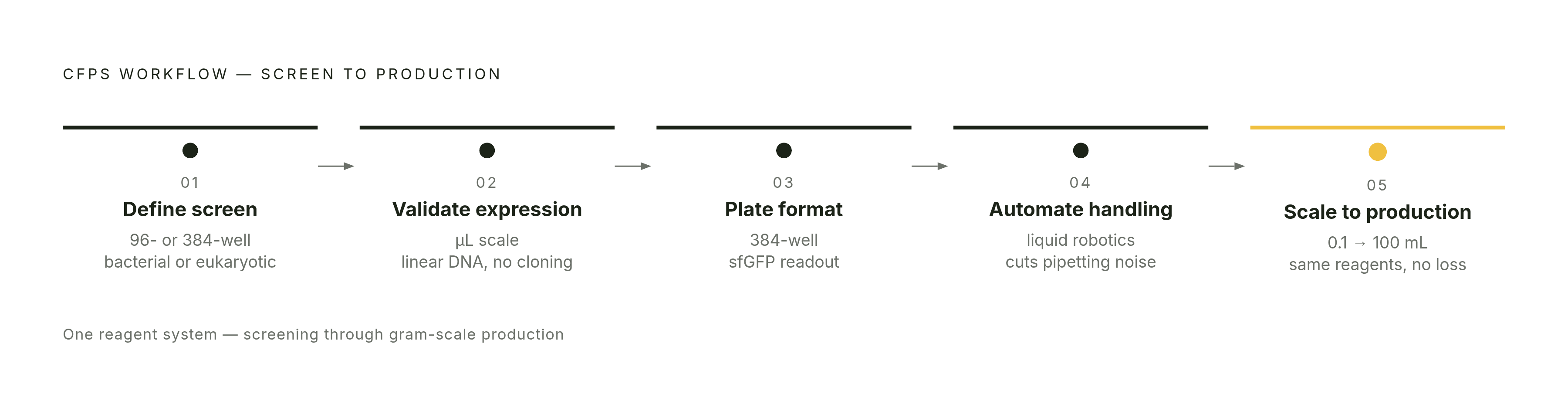
The four levers, miniaturization, plate format, automation, and reagent discipline, don't operate in parallel. Miniaturization and plate formatting set the automation compatibility and reagent consumption rate, and together these decide whether the whole plan is financially workable at the intended scale.
The first step is defining the screen size and protein class before picking a format. The number of variants in the library and the protein's expression difficulty, toxic, unstable, needing a non-canonical amino acid, or carrying a post-translational modification, set whether a 96-well or 384-well plate is the right starting point, and whether the extract needs to be bacterial or eukaryotic.
The second step is validating expression at microliter scale using linear DNA. PCR products go directly into the reaction, so construct testing can happen without a cloning step. That's where the design-build-test cycle is cheapest and fastest, and also where reagent lot consistency starts to matter, since a bad lot at this stage wastes design iteration time that's hard to recover later.
The third step moves the work into plate format with fluorescence readout. If you pair a 384-well plate with a fluorescence plate reader, you get end-to-end screening data without gel-based readout, and if you add sfGFP fusion or a co-expressed reporter, you get real-time yield monitoring across every well at once.
The fourth step introduces liquid handling automation. Even a basic liquid handler cuts pipetting variability across hundreds of wells, and that variability is the dominant source of noise in plate-format CFPS before automation enters the picture. Lot-level QC data on the reagent becomes critical at this point, since automation amplifies reagent variability on top of adding throughput.
The fifth step scales winning variants up to milligram-level production using the same reagent system. ALiCE scalability data spans 0.1 to 100 mL, a 1,000-fold range with no yield loss, so a system validated at microliter screening scale can produce milligram quantities in the same reaction format without needing to re-optimize anything. OpenCFPS™ kit sizes are built around that same logic, running from small volumes suited to light screening and kit testing, through intermediate sizes for heavier screening or light milligram-scale work, up to large and bulk volumes for automated screening and gram-scale production, letting a team step up in volume within one system rather than switching reagents or re-validating a protocol at each stage.
Throughout all five steps, the reagent choice matters as much as the step sequence: a reagent with documented formulation and lot-level QC data allows root-cause analysis when a plate fails. This sequence holds regardless of whether the project is enzyme variant screening, antibody fragment expression, toxic protein characterization, or non-canonical amino acid incorporation, since the plate-format and automation logic doesn't depend on protein class. The extract choice, bacterial versus eukaryotic, is the one decision in the sequence that does.
The cost ceiling once all four levers are engaged
Once miniaturization, plate formatting, automation, and reagent transparency are all running together, the cost per reaction falls to a level where hundreds of reactions become an ordinary budget line. The GPT-5 autonomous lab result makes that case most clearly: across more than 36,000 reactions and 580 automated plates, the system found reaction compositions that cut protein production cost meaningfully and improved reagent cost efficiency, showing that iterative automated optimization at scale lands on a lower cost floor than any single fixed protocol can reach on its own.
At entry pricing for a documented, lot-QC'd reagent system, individual reactions cost cents in reagents, and a full 384-well plate runs under a hundred dollars in reagents, a cost structure that makes plate-scale screening a routine experiment rather than something that needs a special budget request. What's left to manage at that point is labor, cut by automation, DNA preparation, cut by linear DNA compatibility, and detection, already covered in most labs by plate readers already on hand. None of those three scale linearly with reaction count the way reagent cost does on its own, which is what makes the overall economics work at volume.
The honest boundary sits with eukaryotic systems, which still cost more per reaction than bacterial ones. For glycoprotein targets that need authentic post-translational modifications, the cost gap against conventional CHO manufacturing hasn't closed yet, and that remains the edge of where the full solution stack performs best today. Budget discipline in CFPS is about spending predictably: documented formulations and lot-level QC data turn reagent cost from a variable into a constant, and that predictability is what makes a scaling plan something a budget can actually defend.
Sources
- Cell-free protein synthesis and vesicle systems for programmable therapeutic manufacturing and delivery - PMC
- High-Throughput Regulatory Part Prototyping and Analysis by Cell-Free Protein Synthesis and Droplet Microfluidics
- High-throughput screening of cell-free riboswitches by fluorescence-activated droplet sorting