Isotopic Labeling of Proteins for NMR Using Cell-Free Systems
Cell-free protein synthesis enables precise isotope labeling without metabolic interference.

An NMR spectrum is only as good as the isotope labels placed into the protein that produced it. Dilution, scrambling, and cross-incorporation each degrade resolution and complicate assignment, and all three originate at the labeling stage. Dilution of labeled amino acids by endogenous pools weakens signal where it should be sharp. Metabolic enzymes that interconvert amino acid classes can scramble the label, putting it where it doesn't belong. Incomplete incorporation during expression leaves gaps in coverage that no amount of pulse sequence cleverness can fill after the fact. Every downstream choice in this piece, uniform labeling, selective labeling, methyl-specific labeling, exists to manage these three failure modes, and the platform that manages them with the least compromise is the one worth building a workflow around.
How Cell-Based Expression Systems Introduce Labeling Errors
Cell-based expression systems fail at labeling because living cells are built to resist the kind of compositional control that clean isotope labeling needs. A living cell maintains a large endogenous amino acid pool as a matter of basic physiology, and that pool dilutes any labeled precursor added from outside, regardless of how carefully the experiment is designed. The same cell runs enzymatic pathways that interconvert amino acids continuously, because that interconversion is part of normal metabolism, not an experimental artifact to be tuned out.
The enzymes most responsible for this are pyridoxal-phosphate (PLP)-dependent aminotransferases, which redistribute isotope labels across entire amino acid families through transamination. Selective labeling of a single amino acid type is further undercut by the instability of labeled precursors once they enter the cell and by the host's own biosynthetic machinery, which keeps manufacturing unlabeled versions of the target amino acid from other carbon sources in the medium.
Toxic or growth-inhibiting target proteins compound the problem. None of this reflects a fixable flaw in cell-based technique. It reflects what a living cell is for: homeostasis, not compliance with an isotope labeling protocol.
Why CFPS gives researchers direct, programmable control over what isotopes end up where
Cell-free protein synthesis replaces the living cell with a crude lysate, retaining ribosomes, tRNAs, and the rest of the translation machinery while discarding intact cellular membranes and the metabolic homeostasis that drives amino acid interconversion. Removing the membrane removes the boundary that used to separate the researcher's reagents from the cell's own regulatory instincts. There is no growth to sustain, no viability threshold to protect, and no competing biosynthetic pathway quietly manufacturing an unlabeled version of the amino acid a researcher just paid to label.
That absence of cellular upkeep hands researchers direct compositional control over the amino acid pool supplied to the reaction. A fully defined amino acid mixture can specify which residues carry isotope label and which don't, and the label pattern that ends up in the finished protein reflects that input directly rather than whatever compromise cellular metabolism would otherwise negotiate. Cell-free protein synthesis reagents like Sepia Bio's OpenCFPS™ line are engineered precisely to enable this kind of compositional control: researchers define the amino acid pool down to the isotope label, and the label pattern in the product reflects that input directly, unfiltered by cellular metabolism.
That control starts with the lysate itself. But removing the cell's membrane does not remove every trace of the cell's chemistry. Even a crude lysate retains a measure of enzymatic activity from its parent cell, and that residual activity is where the next source of labeling error comes from.
Suppressing Residual Scrambling in Cell-Free Lysates
E. coli S30 lysates carry far less metabolic activity than an intact, growing cell, but they are not metabolically inert. The cofactor-dependent enzymes responsible for scrambling in living cells survive the lysate preparation process in functional form, and they continue to cause measurable scrambling of selectively supplied isotope labels inside the cell-free reaction. The labeling advantage of CFPS over cell-based expression depends on suppressing residual lysate activity, and treating that advantage as automatic is where selective labeling experiments go wrong.
Transamination raises the risk hardest for amino acids that participate in it, aspartate, glutamate, and alanine among them, where label can redistribute to structurally related residues and generate cross-peaks that muddy spectral assignment exactly where resolution matters most. A validated fix exists: treating E. coli S30 extracts with a reducing agent irreversibly inactivates the cofactor-dependent enzymes while preserving the extract's protein synthesis activity, and the reduced extract stores the same way a conventional S30 extract does. It is a simple, inexpensive treatment that removes the scrambling pathway at its enzymatic source.
A second, complementary approach addresses the dilution side of the problem by altering the S30 extract preparation protocol to minimize endogenous amino acid content before the reaction ever starts. Residual scrambling in E. coli lysates can be quantified and mitigated through protocol optimization, and affordable, high-throughput cell-free systems make it practical to screen suppression strategies, testing inhibitor concentrations targeting the responsible cofactor, lysate formulations, or reaction conditions, across dozens of labeling variants without the cost barriers that would make such screening prohibitive in cell-based expression.
Three Labeling Schemes CFPS Supports
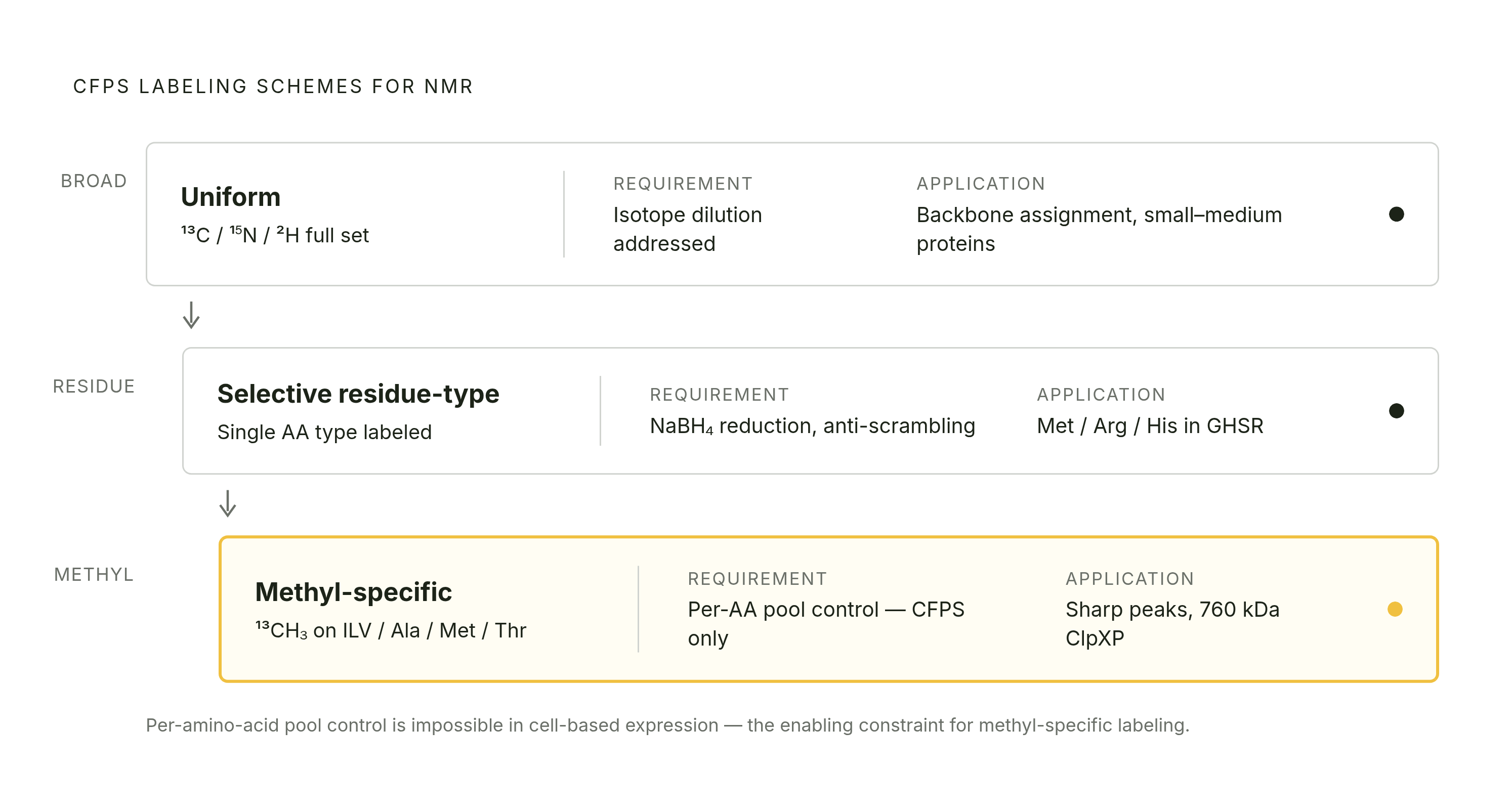
CFPS supports three distinct labeling designs, each built for a different class of NMR problem.
Uniform labeling (¹³C, ¹⁵N, or ²H/¹³C/¹⁵N) is achieved by supplying a complete set of labeled amino acids, and it's the most straightforward scheme to implement in CFPS because the main concern is isotope dilution from endogenous pools, addressed with depleted lysates or supplemented extracts. Deuteration for larger proteins works the same way: deuterated amino acids combined with a deuterated energy mix suppress unwanted proton backgrounds, and CFPS sidesteps the growth impairment that deuterated media routinely cause in cell-based hosts. This scheme fits backbone assignment of small-to-medium proteins.
Selective residue-type labeling supplies only the target amino acid type or types in labeled form, and NaBH₄ reduction of the lysate becomes critical here, since scrambling to other residue types would undo the point of selecting a single type. The approach has already delivered structural detail unavailable by other means: labeling methionines, arginines, and histidines in the growth hormone secretagogue receptor (GHSR) made it possible to characterize transmembrane domains, loops, and the C-terminus by solid-state NMR. Verifying labeling specificity by mass spectrometry before committing to NMR data collection is the step that catches this before instrument time is wasted on a compromised sample.
Methyl-specific labeling (¹³CH₃) targets methyl-bearing residues, isoleucine, leucine, valine, alanine, methionine, and threonine, for high-sensitivity detection in large assemblies, since these groups produce sharp peaks even in complexes that tumble slowly in solution. CFPS makes this possible by letting each amino acid in the reaction pool be controlled independently, a constraint that cell-based systems cannot satisfy because ILV biosynthesis in a living cell cannot be cleanly separated from the rest of its metabolism.
How CFPS Solved the ClpXP Labeling Problem
The ClpXP proteolytic machine, a 760 kDa, 26-subunit assembly, marks the point where cell-based NMR sample preparation runs out of road. ClpX is unstable and poorly soluble when expressed on its own, and that instability prevented production of a ¹³CH₃ methyl-labeled ClpXP complex, closing off solution NMR investigation of the intact machine.
Audibert, Vermot, Trauchessec, Giandoreggio, Boisbouvier, and colleagues solved it with a sequential in vitro multi-step CFPS protocol built specifically to exploit the open-system architecture of cell-free synthesis. A stable subunit, ClpP, was introduced directly into the synthesis reaction for the unstable component, ClpX, allowing the full complex to assemble with methyl groups labeled on either ClpP or ClpX independently of the other. Labeling one subunit while leaving the other unlabeled is a capability that exists only in a cell-free system: in cell-based co-expression, both subunits draw from the same intracellular amino acid pool, so independent control of that kind is structurally impossible.
The results justified the approach. ¹³CH₃-labeling of alanine and methionine, applied separately to the ClpX and ClpP subunits, produced high-quality 2D solution NMR spectra. The ClpP₁₄ complex, itself a 300 kDa assembly, yielded an average of 2.7 mg/mL of cell-free reaction mixture, a quantity sufficient for NMR sample preparation at that molecular weight. The ClpXP case generalizes beyond this one machine: whenever instability or toxicity makes cell-based co-expression impractical, the open-system design of CFPS becomes the technology that makes the experiment possible.
Applying the same open-system logic to membrane proteins and intrinsically disordered proteins
The open-system logic that resolved ClpXP applies just as directly to membrane proteins and intrinsically disordered proteins (IDPs), two classes that cell-based expression handles poorly for reasons specific to each but resolvable by the same underlying mechanism: direct control over the reaction environment.
Membrane proteins benefit from detergents, lipids, or nanodiscs added straight into the CFPS reaction to support cotranslational solubilization, an option that doesn't exist in a living cell, where membrane insertion is governed entirely by the host's own machinery. Membrane protein yields in CFPS can also be improved by adjusting detergent concentration in the reaction, an iterative optimization that only an open system permits.
Intrinsically disordered proteins present a different failure mode in cell-based expression, where their lack of stable tertiary structure often leads to degradation or aggregation before they can be purified. CFPS has already been applied to small IDPs for NMR spectroscopy, and the absence of cellular proteases combined with the controlled redox environment of a cell-free reaction reduces degradation of these unstable polypeptides during synthesis itself. Uniform ¹⁵N or ¹³C/¹⁵N labeling remains the typical NMR strategy for IDPs, and CFPS delivers it without the growth burden that heavy isotope media impose on cell-based hosts. Across both protein classes, the enabling factor is the same one that solved ClpXP: control over the reaction environment that a living cell simply does not grant.
Designing a CFPS-Based NMR Labeling Workflow
A sound CFPS NMR labeling workflow treats lysate preparation, amino acid pool composition, reaction format, and analytical verification as four independent variables, each optimized on its own terms before any large-scale sample production begins.
Lysate selection comes first. E. coli S30 extracts offer the highest protein yields and the most validated track record for NMR labeling protocols, though selective labeling applications require NaBH₄ reduction or a modified preparation to control scrambling. Wheat germ extracts suit eukaryotic proteins that need eukaryotic chaperones or post-translational context, and the standard approach starts with a small-scale 50 μL in vitro sequential transcription/translation trial to check expression level and solubility before scaling up, a scouting model that maps directly onto NMR sample optimization. Whichever lysate is chosen, minimizing endogenous amino acid content in the preparation directly improves labeling efficiency and spectral quality, since every endogenous amino acid left in the lysate is one more molecule competing with the labeled input.
Amino acid pool design follows from the labeling scheme. Methyl labeling calls for ¹³CH₃-labeled precursors, directly labeled amino acids for alanine and methionine, α-keto acid precursors for ILV, supplied against a deuterated background whose deuteration level should also be confirmed by MS.
Reaction format and scale matter because NMR sample preparation typically needs only low-milligram quantities of pure, labeled protein, and modern CFPS yields, with well-expressing proteins reaching roughly 2 mg/mL, make that achievable at the milliliter scale for many targets without resorting to continuous-exchange setups. OpenCFPS™ from Sepia Biosciences is one E. coli-based platform suited to this stage of the workflow, built on fully documented formulations and lot-level QC data that matter directly to NMR labeling work, where reagent consistency between an early scouting run and a later preparative run has to be verifiable. It is compatible with plasmid and linear DNA and with plate-based and automated formats, which supports the small-to-large scale progression an NMR labeling workflow typically follows.
Verification closes the loop before any spectrometer time gets booked. SDS-PAGE and A280 confirm yield and purity, and NMR samples demand high purity because even minor contaminants can generate overlapping peaks. For large assemblies, size-exclusion chromatography or diffusion-ordered NMR spectroscopy (DOSY) confirms oligomeric state and sample homogeneity before committing to full data collection.
Where CFPS Still Falls Short
CFPS for NMR labeling carries three genuine limitations: batch-to-batch variability in lysate activity, the cost of isotopically labeled amino acids, which CFPS has no mechanism to reduce, and the inability of standard E. coli lysates to install the mammalian post-translational modifications that shape protein structure and shift NMR peak positions.
Reproducibility has long been the central objection to CFPS, because consistency is hard to achieve even between members of the same lab, let alone across separate research groups: lysate preparation involves many steps, and small variations in them accumulate into large ones. Recent development has narrowed this gap directly: optimized, minimally complex formulations built from systematic reagent screening have shown robustness across batches of cell lysates, across users, across locations, and across the synthesis of more than 20 different proteins, weakening the reproducibility objection for researchers willing to work with standardized lysates. Lot-level QC data from reagent suppliers gives researchers the documentation needed to compare a scouting run against a preparative run directly, a safeguard that matters in NMR workflows where sample consistency isn't negotiable.
The cost of labeled amino acids sits outside what CFPS can solve. Small-scale scouting reactions and efficient lysate preparation that minimizes the volume needed before scale-up help contain the expense, as does reaction engineering aimed at maximizing yield per volume of labeled amino acid supplied.
Post-translational modification remains the clearest structural gap. For a protein whose NMR-relevant conformation depends on a PTM, cell-based expression may still be the better choice, or the CFPS reaction can be supplemented with purified modifying enzymes at the cost of added complexity. Taken together, improved reproducibility from standardized reagents and documented formulations closes two of the three limitations that once defined CFPS's ceiling, leaving the cost of labeled amino acids as the one constraint that remains intrinsic to the method itself.
Sources
- Subunit-specific isotope labelling of heteromeric complexes using cell-free protein expression: application to the 760 kDa ClpXP molecular machine - PubMed
- Cell-Free Protein Synthesis of Small Intrinsically Disordered Proteins for NMR Spectroscopy - PubMed
- Cell-free protein production and labeling protocol for NMR-based structural proteomics
- Protein labeling strategies for liquid-state NMR spectroscopy using cell-free synthesis - ScienceDirect
- Efficient production of isotopically labeled proteins by cell-free synthesis: A practical protocol