Cell-Free Synthesis of Proteins for SPR and ITC Characterization
Cell-free synthesis accelerates protein screening for binding studies without weeks of cell culture.

The bottleneck in SPR and ITC characterization has almost nothing to do with the instrument. The struggle is upstream: getting enough correctly folded, sufficiently pure protein into the machine. If you need label-free, real-time measurement of how two molecules bind, you reach for surface plasmon resonance. Isothermal titration calorimetry is the only method that returns all four thermodynamic parameters, enthalpy, entropy, binding constant, and stoichiometry, from a single titration, without labels, across a wide range of binding strengths. Both techniques demand protein that is correctly folded and functionally active, not simply present in a tube, and both are routinely starved of exactly that by the way most labs still make protein.
Cell-based expression introduces failure modes that corrupt the biophysics before a sample ever reaches the sensor chip or the calorimeter cell. Proteins misfold into insoluble aggregates inside bacterial or mammalian cells. Host proteases chew on the product during expression. Some targets are so toxic to the host that yield collapses before purification can even start. Add to that the one to two weeks it typically takes to go from a cloned sequence to purified material, and a researcher running an SPR kinetics screen or an ITC titration series is often waiting weeks for protein that may not even fold correctly when it arrives.
How cell-free protein synthesis bypasses the constraints that cell-based expression imposes
Cell-free protein synthesis, or CFPS, removes cell viability from the equation. A living cell asked to overproduce a protein it finds toxic, destabilizing, or metabolically expensive will resist, slow down, or die. A cell-free reaction cannot do any of that, because there's no cell left alive to protect. The transcription and translation machinery comes from lysed cells, extracted and purified to varying degrees, and the reaction itself runs in an open system where pH, temperature, and substrate concentration can all be adjusted directly and in real time. That alone changes what kinds of proteins are reachable at all, not just how fast they're reachable.
The open architecture also changes the timeline, in a way that matters for high-throughput work. PCR products can serve directly as expression templates, so you skip cloning and transformation entirely, and the DNA-to-protein timeline collapses from one to two weeks down to two to six hours. You can run multiple constructs in parallel wells without separate cloning steps for each one, so a plate of a hundred variants costs roughly the same setup time as a plate of one.
Two system architectures serve different purposes. Crude lysate-based systems, built from E. coli, CHO, wheat germ, or insect cell extracts, retain the endogenous chaperones and folding factors that complex proteins often need to fold correctly. Defined PURE systems strip the reaction down to reconstituted components only, so you trade some folding support for full reagent transparency and a cleaner background, but you pay a higher cost per reaction. Sepia Bio's OpenCFPS platform, built on an E. coli lysate architecture, documents its formulations down to the genome and buffer level, aiming at the specific trade-off between reaction speed, protein quality, and cost per milligram that high-throughput variant screening depends on.
CFPS has one real limit: complex mammalian glycosylation is the one area where cell-based systems still hold a clear advantage. CHO and HEK293 cells carry out full Golgi processing that no cell-free system fully reproduces, so researchers who need precise, native glycan structures have to weigh that gap against everything CFPS offers in speed and flexibility. For the large share of SPR and ITC targets that don't hinge on glycosylation, the trade mostly favors moving the work cell-free.
Coupling CFPS directly to SPR: screening from crude lysate without purification
Modern SPR capture chemistry has made purification optional at the screening stage. CFPS crude supernatant can go straight onto the sensor chip. You immobilize anti-His tag antibodies or Protein A on the sensor surface as capture molecules. Tagged binders made in the CFPS reaction get pulled selectively out of the crude lysate, the background of the cell-free extract washes away, and only then does the target antigen get introduced for the actual kinetic measurement. No chromatography column, no concentration step, no delay between synthesis and data.
Stech and colleagues demonstrated what this looks like with difficult formats: full-length IgG and scFv-Fc antibodies expressed in a microsome-containing CHO-based cell-free system, then run directly through SPR. The data confirmed conformational integrity and specific, concentration-dependent binding affinity, which matters because it shows that even complex, multi-domain antibody formats synthesized outside a cell produce SPR data that looks and behaves like the real thing.
The throughput case from the same body of work is concrete. A study pairing an optimized CFPS platform with Biacore SPR technology screened 200 distinct VHH variants, with synthesis finished in three hours and SPR screening of the full set of 200 completed within a matter of hours after that. Eleven positive binders came out of that screen, and you could go from sequence to ranked hits inside a single working day. That's one documented run, not a guaranteed outcome for every target, but it shows what the ceiling looks like when the workflow runs cleanly.
That speed matters because the bottleneck in protein discovery has moved. AI generative models can now design hundreds or thousands of candidate binders in minutes, and the slow part of the pipeline is no longer the design step. It's validating which of those candidates actually bind. Coupling CFPS to SPR directly from crude lysate closes that gap, letting empirical ranking catch up to computational design without reinserting weeks of cell culture and column purification between the two.
ITC Requirements for CFPS-Derived Material
ITC sits downstream of SPR screening precisely because it asks for more. It consumes protein in the low-milligram range per run, it needs material that is both pure and fully active, and its stoichiometry readout exposes partially misfolded or inactive protein in a way that total-protein assays simply miss.
The reason ITC is stricter comes down to what it measures. ITC reads the heat released or absorbed during binding directly, so any inactive or misfolded fraction in the sample dilutes that signal and distorts the apparent stoichiometry, often producing a binding ratio, n, that comes out below 1 even when the active protein itself binds correctly at a 1:1 ratio. That makes the stoichiometry value from an ITC run function as an activity check on the preparation, not only as a reported parameter. If stoichiometry deviates from what you expect, that's a direct signal of a protein quality problem, and a simple total-protein concentration assay would miss it and report the protein as perfectly good. Because ITC consumes milligram quantities per run, and a titration series multiplies that several times over, scale-up has to happen before the experiment can even begin.
CFPS doesn't eliminate the purification step that feeds ITC. It improves what arrives at that step. If a protein aggregates, degrades, or simply fails to express in sufficient quantity in living cells because the host finds it toxic, a cell-free reaction can often produce it solubly, giving you material worth purifying. The workflow that follows from this logic runs in two stages: CFPS triage by SPR straight from crude lysate first, then purification of only the confirmed hits up to milligram scale for ITC. Staphylokinase variant work by Tomková and colleagues, published in FEBS Open Bio in 2026, states this two-stage logic directly: CFPS offers an effective, simple, and fast platform for screening protein variant activity, but classical protein production and purification are still required to characterize the top hits with precision.
Concentration accuracy adds another layer to this. Harvey and colleagues, researchers from Bristol-Myers Squibb, reported in Analytical Chemistry that lot-to-lot differences in protein activity often trace back to traditional total-protein assays, because those assays count inactive protein species alongside active ones and so misrepresent concentration. Switching to calibration-free concentration analysis by SPR cut immunoassay lot-to-lot coefficients of variation by more than 600% compared to total protein measurement. That finding applies just as directly to CFPS-derived batches heading into ITC: knowing the active concentration, not just the total protein concentration, is what makes the thermodynamic numbers that come out of the calorimeter mean something.
Challenging protein targets that cell-based expression fails and CFPS can handle
The protein classes most often sent to SPR or ITC, membrane receptors, enzyme variants, designed binders with unusual properties, are frequently the same classes that cell-based expression handles worst. CFPS doesn't just make these targets faster to produce. It often makes them producible.
Toxic proteins and overactive enzymes are the clearest case. Antimicrobial peptides, pore-forming proteins, and proteases with high catalytic activity tend to harm or kill the host cell before they accumulate to useful levels, so a bacterial or yeast culture asked to overexpress them simply fails. A cell-free reaction has no living host to protect, so expression proceeds regardless of what the product would do to a cell if it were still alive.
Membrane proteins present a different kind of difficulty, and CFPS addresses it differently. Liposomes or nanodiscs can be added directly into the cell-free reaction, supporting co-translational insertion of the membrane protein as it's made, something standard fermentation has no equivalent for. This isn't a complete fix for every membrane protein: multi-pass transmembrane proteins need precise, well-timed insertion mechanisms that in vitro systems still replicate imperfectly, and results vary by target. But for many single-pass or simpler multi-pass proteins, the approach works well enough that you get SPR-ready material where cell-based expression would have left you with inclusion bodies.
Multi-domain proteins and antibody fragments round out the picture. Extract-based CFPS systems can express dozens of distinct constructs in a single day, a pace that cell-based expression can't match when each construct needs its own culture. scFvs and VHH nanobodies are now produced cell-free routinely, at yields that support direct SPR screening, and the Stech work on full-length IgG shows the same holds for larger, more structurally demanding antibody formats.
High-throughput variant screening workflows: how CFPS, SPR, and ITC fit together in practice
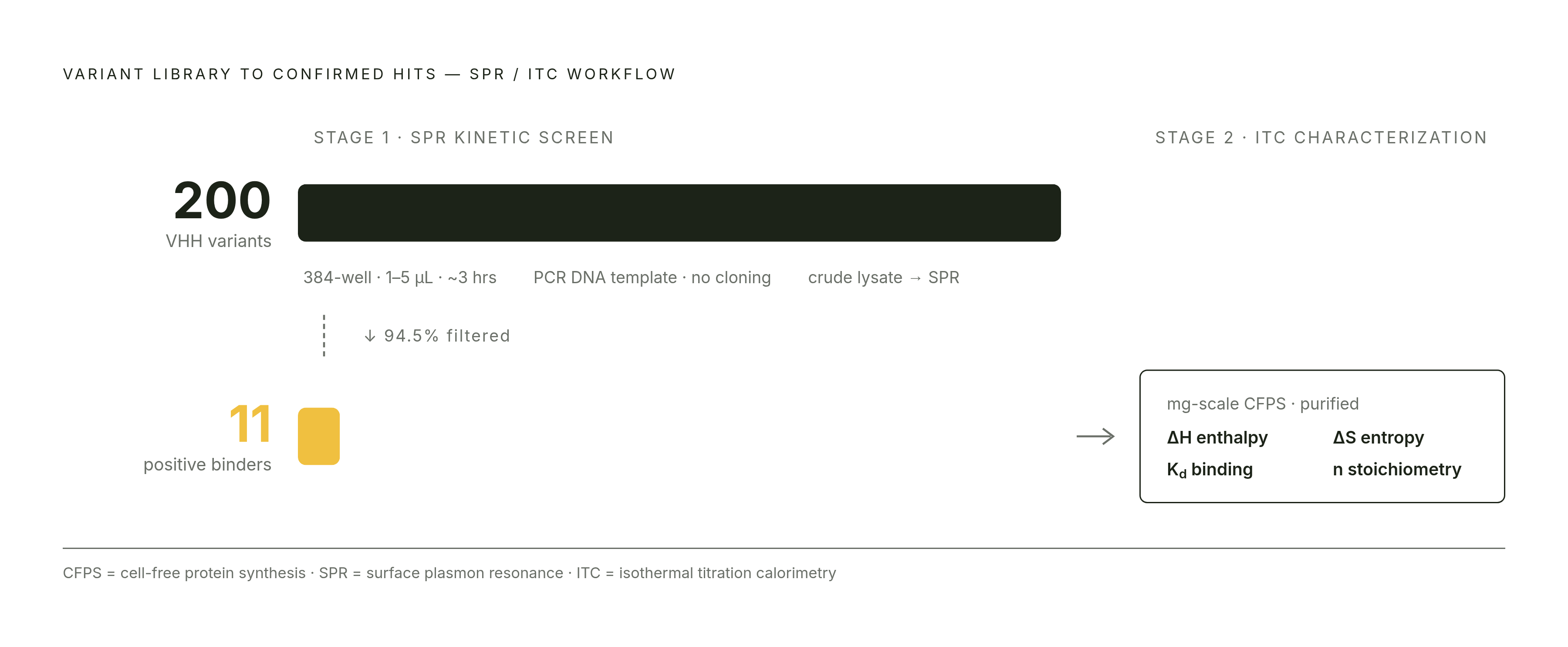
The practical shape of a modern screening campaign is a two-stage funnel: CFPS run in plate format to triage many variants by SPR, followed by milligram-scale CFPS production of the handful of confirmed hits for ITC thermodynamic profiling.
Stage one runs small and fast. CFPS reactions scale down to 1 to 5 microliters in 384-well plates, so you can express hundreds of constructs in a single afternoon if you have standard robotic liquid handling. You can take linear DNA straight from PCR into these reactions with no cloning step, so the pipeline stays compatible with a workflow that designs and tests new sequences daily. A 2025 study in ACS Synthetic Biology, by Thornton, Boyle, Laohakunakorn, and Regan, put this into practice by screening 138 protease variants in CFPS, each one produced and screened in six hours total, with dozens run simultaneously in the same plate. That screen identified an enzyme variant with improved kinetic properties, a direct result pulled out of a plate-based pipeline, not a serial, one-at-a-time expression campaign.
Stage two scales up only what stage one confirms. You can scale the same CFPS reagent chemistry used for screening up to milligram volumes for the selected hits, and you don't need to re-optimize the reaction itself. Purification of that CFPS-derived material still follows standard chromatographic methods. The advantage appears in volume: far fewer constructs reach the purification bench, and the ones that do have already been confirmed to bind by SPR before anyone spends a purification run on them. ITC then delivers the full thermodynamic picture, enthalpy, entropy, binding constant, and stoichiometry, on material that's already been shown to work.
Reagent platforms built for direct integration with automation and plate-based liquid handling make this funnel practical at scale, because documented, transparent reagent chemistry lets you aliquot the same crude extract that feeds one SPR kinetics run across hundreds of binding variants in parallel. That turns what used to be a bottleneck, waiting on cell culture for every single variant, into a throughput multiplier instead.
The field is pushing this miniaturization further still. The PUREdrop platform, described on bioRxiv in 2026, automates this down to a microfluidic level, encapsulating and expressing protein libraries across thousands of picolitre-sized synthetic cells per construct, sorted into a 96-well plate and read by time-lapse imaging, pointing toward screening stages smaller and faster than plate-based CFPS already is.
Reagent Reproducibility and Trust in CFPS-Derived SPR and ITC Data
Extract variability is the strongest objection raised against using CFPS for quantitative biophysics. A cell lysate is a complex mixture, and if the composition of that mixture shifts from batch to batch, the protein it produces can shift with it, undermining the SPR kinetics and the ITC thermodynamics that depend on consistent material. That objection is fair, and it's also increasingly answered by how CFPS reagents are now built and sold.
The fix is to treat lot-level quality control and documented formulation as a design requirement, not an afterthought. Reagent lines built for this purpose ship with certificates of analysis tied to specific lot numbers, so you get composition and QC release results for that batch, and not just a generic spec sheet. Sepia Bio's control DNA product, for instance, ships with a lot-specific certificate of analysis and an annotated GenBank sequence for the construct, letting you check the exact lot behind a given result when you're troubleshooting a screening run. That level of documentation, extended across both the extract and the control reagents used to validate it, is what turns extract-to-extract variation from an open question into a tracked, bounded variable.
Cost structure reinforces the same point about scale. Reagent pricing as low as $25 per milliliter, against typical kit pricing near $1,330 per milliliter, changes what a lab can afford to screen, and yields near 2 milligrams per milliliter for well-expressing proteins mean that scale-up to ITC-ready quantities doesn't require a separate expression system once a hit is confirmed. If reagents run in both modes, screening and milligram-scale production, with the same underlying chemistry, you don't need to re-validate a new expression system every time a project moves from the plate to the calorimeter. That continuity, documented composition, lot-level QC, and one reagent chemistry spanning both screening and scale, is what makes CFPS-derived SPR and ITC data something a reviewer or a regulator can trust.