Yield Benchmarking for Cell-Free vs. E. Coli Recombinant Expression
Cell-free synthesis outperforms E. coli cultures for toxic, membrane, and eukaryotic proteins.
A protein engineer picks an expression platform off a headline yield figure, commits weeks of bench time to it, and discovers partway through the project that the number came from a different protein class, a different scale, or a different throughput mode than the one actually in play. That mismatch costs real time and real reagent spend, and it happens because yield is the outcome of an interaction between platform, protein target, reaction mode, and scale, and when any one of those variables goes unstated, the number attached to it stops being useful as a decision input. What matters is not which platform yields more, but which platform yields more for a given protein, at a given scale, inside a given workflow. That question has a structured answer, and the rest of this piece builds it out.
What generates protein in each platform and its yield ceiling
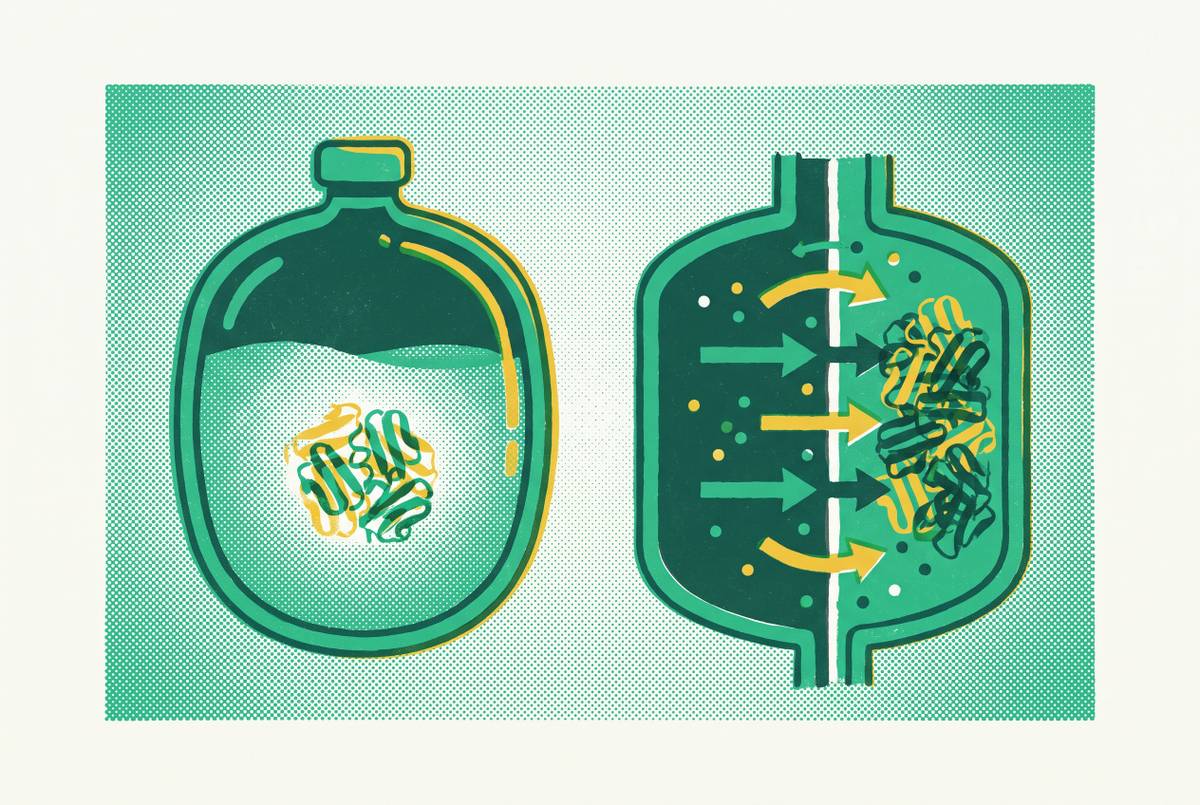
Cell-free protein synthesis (CFPS) and E. coli cell-based expression start from a different premise about what the cell is for. CFPS takes cell-derived lysate and supplements it with energy sources, amino acids, nucleotides, and a genetic template, and the cell that donated the lysate does not need to survive the reaction. E. coli cell-based expression keeps the cell alive throughout, and that single requirement sets limits on what can be made (a protein toxic to the host cannot be expressed at scale), how the reaction environment can be adjusted, and how fast a new construct moves from DNA to finished protein. Because CFPS runs in an open tube rather than inside a living cell, chaperones, lipid mimetics, redox conditions, and non-canonical amino acids can all be added directly to the reaction, something no living cell permits. The batch format is the method most labs reach for in both prokaryotic and eukaryotic CFPS systems, largely because it is fast and a full synthesis run can finish in hours rather than days. The part of the system that actually limits how much protein comes out is energy regeneration: ATP has to be supplied continuously, and the choice of energy substrate, whether a phosphorylated donor or a metabolic intermediate like 3-phosphoglycerate, sets both how long the reaction can keep running and how much inhibitory phosphate builds up before it stalls.
The actual yield landscape: what benchmarks across platforms show
No single number describes CFPS yield, because different chassis occupy genuinely different tiers. Among bacterial CFPS systems, a direct comparison of four chassis, E. coli, C. glutamicum, B. subtilis, and V. natriegens, found E. coli out in front by a wide margin, and that lead has been extended further by energy substrate optimization. 3-phosphoglycerate is now the best-characterized energy source for E. coli cell-free systems, and it supports yields well beyond what phosphorylated donors alone can sustain. Eukaryotic CFPS platforms sit in a different part of the map entirely: they trade raw yield for biological capabilities that bacterial systems lack, chiefly post-translational modification and better folding of complex eukaryotic proteins. P. pastoris CFPS, as characterized by Wu et al. (2026), yields only about 5% of what a comparable E. coli-based CFPS system produces, and the authors attribute the platform's limited adoption to the combination of low protein yield and high reagent cost. Insect cell-free systems run in the tens of micrograms per milliliter in standard configurations, improving with optimization but still well under E. coli CFPS output. Plant-based CFPS using tobacco BY-2 extract breaks that pattern: it reaches up to 3 mg/mL in batch mode, on par with optimized E. coli CFPS, while still supporting the folding of complex proteins and glycosylation that bacterial systems cannot perform.
E. coli cell-based expression is not a cell-free system at all, but it remains the benchmark CFPS gets measured against most often, and its yield depends heavily on whether the target protein is soluble, something you often cannot know until you have already tried expressing it. For a simple cytosolic protein with no post-translational modification requirement, E. coli CFPS and E. coli cell-based expression compete closely on yield. For a eukaryotic, membrane-associated, or toxic target, the comparison changes shape entirely, and the next two sections lay out exactly where and why.
Where E. coli cell-based expression systematically fails on yield and solubility
For a substantial class of proteins, a low E. coli cell-based yield figure understates the real problem: the binding constraint is not expression level but solubility, and an insoluble protein is not usable protein regardless of how much of it the cell made. When 62 full-length human kinases were expressed in E. coli at scale, most of them did express, but close to half of those expressed proteins came out insoluble or only partially soluble. So the nominal yield number for that experiment overstates usable protein by a wide margin for this entire protein class.
Toxic proteins fail for a different, more categorical reason: E. coli cell-based expression cannot reliably produce a protein that kills or disables its host, because the system depends on the host cell staying alive. CFPS removes that constraint entirely, and Jin et al. (2019) show what that removal makes possible with antimicrobial colicins. Colicin M showed poor solubility when produced in cells, but reached near-complete solubility, around 100%, in chaperone-enriched E. coli CFPS extract. Colicin E3's low cell-killing activity was addressed separately, by co-expressing its immunity protein inside the reaction, a rescue that has no equivalent inside a living cell that would be killed by the colicin itself.
Membrane proteins run into a related structural wall. Heterologous expression in E. coli often forces membrane proteins into inclusion bodies, and the engineered strains sometimes used to work around this add cost and uncertainty without actually solving the folding problem underneath. Refolding from inclusion bodies is a real option, and some labs make it work. But it adds a significant round of downstream labor and cost, success varies by protein, and none of that changes the fact that CFPS folds the protein correctly at the point of synthesis rather than trying to repair misfolding afterward.
Where CFPS recaptures yield for the protein classes E. coli cell-based cannot handle
CFPS's advantage on these protein classes traces directly back to its open-reaction architecture: chaperones and lipid mimetics go into the tube directly, and there is no living host whose survival has to be managed. Membrane proteins show this clearly. A CFPS-based high-throughput screen applied to 61 eukaryotic membrane protein targets found that most of them could be expressed in the soluble fraction in at least one lipid mimetic condition, with detergents outperforming nanodiscs and liposomes, and the resulting protein complexes were functionally competent, forming complexes and binding substrate as expected.
Toxic antimicrobial proteins follow the same pattern. Jin et al. (2019) report that colicins M, Ia, E1, and E2 can all be synthesized in E. coli CFPS with high yield and good solubility, including colicin M reaching nearly 100% solubility through a chaperone-enriched extract, a result cell-based expression cannot match for this protein.
Vaccine antigens add a third example. Using E. coli-based CFPS, the major outer membrane protein (mMOMP) of Chlamydia spp. was produced in its native-like multimeric form in the presence of nanolipoproteins, at a yield around 1.5 mg/mL, a combination of yield and correct structural assembly that E. coli cell-based expression has struggled to deliver for this target.
The open reaction environment also pays off whenever the right folding condition for a protein isn't known in advance: a single plate-based CFPS experiment can test six different conditions in parallel, where cell-based expression would need six separate runs, each with its own strain modification, to cover the same ground.
Comparing throughput mode and scale across platforms
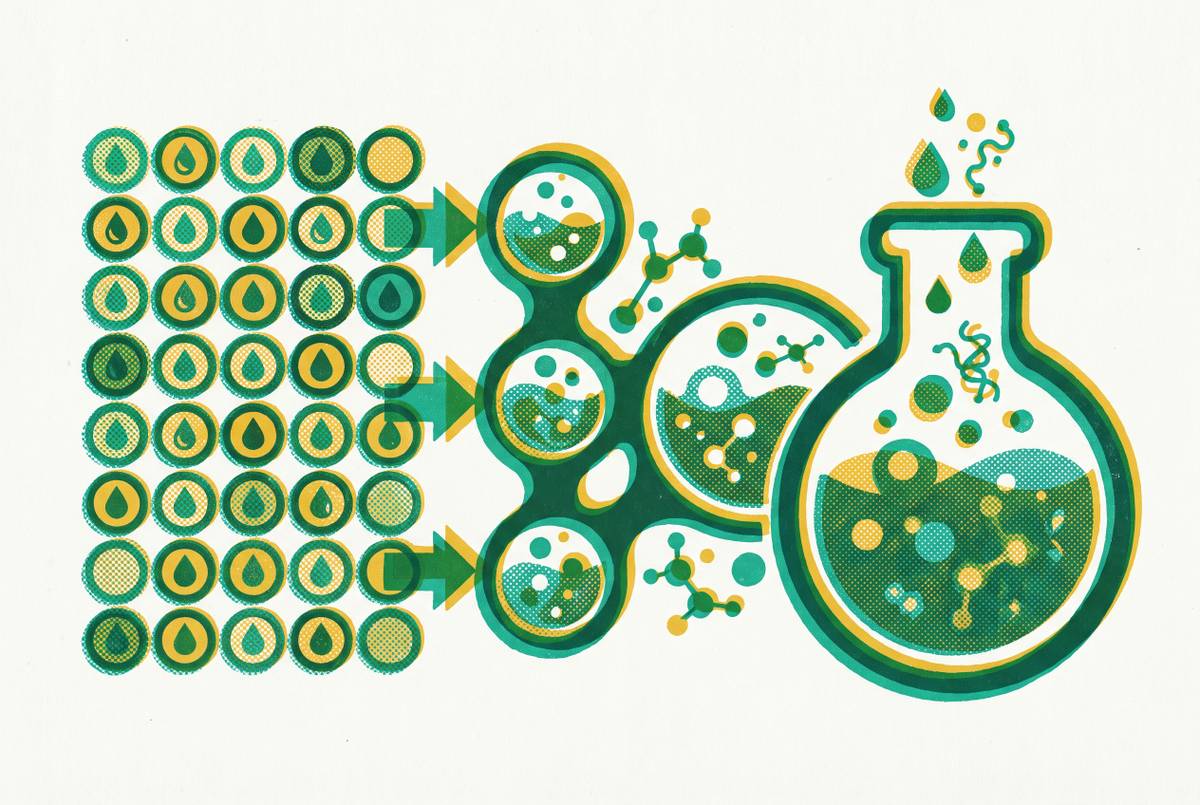
Yield-per-reaction and yield-per-unit-time point to different winners: it depends on whether the goal is screening many variants or accumulating milligrams of one protein for downstream assays. In screening mode, CFPS's edge is speed and parallelism. Because the system is an open reaction rather than a living culture, it miniaturizes naturally, and microfluidic and plate-based formats let a researcher run many proteins at once in reduced reaction volumes. A 2026 autonomous lab experiment shows what that throughput looks like at scale: thousands of distinct reaction compositions were tested across hundreds of 384-well plates, over six sequential rounds of optimization, a density of experimentation that cell-based expression cannot structurally match.
Production mode favors a different platform for a different reason. For a simple, soluble, cytosolic protein, E. coli cell-based expression regains competitive ground, since the marginal cost per milligram drops at scale when the protein expresses well, and fermentation infrastructure is already widely built out across the industry. CFPS, for its part, scales cleanly in many systems rather than losing efficiency as volume increases: tobacco BY-2 plant CFPS shows linear, lossless scale-up in batch mode, so the yield-per-mL measured at small scale holds as volume goes up. Cell-based expression does not always offer that same guarantee, because scale-up there runs into oxygen transfer and mixing constraints that a cell-free reaction never faces. The crossover between the two platforms depends on the protein class and on whether solubility is reliable.
Cost considerations before choosing a platform
If you are building a high-throughput protein production campaign, cost per milligram across both screening and production scale is the number that actually governs platform choice, and it has moved substantially in CFPS's favor over the past several years, though it still depends on protein class. Cost used to be CFPS's biggest practical weakness relative to E. coli cell-based expression, and that weakness had real consequences: older formulations such as PANOx-SP carried a cost per gram of protein that only made sense for small-scale or high-value work. That picture has shifted sharply. Recent techno-economic analysis documents a reduction in cost per gram of well over 90% relative to the PANOx-SP baseline, driven mainly by energy substrate optimization and simpler reaction formulations.
Nucleotide triphosphates and the ATP regeneration machinery built around them used to dominate the cost of older formulations, but switching to metabolic energy substrates in place of phosphorylated donors has largely fixed that. In optimized formulations, cell lysate and DNA template now make up most of the remaining reaction cost, so the next real cost frontier is lysate manufacturing economics, not buffer chemistry. Wu et al. (2026) take this on directly for P. pastoris CFPS, where low yield and high reagent cost have both limited adoption, and show that systematic reagent optimization can improve the economics even of a lower-yield eukaryotic system.
The cost comparison still depends on context. For a simple cytosolic protein that expresses well in E. coli, cell-based production at scale remains cost-competitive, and nothing about CFPS's recent cost gains changes that. CFPS's cost advantage is strongest when the alternative is a cell-based run that comes back insoluble, or one that requires several rounds of strain engineering before it works at all, because the cost of those failed cell-based attempts belongs in the comparison, not just the cost of the successful run. Because CFPS reactions are open systems, the energy substrate, chaperone supplementation, and reaction conditions can all be adjusted directly, and reagent suppliers focused on this space, Sepia Bio among them, have used that architectural flexibility to push E. coli cell-free yields upward through energy regeneration work that has no equivalent inside a living cell bound by viability constraints. Transparent, fully documented reagent formulations matter for the same reason: a researcher who knows what is in the reaction can identify which component is driving cost, swap it out, troubleshoot yield problems without waiting on vendor support, and keep performance consistent from lot to lot, all of which lowers the total cost of running a CFPS workflow rather than just the sticker price of the kit. E. coli CFPS systems built for high-throughput screening, where low reagent cost lets a lab run many variants in parallel and iterate quickly, now match or beat cell-based yields across a number of protein classes, particularly the difficult ones covered above, and that shift means the choice between platforms increasingly turns on throughput mode and total cost of ownership rather than a default assumption that cell-based expression wins on yield.
Reproducibility and lot-to-lot variation as a yield variable
A yield figure is only as trustworthy as the documentation behind it: the lysate source, the exact formulation, the reaction mode, and the identity of the protein target all have to travel with the number for it to mean anything in a different lab. Reaction-to-reaction and lot-to-lot variation in CFPS stems largely from variability in lysate preparation, since lysate is a biological product and batches differ in ribosome activity, metabolic enzyme levels, and residual nuclease content even when the source strain and protocol are identical. That variability is why detailed, lot-level quality control data matters as much as the headline yield number itself, and it is why suppliers in the CFPS space, Sepia Bio included, publish lot-level QC and fully documented formulations so a researcher can judge whether a published benchmark actually applies to the protein and workflow in front of them, rather than taking a single yield figure on faith. A benchmark run under one lysate batch, one energy substrate, and one reaction volume does not automatically predict performance under a different combination of the three, and the only way to know whether it does is to have the underlying conditions in hand. That is the standard a yield number has to clear before it belongs in a platform decision.
Sources
- Optimizing Pichia Pastoris Cell‐Free Protein Synthesis to Improve Economics - Wu - 2026 - Biotechnology and Bioengineering - Wiley Online Library
- Optimizing Cell-Free Protein Synthesis for Increased Yield and Activity of Colicins
- An AI-driven workflow for the accelerated optimization of cell-free protein synthesis - PMC
- Scaling eukaryotic cell‐free protein synthesis achieved with the versatile and high‐yielding tobacco BY‐2 cell lysate - Gupta - 2023 - Biotechnology and Bioengineering - Wiley Online Library