Cell-Free Expression for Antibody Fragment and Nanobody Production
Cell-free synthesis lets antibody fragments fold correctly outside bacterial cells.
What cell-free protein synthesis does differently for these formats
Antibody fragments and nanobodies tend to fail in bacterial cells for a specific, structural reason: the cytoplasm of E. coli can't fold them correctly, and the usual workarounds cost weeks. Cell-free protein synthesis sidesteps that problem by moving folding outside the cell entirely, into a tube where the conditions for correct disulfide bond formation get set directly, instead of negotiated with a living organism that has its own agenda. That's the argument this piece makes, and the data below backs it up format by format.
Start with what's actually in scope. An scFv links the variable heavy and light domains of an antibody with a short peptide, keeping the antigen-binding surface intact in a single chain. A Fab keeps the light chain paired with the heavy chain's first constant domain, giving a heavier but often more stable fragment. A nanobody, or VHH, is smaller still: the roughly 15 kDa variable domain of a camelid heavy-chain-only antibody, lacking a light chain partner.
Nanobodies draw attention out of proportion to their size, and the reasons hold up. They stay stable and soluble even at high concentration, and they're small enough to reach into cavity-like epitopes a full IgG can't touch. They lack a light chain partner, so there's no chain-pairing problem to solve going in. But size cuts both ways here. A protein that folds through disulfide bonds and depends on tight domain packing runs into trouble the moment you force it through a production system built for neither.
E. coli cytoplasm is exactly that system, and it's a bad match on chemical grounds. The cytoplasm is a reducing environment, and reducing environments work against disulfide bond formation rather than support it. Pushing a nanobody sequence through it usually produces misfolded protein clumping into insoluble inclusion bodies, sometimes disrupting normal host cell function. scFvs run into a related but separate problem: they are prone to aggregation, complicating production in bacterial systems. That's why so many bacterial scFv protocols lean on chaperone co-expression or a post-lysis refolding step just to recover something that still binds, and neither fix is fast, and neither is guaranteed to work.
CFPS runs transcription and translation as an open biochemical reaction outside a living cell. A DNA template goes in, protein comes out, and no cell-viability constraint sits in the middle to punish the reaction for making something toxic or slow to fold. The reaction needs two things: an extract or reconstituted system supplying ribosomes, tRNAs, and the transcription and translation enzymes, plus a substrate module supplying amino acids, nucleotides, cofactors, and an ATP/GTP regeneration system to keep energy flowing for as long as synthesis runs.
Redox state, ionic strength, pH, chaperone concentration: all of it can be adjusted directly in the tube, because there's no membrane and no growth requirement standing between the experimenter and the chemistry. Folding conditions stop being a fixed biological given and turn into a set of dials someone can actually reach.
For disulfide bonds specifically, that turns into a short list of concrete interventions. The redox environment can be shifted toward oxidizing conditions, favoring correct disulfide formation instead of the reduced state E. coli cytoplasm defaults to. Disulfide bond isomerases can be included to shuffle incorrectly paired bonds into the right configuration during synthesis rather than after the fact. Additional chaperones can be added where specific folding steps prove rate-limiting. Extracts derived from Origami B(DE3), which carry mutations in the trxB and gor genes, let disulfide bond formation happen in what would otherwise be a cytoplasmic-style lysate, and pretreating those extracts with iodoacetamide locks in the oxidizing redox state before synthesis even starts. None of it requires keeping a cell alive. It just requires controlling chemistry a living cell would otherwise regulate on its own clock.
Measured yields: what CFPS produces for scFvs, Fabs, and nanobodies
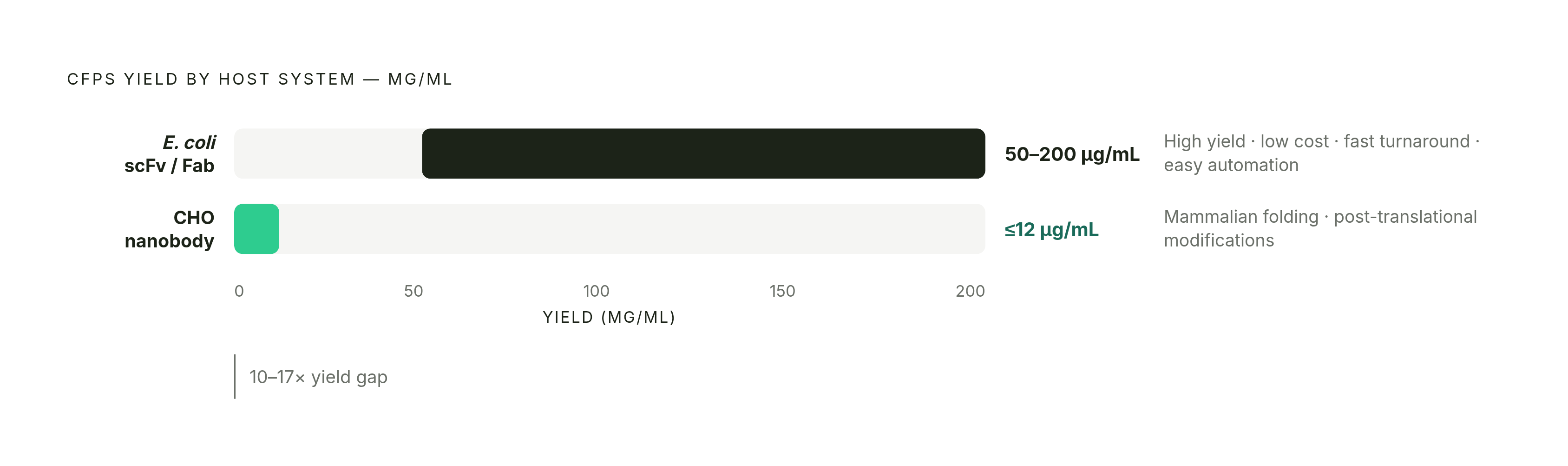
Yield is where skepticism about cell-free systems usually lands, and the number depends heavily on which host system did the work. E. coli-based CFPS produces scFv and Fab fragments in the range of 50 to 200 μg/mL. Nanobodies made in cell-free CHO systems come in lower, up to roughly 12 μg/mL, a meaningful gap relative to the E. coli range.
It looks worse than it is once you ask what the protein actually has to do next. A yield of 50 to 200 μg/mL is enough for ELISA, bio-layer interferometry, and fluorescence correlation spectroscopy after purification, and ELISA or BLI can often run directly on unpurified reaction output with no cleanup needed. The lower CHO-based number still clears the bar for a real assay: a 2022 paper in Frontiers in Bioengineering and Biotechnology from Fraunhofer IZI researchers Haueis, Stech, and Kubick showed that roughly 12 μg/mL was enough to run functional ELISA analysis straight out of the synthesis reaction, no purification step required.
A 2025 preprint from Lawrence Livermore researchers (Nikfarjam et al., bioRxiv) pushes the point further. The team produced scFvs and Fabs using E. coli CFPS and characterized their binding against the SARS-CoV-2 receptor-binding domain using fluorescence correlation spectroscopy. The output wasn't a yield number read off a gel. It was a binder with measurable, analyzable kinetics. Some of the scFvs came out misfolded and precipitated, and a downstream refolding protocol recovered active, binding-competent protein from that precipitate anyway. A messy first-pass yield doesn't have to end the story: the reaction can get rescued downstream instead of repeated from scratch.
High-throughput nanobody screening: how CFPS and binding measurement combine in practice
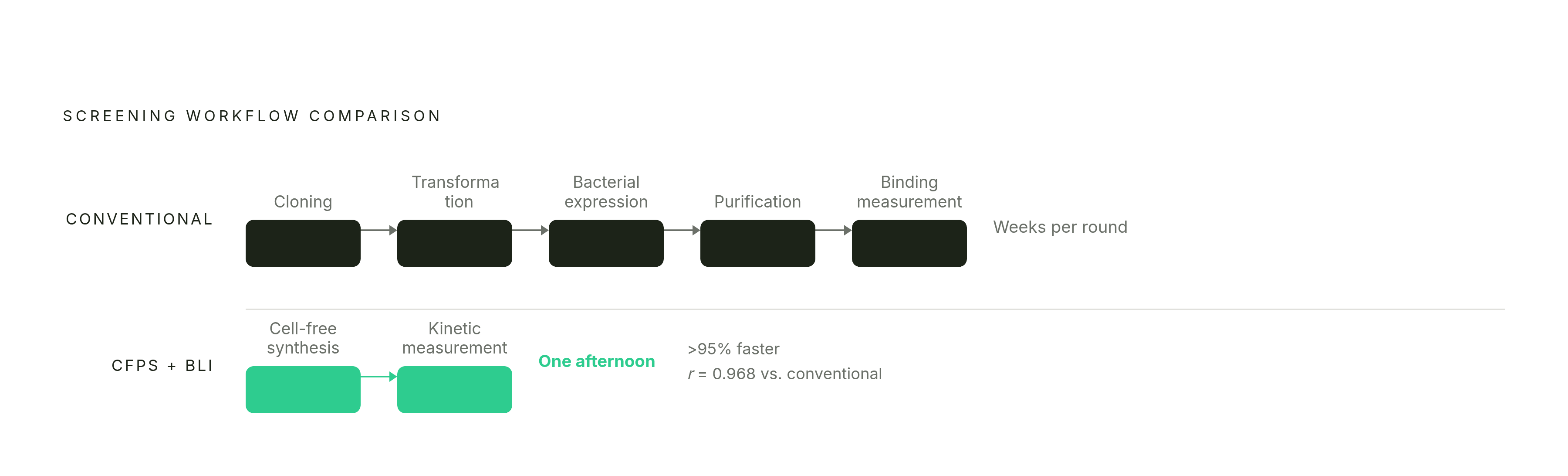
Conventional nanobody screening is slow in a specific, countable way. Every candidate needs cloning, transformation, bacterial expression, and purification before a single binding measurement can happen, and that sequence typically eats weeks per round. None of those steps run in parallel. Each one gates the next, one at a time.
Combining CFPS with bio-layer interferometry collapses that sequence into something closer to a single afternoon. One demonstrated workflow ran affinity evaluation on the anti-aflatoxin B1 nanobody G8 and a panel of its mutants, fusing each variant to GFP so nanobody concentration in raw lysate could get read off a fluorescent calibration curve, no purification needed before kinetic analysis. The results tracked conventional methods closely, with a Pearson correlation coefficient of 0.968 between the two approaches, while cutting processing time by more than 95%.
A second version of the same idea flips the binding orientation: the target protein sits immobilized on the biosensor surface instead of the nanobody, and the cell-free-expressed nanobody gets measured straight out of lysate. That inversion matters for multimeric targets that don't present well in the standard orientation. A fluorogenic HaloTag fusion for quantification also amplifies the BLI signal for a binder as small as a nanobody, where low molecular weight normally makes signal detection harder, and the resulting affinity measurements came out consistent with previously reported values. Further work has pushed throughput further still, chaining cell-free DNA template generation, CFPS, and binding measurement together to express and profile large panels of antibody fragments in compressed timeframes.
Automation and plate-based integration: running CFPS at library scale
CFPS reactions don't need custom hardware to scale. They run in standard microplate wells, get sealed, and incubate under ordinary conditions. The format was compatible with automation from the start, long before anyone thought to bolt machine learning onto the loop.
Acoustic liquid handling is where that compatibility turns into real throughput. A 2025 paper describes an AI-driven CFPS workflow that uses an Echo 650 acoustic dispenser to move nanoliter volumes of reaction components into 384-well plates, following instructions generated computationally instead of pipetted by hand. After two rounds of machine-learning-guided screening, the system generated 100,000 droplets in about four hours using roughly 25 μL of reagent, total. Yield from the E. coli CFPS system improved 1.9-fold, cost dropped 2.1-fold, and the approach held up across 12 different proteins spanning 27 to 370 kDa.
For nanobody screening specifically, shrinking the reaction volume does two things at once: it stretches expensive reagent further, and it lets hundreds or thousands of variants run in parallel instead of one after another. Microfluidic integration adds a further layer on top of that, enabling additional miniaturization and parallel processing of synthesis reactions.
Reagent variability is the practical ceiling on CFPS reproducibility
None of this works if the reagents don't behave consistently, and the evidence says that's exactly where CFPS is weakest. A 2019 interlaboratory study in ACS Synthetic Biology found a coefficient of variation of 40.3% when different labs prepared their own materials and exchanged them pairwise. A single operator, using one set of materials across multiple days, saw a coefficient of variation of just 7.64%.
That's roughly a five-fold gap, and it points straight at where the noise comes from. Extract chemistry itself isn't the weak link. Reagent preparation varies from lab to lab and batch to batch, and that variance appears downstream as noise nobody can trace back to its source. Fixing it means standardizing what goes into the tube before the reaction starts, not reformulating the extract system itself.
For nanobody and antibody fragment work, that distinction has teeth. Variation in redox buffer concentration, in chaperone lot, or in the components driving ATP regeneration feeds directly into disulfide bond formation and folding efficiency: the exact chemistry deciding whether a given variant reads as a hit or gets thrown out as a false negative. A screening result is only as trustworthy as the reagent batch sitting behind it.
That's the case for lot-level QC documentation. When a reagent system ships with batch-level quality control data attached, a lab running a 384-well screen can trace plate-to-plate variation back to an actual experimental variable, instead of shrugging at an unspecified reagent inconsistency. That traceability turns a screening result into something a lab can act on, rather than a data point that needs a re-run before anyone trusts it.
When to use CFPS for antibody fragments and nanobodies
CFPS earns its place when the constraint is time or parallelism, not final protein quality. Screen a large nanobody or scFv library against a 3 to 5 day animal cell transfection cycle, and what should be parallel work turns into a serial bottleneck instead. That mismatch alone justifies moving to cell-free for the screening phase. The same logic holds when the target protein is toxic, unstable, or chewed up fast by intracellular proteases, conditions where a living host cell is a liability rather than a help. It holds when disulfide bond formation needs a redox environment the E. coli cytoplasm can't supply on its own, and it holds when the actual goal is binding triage: a fast yes-or-no on whether a sequence binds its target, not a full developability workup. Wherever speed is the binding constraint, infectious disease response, rapid diagnostic development, checking an AI-generated variant library faster than the computation itself can propose new candidates, CFPS is the right tool for the job.
Cell-based systems still hold their ground elsewhere, and pretending otherwise would be dishonest. Authentic glycosylation matters when the binding or effector function under study depends on it, though that's rarely true for nanobodies or scFvs at the screening stage, since neither format typically carries functionally essential glycans this early. Large-scale manufacturing still belongs to industrial fermentation, a mature, well-characterized process for producing fragments at volume. Any post-translational modification more complex than a disulfide bond, where the application genuinely needs it, is still better served by a living expression host.
The pipeline has a stopping point built into it: a hit from a fragment-based CFPS screen is not a finished therapeutic candidate. It still has to be reformatted into a full-length IgG for further development. CFPS was never meant to replace that step. It exists to make the triage stage in front of it faster and cheaper, nothing more.
The choice between E. coli and CHO cell-free systems comes down to the same trade-off in miniature, and E. coli should win by default for most fragment and nanobody work. It delivers higher yields, 50 to 200 μg/mL for scFvs and Fabs, at lower cost, with faster turnaround and an easier path to standardization and automation. CHO-based CFPS yields less, up to about 12 μg/mL for nanobodies, but it offers a mammalian folding environment and the potential for post-translational modifications that E. coli extracts simply can't provide. Reach for CHO specifically when the downstream application demands a mammalian folding context, or when the full E. coli disulfide-bond toolkit, glutathione buffer, DsbC, FkpA, extracts from a specialty strain built for disulfide-bond formation, has already been tried and still isn't producing functional protein.