Cell-Free Prototyping of Genetic Regulatory Circuits
Testing genetic circuits outside living cells speeds up design and strips away cellular noise.

Cell-free transcription-translation systems let researchers build and test genetic regulatory circuits outside a living cell, and that single fact changes what is possible in circuit design entirely. What follows lays out how the technology works as a prototyping platform, what regulatory logic it can host, and the practical tradeoffs that govern when to use it. Cell-Free Prototyping of Genetic Regulatory Circuits.
Cell-free transcription-translation systems and their openness for circuit work.
The machinery comes either from an extract pulled out of disrupted cells or from purified components reassembled, and either route provides cellular transcription-translation machinery such as ribosomes, RNA polymerase, tRNAs, and energy substrates. The approach is not new. Nirenberg and Matthaei ran the first cell-free protein synthesis experiments in the 1960s using E. coli extracts, and the field has since expanded to yeast, insect, and human cell-line sources, each bringing its own folding chaperones and post-translational machinery to the table.
What makes this matter for circuit engineers specifically is the openness of the reaction. Genetic parts, promoters, ribosome binding sites, regulatory RNA elements, can be dropped into a defined reaction mixture the same way a chemist adds a reagent to a flask. There is no membrane to cross, no transformation step, and no selection pressure exerted by a cell that would rather not express your construct. A 2026 chapter in the Springer Nature Handbook of Synthetic Biology frames this "open and modular nature" as the central property driving CFPS adoption for rapid circuit prototyping, and that framing holds up under scrutiny. Inside a living cell, a circuit's behavior is always entangled with the host's own priorities: growth rate, resource allocation, stress response. Taking the cell out of the equation makes the circuit's output a much cleaner signal of what the design itself is doing.
The two main platform architectures a circuit designer chooses between
Two broad families of CFPS systems dominate the field, and the choice between them is really a choice about what kind of noise you're willing to tolerate Cell-Free Protein Synthesis Technologies | Synthetic Biology | Bioche….
Crude lysate systems, made by breaking open E. coli or another host and using the resulting soup of endogenous enzymes and metabolites, are cheap and they scale. The tradeoff is that a crude lysate carries whatever the host cell happened to be doing when it was harvested, undefined enzymes, undefined metabolite pools, undefined regulatory factors sitting alongside whatever circuit you're trying to characterize. That background activity, and the fact that it shifts from one extract batch to the next, can confound a quantitative read on any single part.
Reconstituted systems, commonly known by the PURE name, take the opposite approach. Every component is purified and added back deliberately, including all twenty aminoacyl-tRNA synthetases, the initiation, elongation, and release factors, T7 RNA polymerase, ribosomes, tRNAs, NTPs, amino acids, and creatine phosphate for energy regeneration. Nothing is a mystery, and because there are no host proteases or nucleases lurking in the mix, the reproducibility is excellent. PURExpress and PUREfrex 2.0 are the two commercially available versions researchers reach for when quantitative precision is the point. The cost is higher, historically the tax paid for a clean background, but that tax is starting to shrink. A September 2025 preprint, since published in eLife, describes an optimized E. coli system called eCFPS that cuts the number of essential core reaction components from thirty-five down to seven while holding expression levels steady or even improving them Cell-Free Protein Synthesis Technologies | Synthetic Biology | Bioche…. The engineering trend is toward closing the complexity gap, not widening it.
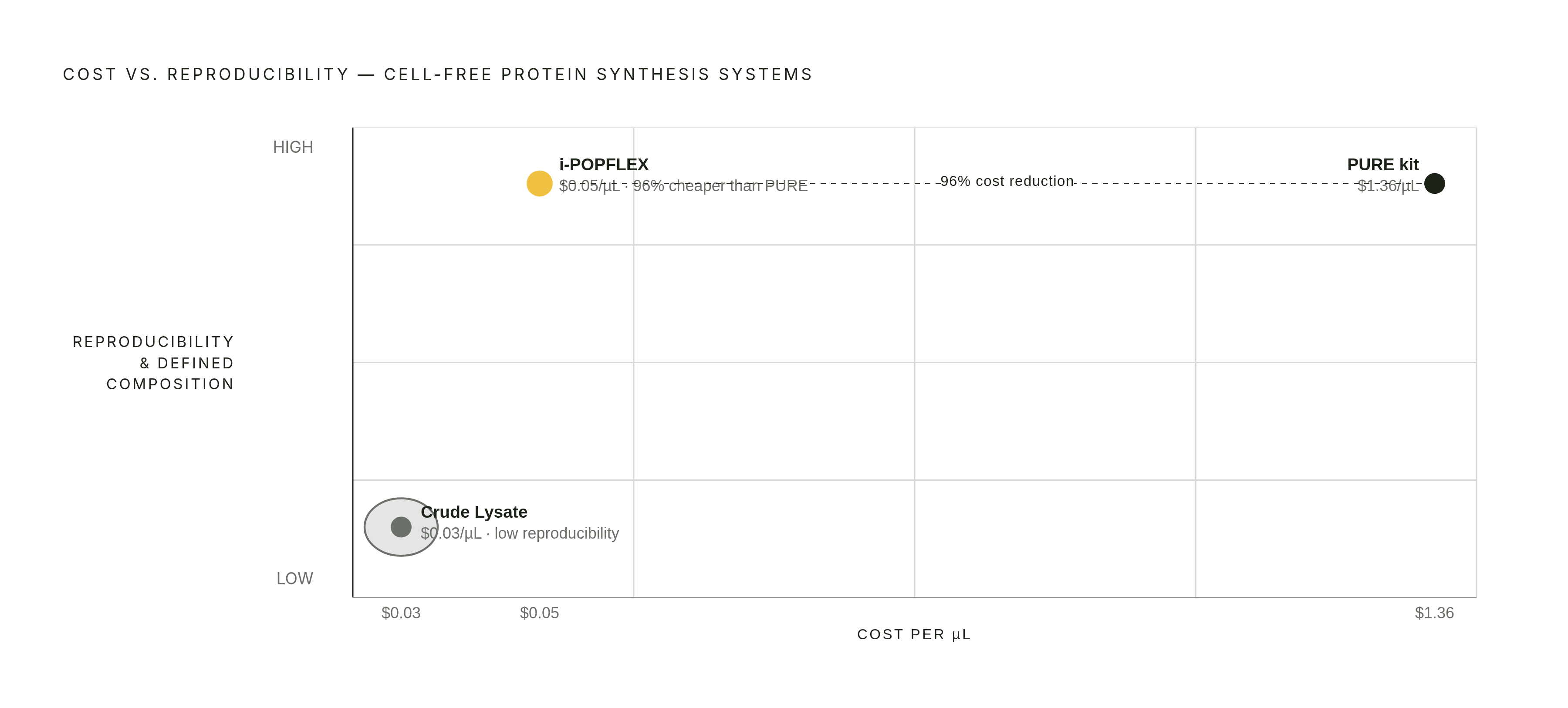
For a circuit designer, the practical rule is straightforward: quantitative characterization of individual parts calls for the clean background a reconstituted system provides, while large-scale or cost-sensitive screening favors the lysate format. The platform choice should follow from the question being asked. Low cost (approximately USD 0.03 µL⁻¹) and scalable from microliters to industrial volumes (up to 4.5 kL demonstrated) Cell-Free Protein Synthesis Technologies | Synthetic Biology | Bioche….
What kinds of genetic regulatory logic CFPS can host
The range of regulatory logic that has been built and tested in cell-free reactions is wider than a casual reader might expect.
Promoter and ribosome binding site characterization is the most basic use case: measuring how strong a given regulatory element is, in isolation, without the genomic context or growth-phase timing that muddies the same measurement inside a live cell. Riboswitches, the RNA elements that change their translational output in response to a small molecule or a protein ligand, have also been studied extensively in cell-free formats. A 2025 study in the Journal of Biological Chemistry used cell-free systems to characterize riboswitch behavior directly, and a 2023 Nature Communications paper went further, describing automated design of protein-binding riboswitches that achieved up to sixteen-fold translational regulation when tested in cell-free expression. Riboswitches in particular benefit from the cell-free format because there is no competing cellular RNA metabolism around to obscure the kinetics being measured.
Transcriptional regulators, activators, repressors, and multi-step cascades built from them, can be assembled straight from DNA templates added to the reaction, with no cloning or transformation needed between one design iteration and the next. PCR products can be used directly to drive simultaneous expression of several proteins at once, and the cloning step that would normally gate every design change simply disappears. At the far end of complexity, a 2026 Nature Communications paper reported the autonomous biogenesis of all thirty proteins that make up the E. coli translation machinery, entirely within a cell-free system, a genuine milestone for circuits designed to regenerate their own components.
One caveat deserves attention here, because it gets lost in the excitement over throughput. Comprehensive characterization of a circuit's behavior needs time-course measurements, tracking a reaction as it unfolds against the backdrop of whatever endogenous components are present. Anyone tempted to treat an endpoint assay as the full story should recognize that measurement discipline matters.
Compression of the design-build-test cycle for circuits in the cell-free environment.
In vivo prototyping runs on a slow clock. Cloning a construct, transforming it into a host, growing up the culture, inducing expression, then waiting for growth-phase effects to settle, each step adds days, and each step introduces a confound that has nothing to do with the circuit's actual design.
Cell-free systems collapse that clock. A DNA template, whether a PCR product or a plasmid, goes straight into the reaction, and results come back in hours rather than days. Since there is no living cell whose survival depends on the outcome, toxic constructs that would otherwise be untestable become fair game.
The automation layer built on top of this speed is where the compression really compounds. A fully automated Design-Build-Test-Learn pipeline published in iScience in 2025 used active learning to pick the most informative experimental conditions to run next, with an Echo 650 acoustic dispenser handling nanoliter-volume liquid transfers into 384-well plates and a multi-mode plate reader taking the fluorescence readout. The design phase of that pipeline was generated entirely using ChatGPT-4, with no manual code revisions needed. At a larger scale, a GPT-5-directed autonomous system ran more than 36,000 CFPS reactions spread across 580 automated plates, cutting protein production cost by 40 percent against the best prior baseline over three rounds of optimization across two months openai.com. That result was demonstrated on one protein, sfGFP, in one CFPS system, so whether it generalizes to other proteins or platforms is not yet confirmed openai.com.
Why does throughput matter this much for circuit work specifically? High-throughput cell-free screening turns what would be an impractical search into something exhaustive and tractable, and because these workflows run on plate formats and acoustic dispensers, they slot into laboratory automation infrastructure that already exists, rather than demanding bespoke equipment built just for this purpose. Antibody expression in CFPS systems completed in 3 hours in demonstrated workflows, Sino Biological data shows. Because circuit behavior is sensitive to component ratios and context, finding functional parameter space requires many iterations, and high-throughput CFPS makes exhaustive exploration tractable.
Tractability of toxic, membrane-associated, and otherwise difficult regulatory proteins in CFPS.
A living cell has to survive its own gene expression. A cell-free reaction doesn't, and that single difference opens up an entire category of regulatory proteins that in vivo prototyping simply cannot touch.
Take colicin M and colicin E1, bacteriocins that are toxic to E. coli by design Cell-Free Protein Synthesis Technologies | Synthetic Biology | Bioche…. Optimization work in both E. coli-based and HeLa-based cell-free systems pushed yields up two- to nine-fold across four rounds of optimization, turning proteins that would kill a live bacterial host into something researchers could produce and study directly Cell-Free Protein Synthesis Technologies | Synthetic Biology | Bioche…. That is not a marginal gain; it makes a protein workable at all instead of unworkable.
Membrane proteins present a related problem in living systems: they tend to misfold or express at low yield when a cell tries to insert them into its own membrane while also trying to grow. Cell-free synthesis sidesteps that constraint, which matters for circuit design because so many regulatory circuits depend on membrane-associated sensors or output components to function. Proteins that need disulfide bonds to fold correctly, historically a headache in reducing cellular environments, have their own answer in open cell-free synthesis systems optimized for redox folding conditions, with the scalability from microliter optimization runs up to larger production volumes holding up linearly.
None of this is possible in a sealed cellular system without genetically modifying the host first. In a cell-free reaction, chaperones, folding enhancers, or unnatural amino acids can simply be added to the mix as needed. For a circuit designer, the practical upshot is that a toxic repressor, a membrane-bound receptor acting as a sensor, or a disulfide-stabilized binding domain is no longer a reason to set the cell-free approach aside.
Encapsulation and spatial control as a layer above the basic TXTL reaction
Once the basic reaction is working, the next question researchers tend to ask is if it can be given some spatial structure, some resemblance to what a cell actually looks like on the inside.
Giant unilamellar vesicles, GUVs, offer one answer: encapsulate a CFPS reaction inside a lipid vesicle and the reaction now runs inside a compartment that mimics the spatial organization of a real cell. Temporal control over that compartmentalized reaction has its own emerging toolkit. A PNAS study describes engineered polymers carrying multivalent association motifs that reversibly drive liquid-liquid phase separation, aggregating and releasing the translational machinery on command and giving precise timing control over CFPS activity inside an artificial cell. pH-responsive expression takes the concept further still: GUVs carrying targeted DNA templates have been shown to selectively turn on protein expression in response to a pH shift, tested in a bile duct ligation mouse model of liver injury, where the alkaline conditions found in the injured liver drove significantly higher protein output than normal or sham controls.
Cell-free vesicle systems more broadly depend on genetic circuits acting as programmed logic gates inside a compartment, and predicting how a circuit will behave once it's enclosed remains an open research problem, not a solved one. Encapsulation adds new variables, diffusion across the vesicle membrane, molecular crowding, compartment pH, that have to be characterized on their own terms. The open, unencapsulated cell-free reaction is still the right place to start a circuit's characterization before moving it into a vesicle format. On the manufacturing side, microfluidic platforms that produce GUVs at defined, controlled size distributions suggest the encapsulated format is heading toward standardization rather than staying a bespoke, one-off technique.
Reproducibility and batch variability as the practical ceiling on cell-free circuit characterization
None of the speed and flexibility described above matters much if the numbers coming out of the reaction can't be trusted from one week to the next. CFPS has a documented reputation, deserved, as a highly variable method: a PMC review of industrial CFPS applications names extract-to-extract differences, DNA template variability, dependence on reagent supply chains, and batch-to-batch inconsistency as barriers standing between CFPS and regulated production use.
Part of the trouble is technical in a very specific way. Measuring the raw material attributes of a whole-cell extract, the actual concentrations of the constituent proteins and metabolites sitting inside it, is difficult, and those attributes drive batch-to-batch differences that are hard to predict or control. For circuit data, the consequence is direct: if the extract varies from one experiment to the next, a measured change in circuit output may reflect the design change under test or may instead reflect just a different reagent lot. That ambiguity undercuts the entire premise of a design-build-test-learn loop, which only works if the comparisons across iterations are actually quantitative.
None of that is exotic or unreasonable to ask for, and reproducibility failures do not stem from some intrinsic property of cell-free chemistry that can never be solved. Once an effective protocol for a given protein is locked in and extract variability from batch to batch is actually controlled, the reaction should behave reproducibly under those same conditions. The condition for reproducibility is controllability of the extract, full stop, not some inherent unpredictability baked into the method itself. Reproducibility would require controlled extract preparation, documented RMAs, and lot-level QC data that researchers can inspect and compare across batches.
Reagent transparency and defined formulations for the reproducibility problem.
Two paths address the reproducibility gap, and they solve different parts of the problem.
Lyophilization, freeze-drying the CFPS components, extends shelf life and gets rid of the cold-chain shipping requirement, and it has already been demonstrated across a wide range of applications: antibody-drug conjugates, therapeutic proteins, antimicrobial peptides, virus-like particles, vaccine antigens, and small-molecule medicines. That solves a storage and logistics problem, but it does nothing to open up what's actually inside the formulation. A freeze-dried black box is still a black box.
Defined reagent formulations go after the deeper issue. Researchers cannot troubleshoot a formulation they cannot see. A reagent system that publishes its composition and its lot-level quality control data gives a researcher the information needed to tell reagent variability apart from actual circuit behavior, which is the exact distinction that batch inconsistency currently makes impossible.
Reagent providers built around that transparency principle, documented formulations, openly published lot-level QC, pricing structured to make high-throughput screening viable as a routine activity rather than a rationed one, and compatibility with the plate and automation formats that a real DBTL workflow depends on, represent the direction the field needs to move. A reagent system a researcher can actually understand, compare across lots, and troubleshoot when something looks off is the precondition for calling any cell-free circuit characterization scientifically defensible. Olsen et al., Nat.. 2026;17:3478, referenced in Microbiology, describes design-driven optimization of low-cost reagent formulations for reproducible and high-yielding cell-free gene expression, a community effort toward standardization with documented compositions.
The economics of cell-free circuit prototyping
Cost is not incidental to any of this. It decides which experiments get run and which ones get shelved before anyone even tries.
In high-throughput regimes, the cost of a CFPS experiment is dominated by lysate and DNA, making yield the highest-leverage cost-reduction strategy because it converts the same reagent volume into more usable protein. That is proof the cost gap between defined and crude systems is not fixed; it compresses under the right engineering effort.
For circuit researchers specifically, this arithmetic determines what's actually feasible. A 384-well screening run priced at commercial PURE kit rates puts that experiment out of reach for most labs. The same experiment, run at lysate-comparable pricing but with a defined, documented composition, becomes something a lab can run routinely rather than rationing. Reagent providers pricing defined cell-free systems close to lysate-comparable rates are making a deliberate statement: high-throughput circuit screening shouldn't be gated by what a researcher can afford to spend on reagent alone. That is what turns the design-build-test-learn loop from a theoretical advantage into something a working lab can actually run, week after week, without reagent cost quietly setting the ceiling on what gets tested. The crude lysate cost baseline is approximately USD 0.03 µL⁻¹, affordable at scale, but its undefined composition creates reproducibility costs that are harder to quantify. The commercial PURE kit costs USD 1.36 µL⁻¹ per research data, while the i-POPFLEX reconstituted system from POSTECH achieves up to an 8.4-fold higher yield with a 96% cost reduction at USD 0.05 µL⁻¹ versus commercial PURE kits, illustrating that the cost gap between defined and crude systems is compressible through engineering.
Sources
- Cell-Free Protein Synthesis Technologies | Synthetic Biology | Biochemistry and Cell Biology | Biological sciences | Topics | Nature Index
- Microbial cell-free protein synthesis and its progression toward industrial use - PMC
- Cell-Free Systems | Springer Nature Link
- Artificial cells with liquid–liquid phase separation–regulated cell-free protein synthesis | PNAS
- Active-learning-guided optimization of cell-free systems for genome-wide transcriptomic profiling reveals progressive layers of regulation - PMC
- Linear DNA for Rapid Prototyping of Synthetic Biological Circuits in an Escherichia coli Based TX-TL Cell-Free System | ACS Synthetic Biology