Cell-Free Synthesis of Virus-Like Particles and Protein Nanostructures
Cell-free synthesis lets researchers engineer virus-like particles faster and with precise control.
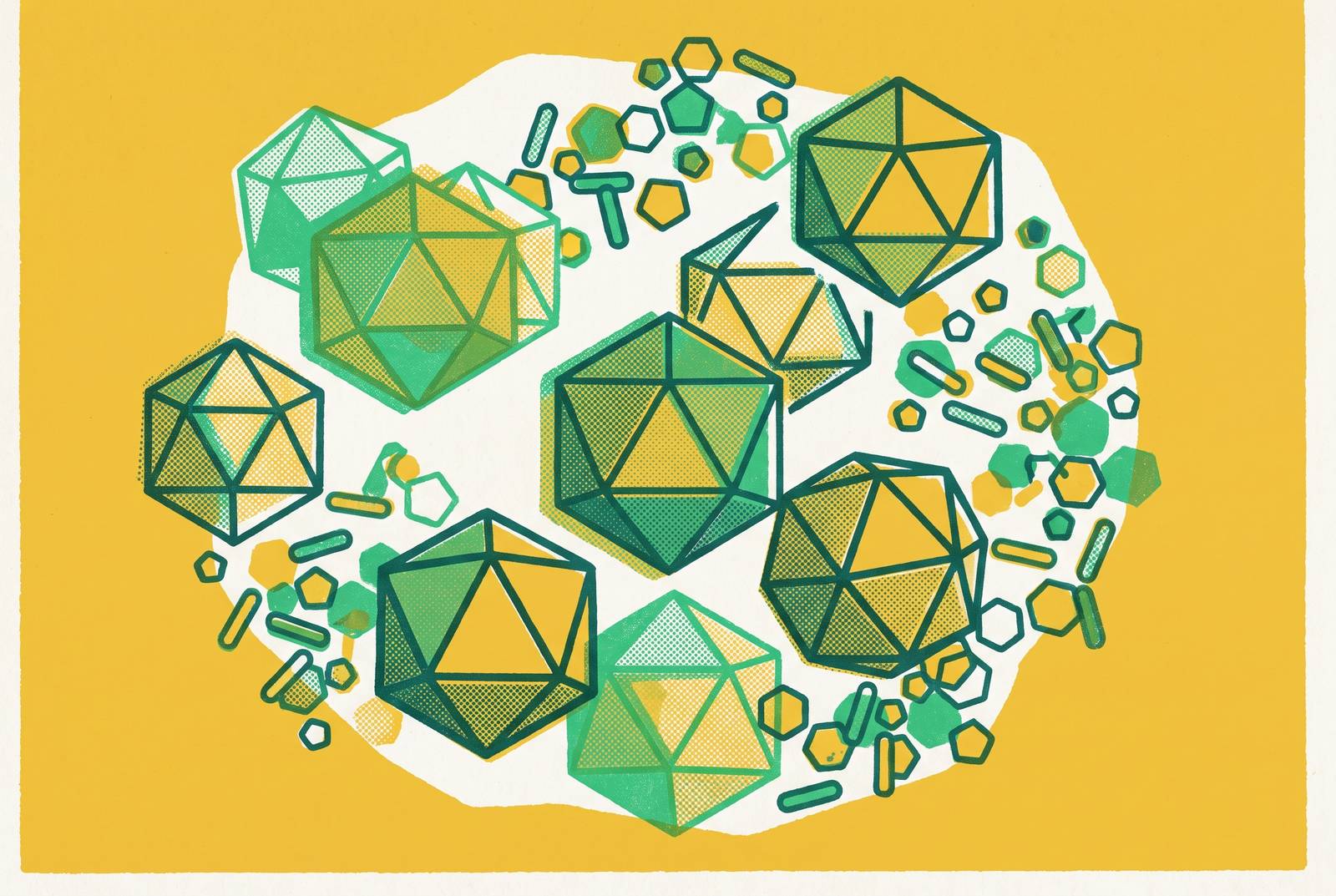
Virus-like particles and other self-assembling protein nanostructures ask three things of an expression system at once: a high yield of correctly folded monomer, tolerance for proteins that may poison the host cell, and precise control over the conditions that trigger assembly.
VLPs are empty shells: nanoscale structures that mimic a virus's shape without carrying viral genetic material. Their value, whether as vaccine scaffolds or delivery vehicles, comes from a repetitive, geometrically exact surface built from many copies of the same folded monomer. A slight misfold in that monomer does not stay contained to one molecule, but propagates outward into particles that are heterogeneous, malformed, or simply inert.
Cells make this hard to prevent. Capsid and coat proteins frequently interfere with host membranes or hijack cellular machinery to get made at all, so the same overexpression that a researcher wants can kill the cell or force it to sequester the protein before enough of it accumulates. Self-assembly is also a chemistry problem as much as a biology one: it responds to protein concentration, redox state, temperature, and molecular crowding, and none of those variables can be adjusted inside a living cell without also disturbing its growth and metabolism. Traditional expression compounds the issue further by tying protein synthesis directly to cell growth, so there's no clean way to halt synthesis at a target monomer concentration and then trigger assembly on command.
The trouble doesn't end at the bioreactor. VLPs carry complex, size-heterogeneous architectures, and the impurities that come along with different expression systems, both process-related and product-related, turn downstream purification into one of the biggest constraints on final product quality, yield, and manufacturability.
How the open-reaction format of CFPS removes expression constraints
Cell-free protein synthesis answers each of those problems by taking protein synthesis out of the cell. The reaction happens in an open vessel, the environment around it stays directly adjustable, and the path from sequence to assembled particle shrinks from days to hours.
Cell extract supplies ribosomes, tRNAs, amino acids, and the rest of the translational machinery in a tube instead of a living cell, so there's no cell membrane to rupture and no viability to protect. These extracts are typically drawn from bacteria, wheat germ, or insect cells, each supplying the ribosomes, tRNAs, and amino acids needed to translate mRNA into protein. A capsid protein that would kill an E. coli culture at high expression simply accumulates in solution instead.
Temperature makes the case concretely. Working with an untagged AAV5 variant, researchers found roughly 90% more soluble protein when the reaction ran at 18°C compared to 37°C, a difference attributed to reduced misfolding at the lower temperature. That kind of adjustment is trivial in an open tube and essentially unavailable inside a growing cell culture, where temperature shifts ripple through every other cellular process at once.
Redox chemistry follows the same logic. Pretreating cell extract with iodoacetamide shuts down the cytosolic enzymes that would otherwise interfere with disulfide bond formation, and adding a glutathione buffer alongside the enzyme DsbC lets the reaction build disulfide bonds deliberately, to the point where proteins carrying up to 24 such bonds have been produced this way. Starting from nothing more than a PCR product or plasmid, a researcher can carry synthesis through to a functional assay in hours, compared with the days that transformation, colony selection, and culture scale-up require in a cell-based workflow.
A further variant, the PURE system, strips out the extract's undefined background entirely and replaces it with a fully purified, individually specified set of components. Contaminating activities drop sharply as a result, which matters most when every variable in an assembly reaction needs to be known and controlled rather than inherited from whatever happens to be in a crude lysate.
The obvious objection: doesn't removing the cell also remove its chaperone networks and post-translational machinery? For eukaryotic-derived extracts, discussed next, those systems are often native to the lysate. For prokaryotic extracts, the answer is that supplements can be added directly to an open reaction in ways that have no equivalent inside an intact cell.
Choosing a CFPS platform: E. coli, Pichia pastoris, and wheat germ for different VLP targets
No CFPS platform wins across every VLP target. The right one follows from what the capsid protein actually needs: post-translational modification, disulfide bond formation, or nothing more than speed and yield at low cost.
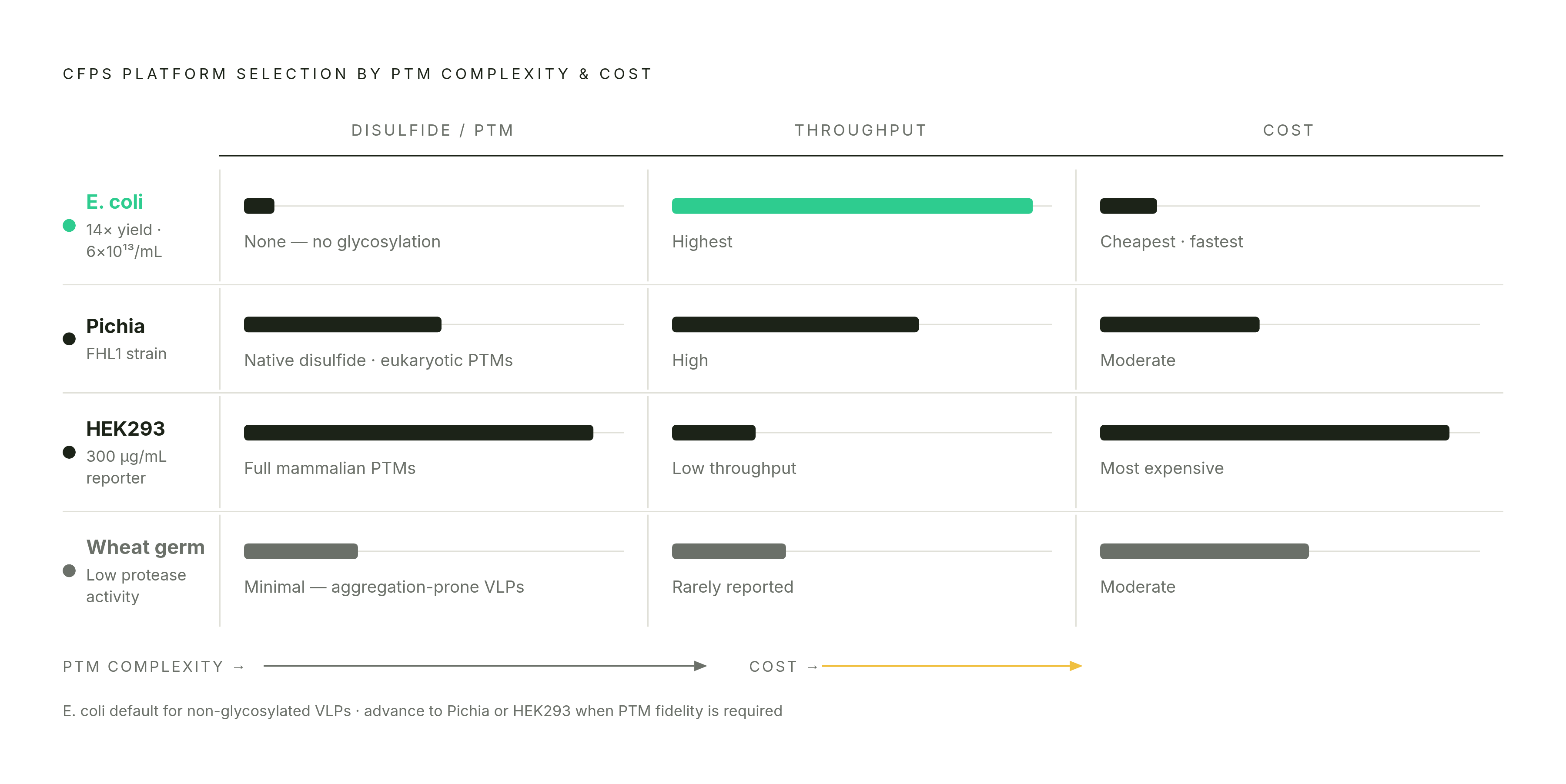
E. coli-based CFPS is the workhorse for simple, prokaryotic-origin capsid proteins that don't require glycosylation. The yield record backs that up: MS2 bacteriophage coat protein VLP produced at 14 times the best published production yield, and a C-terminally truncated Hepatitis B core protein VLP produced at similarly high yields of 6 × 10¹³ VLP/mL. The platform is also the most mature of the group and pairs cleanly with high-throughput, plate-based workflows, making it the fastest and cheapest option on the table. Its limits are equally clear: no native disulfide bond formation without added redox engineering, and no glycosylation.
Komagataella phaffii, the organism long known as Pichia pastoris, offers a eukaryotic alternative. As a eukaryotic platform, it performs post-translational modifications, including disulfide bond formation, without needing extra folding chaperones or supplements added to the reaction. A ribosome-overexpressing strain called FHL1 produces an especially active lysate that has already been used to make both human serum albumin and VLPs. This has been demonstrated across a number of different Komagataella phaffii strains beyond FHL1 itself. It's the practical choice whenever a target's structural stability depends on disulfide bonds that a prokaryotic extract can't form natively. The system also enables faster prototyping of expression vectors before full strain construction, a direct benefit for iterative VLP design cycles.
HEK293-based CFPS goes a step further, drawing on human cell machinery capable of the full range of mammalian post-translational modifications. Reporter protein yields up to 300 µg/mL have been demonstrated in this system. That capability comes at a cost: HEK293 extract runs the most expensive per reaction and scales worst for high-throughput screening, so it belongs specifically to targets where human-type glycosylation isn't optional.
Wheat germ extract rounds out the set. Its main advantage is low endogenous protease activity, which suits aggregation-prone or unstable capsid proteins that would otherwise degrade mid-reaction. The platform has a strong track record in structural proteomics, though it's reported far less often for VLPs specifically. Its tolerance for difficult protein folds still makes it relevant to nanostructure work more broadly.
Put simply: E. coli for prokaryotic, glycosylation-independent targets where throughput matters most; Pichia pastoris as the practical eukaryotic-extract choice when folding support is required; HEK293 reserved for targets where mammalian PTMs are non-negotiable.
What CFPS has already produced
The track record here isn't theoretical. Cell-free systems have already produced bacteriophage coat proteins, hepatitis B core antigen, AAV capsid proteins, spider silk nanofibers, and fusion-protein building blocks for protocells, and in several of these cases the yields exceed what cell-based expression has managed.
The MS2 and HBc results make the comparative case most cleanly. MS2 bacteriophage coat protein VLP reached a yield 14 times the best published in-cell production yield. That figure comes from the Bundy et al. 2008 study reporting a 14-fold yield advantage. Hepatitis B core antigen followed a similar pattern: high yields paired with the ability to rapidly screen HBc variants that still self-assembled into VLPs, including versions with artificial disulfide bridges engineered throughout the particle to improve nanoparticle stability.
AAV capsid work adds a more complex, more recent data point. Cell-free production of AAV5 capsid protein particles reached an estimated 2.98 × 10⁹ capsids per mL of cell-free reagent. The resulting particles measured roughly 20 nanometers in diameter, matching the expected size for an AAV5 particle and confirming that assembly geometry held up under cell-free conditions. Temperature control, discussed earlier as a mechanistic lever, made that soluble yield possible.
Spider silk proteins push the definition of "difficult" further. MaSp1 (69 kDa) and MaSp2 (73 kDa), proteins long considered nearly impossible to produce through recombinant expression, were made via CFPS at yields of 0.61 mg/mL and 0.52 mg/mL respectively, through systematic tuning of cell strain engineering, energy sources, crowding agents, and amino acid supplementation. That result matters beyond spider silk itself: it shows that CFPS's open format can be deliberately tuned, reaction by reaction, for proteins that would aggregate lethally inside a living cell.
A newer application extends the idea into synthetic biology proper. Fusion-protein building blocks synthesized cell-free have been shown to enable autonomous growth in globular protein vesicle protocells, an early sign of where cell-free nanostructure work is heading next. This work was published as a 2025 Biomacromolecules study titled on cell-free protein synthesis of fusion-protein building blocks enabling autonomous growth in globular protein vesicle protocells. CFPS has already produced a broader catalog of proteins that resist standard cell-based expression, including restriction endonucleases, a human microtubule binding protein, cytolethal distending toxin, and membrane proteins such as the tetracycline pump TetA and G-protein coupled receptors. These difficult-to-express proteins are among those already demonstrated in CFPS systems.
How CFPS accelerates variant screening for VLP engineering
Synthesizing one VLP variant successfully isn't the hard part of this work. The hard part is testing enough variants, fast enough, to find the sequence combinations that assemble correctly, present the right surface chemistry, and hold their structure. That iteration is what CFPS compresses, cutting each design-build-test cycle from days down to hours.
Cell-based screening carries a fixed tax on every variant: transformation, clone selection, and culture scale-up, all before a single piece of functional data comes back. CFPS skips that tax by going straight from a PCR product or plasmid to expressed protein. Multiple variants can be tested in parallel on the same day rather than spread across a week of culture work.
The Lu et al. The Lu et al. study from PNAS in 2015 shows what that throughput enables. Working with E. coli-based CFPS, the researchers screened HBc protein variants for retained self-assembly and improved particle stability, engineering disulfide bridges into the structure along the way. None of that screening volume would have been practical if every variant had first needed its own transformation and culture cycle.
That same logic scales into automated and computational workflows. A 2025 study in ACS Synthetic Biology paired machine learning tools with CFPS specifically to get around the bottleneck of large-scale protein purification, using cell-free reactions as a fast way to screen and score variant activity and generate the data density that predictive models need to train on. Plate-based formats at 96-, 384-, and 1536-well scale, run with robotic liquid handling systems such as the Opentrons OT-2 and Labcyte Echo, deliver the accurate, consistent low-volume dispensing that building a real variant library requires. These automated platforms are described specifically in the context of scalable, biofoundry-integrated cell-free workflows.
Microfluidic chips push the same idea to a finer resolution: each droplet acts as its own independent reaction, letting synthesis, immobilization, and kinetic characterization run at the same time across many variants at once, with one demonstrated case identifying an alkaline phosphatase mutant with sharply increased activity through this approach. That case improved alkaline phosphatase activity by nearly 20-fold using a femtoliter droplet array coupling cell-free transcription and translation. The design-build-test-learn loop closes when results from screening feed straight into machine learning models that propose the next round of variants, a cycle that depends entirely on the throughput CFPS makes possible.
Reagent transparency and lot-level consistency as prerequisites for reproducible VLP assembly
A CFPS workflow can be designed well and still fail to reproduce, and the reason usually traces back to the reagents rather than the protocol. Opaque formulations, lot-to-lot drift, and uncharacterized components remain the field's biggest unresolved obstacle to standardized nanostructure production. Downstream purification itself has been identified as a major bottleneck limiting product quality, yield, and manufacturability.
High reagent costs and inconsistent yields are already recognized as major barriers to bringing CFPS into industrial use, and part of the problem is structural: there's still no cost-effective, high-throughput way to monitor metabolite dynamics while a reaction runs, so optimization often happens partially blind. A Nature Communications study by Olsen et al. screened over reagent formulations to confirm that high reagent costs and inconsistent product yields remain significant barriers to industrial adoption.
Energy is where the cost and the variability concentrate hardest. Nucleotide triphosphates, ATP, GTP, CTP, and UTP, get consumed quickly during synthesis and can make up a large share of total reagent spend, with amino acids close behind as another major cost driver.
Assembly of VLPs and self-assembling protein nanostructures is sensitive to precise environmental control, one of three converging demands (alongside high yields of correctly folded monomer and tolerance of proteins that may be toxic to the host) that these structures place on an expression system, which living cells are structurally ill-equipped to meet simultaneously. Reproducible VLP work depends on knowing what's in the tube, at what concentration, and how consistently that holds from one batch to the next.
Sources
- A Pichia pastoris Cell-Free Protein Synthesis Platform | Springer Nature Link
- Downstream Purification Strategies for Virus-like Particles: A Systematic Review of Structure Preservation, Impurity Control, and Viral Safety - PMC
- Cell-Free Protein Synthesis of Fusion-Protein Building Blocks Enables Autonomous Growth in Globular Protein Vesicle Protocells - PubMed
- Assessing sequence plasticity of a virus-like nanoparticle by evolution toward a versatile scaffold for vaccines and drug delivery - PMC
- Cell-free expression and synthesis of viruses and bacteriophages: applications to medicine and nanotechnology - ScienceDirect
- Escherichia Coli-Based Cell-Free Synthesis of Virus-Like Particles | Request PDF
- Escherichia coli-based cell-free synthesis of virus-like particles - PubMed
- Cell-free production of adeno-associated virus protein particles - Synthelis