Enzyme Pathway Reconstitution in Cell-Free Reactions
Researchers bypass cellular interference by running enzyme pathways in cell-free reactions.
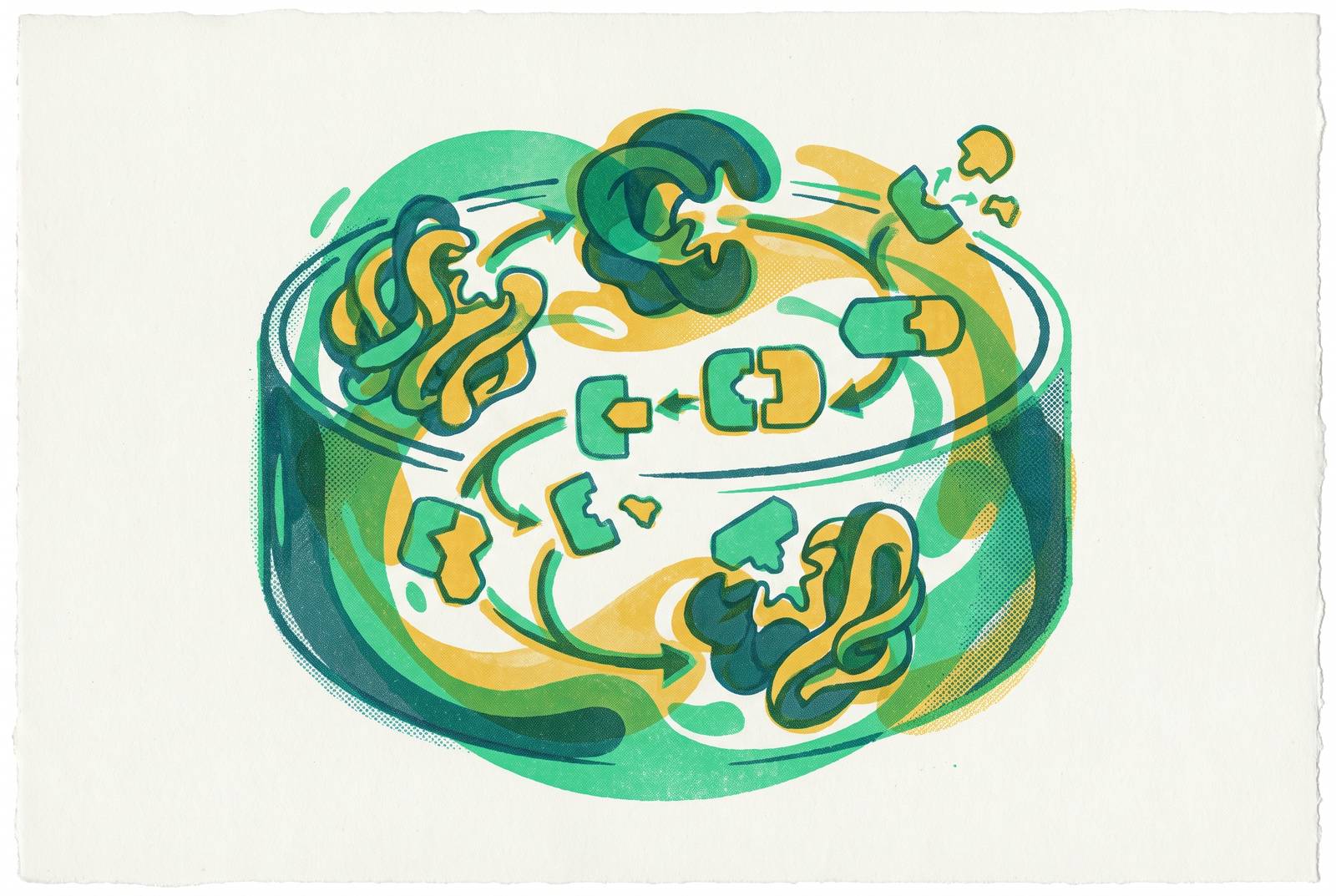
Pathway engineering demands exact control: fixed ratios between enzymes, defined cofactor pools, conditions tuned to whatever chemistry the pathway actually needs. Living cells refuse almost all of it. A cell is not built to serve an engineer's stoichiometry; it is built to survive, and everything it does bends toward that end, often at direct cross-purposes with the flux a researcher is trying to force through a heterologous pathway.
Start with competition. The enzymes native to a host cell were not designed with a newly introduced pathway in mind, and they will happily draw down the same substrate pools and cofactor supplies the engineered enzymes need. Add regulatory interference on top of that. Feedback inhibition, transcriptional repressors, and post-translational modification systems all evolved to hold metabolism at homeostasis. They actively work against attempts to push unnatural flux through a foreign set of reactions. The cell is an opponent with its own agenda. It is an opponent with its own agenda.
Toxicity compounds the problem further. Some of the most useful pathway intermediates and enzymes are the ones a cell cannot tolerate: proteins that puncture membranes, molecules that drain essential metabolite pools, compounds that jam ribosomal function. None of these can accumulate to useful levels inside a living host, because the host dies or shuts down production long before yield gets anywhere interesting.
A cell is a black box. Researchers can measure what goes in and read what comes out, but the intermediate states, the actual moment-to-moment chemistry happening inside the membrane, stay hidden. No amount of external prodding lets someone directly adjust conditions mid-reaction.
Gene cloning, transformation, colony selection, culture optimization, and purification each introduce bottlenecks, and the process typically requires 3–4 days or more from gene to purified protein, with that timeline resetting every time a pathway enzyme needs to be changed.
How cell-free systems create an open, controllable reaction environment
Cell-free protein synthesis solves this by removing the cell itself as a variable. The technique pulls the essential machinery of protein synthesis out of cells and runs it in a tube, outside any membrane, free of the regulatory apparatus that fights back inside a living host. Nothing about the reaction has to negotiate with a genome anymore.
Two platform architectures dominate, and the choice between them is a real design decision. Crude lysate-based systems, drawn from sources like E. coli S30 extract, rabbit reticulocyte lysate, or wheat germ, retain native metabolic activity and cofactor regeneration capacity. That is a genuine asset when a pathway can lean on endogenous catabolism to keep itself supplied with energy and reducing equivalents. Reconstituted, or PURE, systems go the other direction: every component is defined and added deliberately, which avoids the black-box character of a crude extract and cuts down on competing side reactions. The tradeoff is that a PURE system gives up the metabolic support a lysate provides for free, so the researcher has to supply everything the reaction needs by hand.
Lysate quality itself has improved substantially. Modern extracts often come from source strains engineered to knock out non-essential protease genes such as Lon and OmpT, while RNase E activity gets attenuated, commonly through C-terminal truncation, since RNase E is essential and cannot be deleted outright. The payoff is a longer functional lifespan for the reaction: translation can keep running for up to 24 hours in a single batch, which matters enormously for a multi-enzyme pathway that needs sustained output rather than a brief burst.
What makes all of this useful for pathway reconstitution, though, is openness as a working principle. Enzymes, substrates, cofactors, metal ions, redox buffers, any of it can be added, withheld, or titrated to an exact concentration, a level of access that simply does not exist inside an intact cell.
The logic of expressing pathway enzymes directly in cell-free reactions
Cell-free systems produce the enzymes that make up the pathway in the first place, beyond simply hosting the reaction. The standard workflow expresses each enzyme individually, using either plasmid DNA or linear expression templates, quantifies how much protein came out, and then combines the enzymes at defined concentrations with substrate and cofactors to rebuild the pathway from scratch, in vitro.
Two sourcing strategies produce that workflow, each with a real cost attached. Purified enzymes give maximum control: stoichiometry can be set with precision, since every component's concentration is known exactly, but getting there means purifying each enzyme separately, which adds labor upstream. Crude cell extract skips that purification step and keeps native metabolism and cofactor regeneration intact, which is faster to assemble, though the composition of what's actually in the tube stays less transparent.
Linear expression templates change the iteration math considerably. PCR products can go straight into the reaction for simultaneous expression of several proteins at once, with no cloning and no transformation step required. That single change collapses what used to be a multi-day cycle into something that can happen in an afternoon.
The design consequence matters more than the convenience. Because each enzyme's contribution can be measured on its own, a researcher who finds a bottleneck step can simply raise that one enzyme's DNA template concentration, without touching anything else in the construct. Pathway tuning becomes a matter of adjusting inputs rather than rebuilding the whole system from the ground up.
None of this is free of friction, though. Energy regeneration remains one of the persistent limiting factors in cell-free expression, and it deserves to be treated as an honest constraint rather than a solved detail. ATP consumption during upstream glycolysis can inhibit transcription and translation directly, though co-adding glycolytic intermediates such as glyceraldehyde 3-phosphate alongside glucose can ease that inhibition. Frontier work has pushed this further still: glucose-energized reconstituted systems have been shown to synthesize a subset of their own glycolytic enzymes in the same tube where the reaction is running, a small but real step toward systems that sustain their own energy supply. That result matters because it shows the field working directly against one of its hardest remaining limitations, not around it.
What reconstituted pathways can achieve: yield and complexity benchmarks
The clearest demonstration of scale comes from the Bowie group's monoterpene work, reported in the Computational and Structural Biotechnology Journal in 2023: a pathway rebuilt from 27 purified enzymes reached more than 95 percent conversion yield and a titer of 15 grams per liter. That result settles a question that used to sound almost implausible: a pathway with dozens of components and a titer in gram-per-liter territory are not mutually exclusive goals. They can be hit in the same reaction.
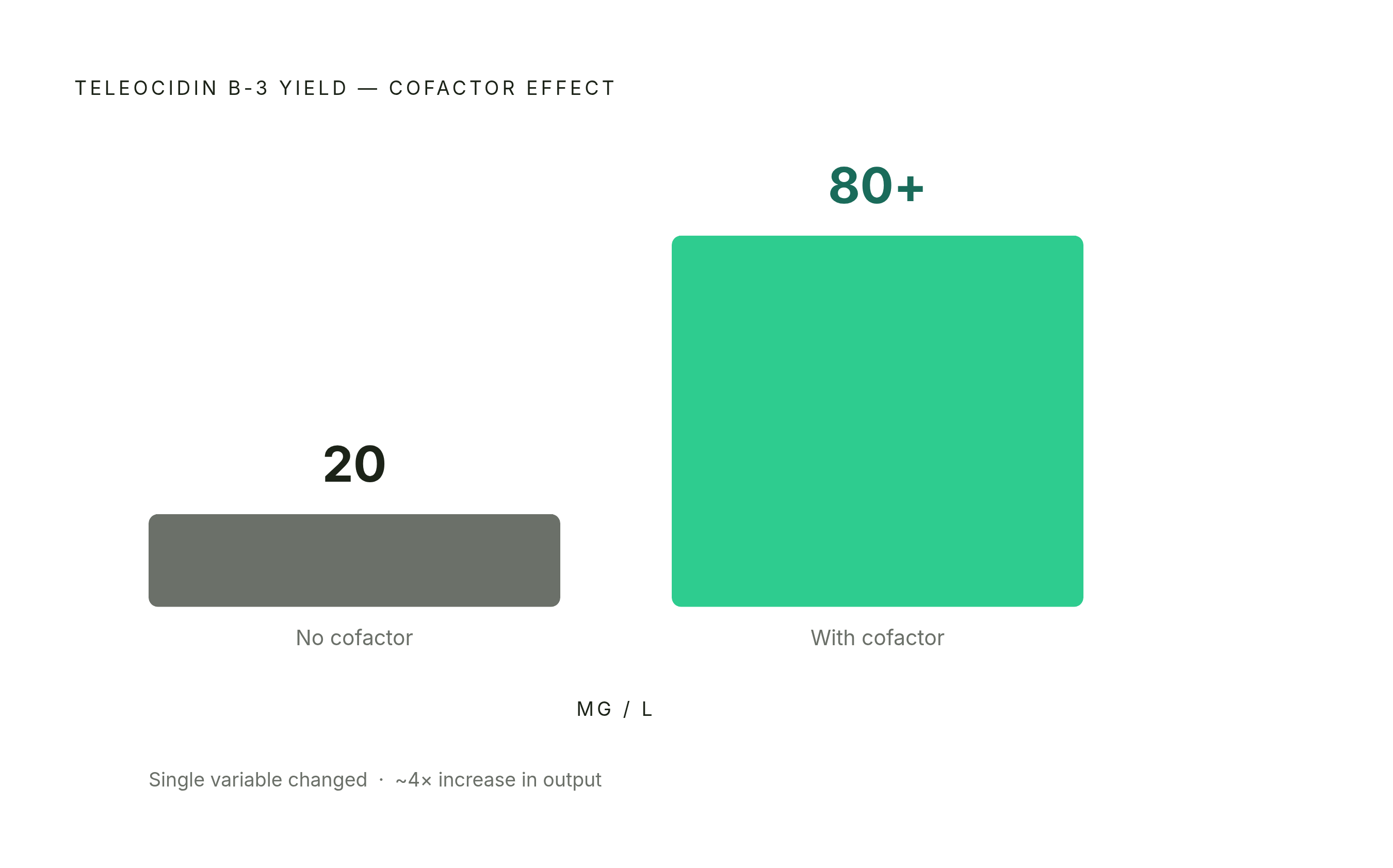
Complexity of a different kind appears in the natural product work published by Madduri and colleagues in ACS Synthetic Biology, published October 2024. The teleocidin biosynthetic pathway was reconstituted in a tobacco BY-2 cell-free protein synthesis system, and with cofactor supplementation the reaction produced more than 80 milligrams per liter of teleocidin B-3, compared with roughly 20 milligrams per liter without it. In the same body of work, the team reported the first cell-free biosynthesis of UK-2 diol, the precursor to the commercially valuable secondary metabolite UK-2A, by refactoring a ten-protein pathway inside a wheat germ system. Neither result was accidental in its platform choice.
Taken together, these numbers cover two separate axes of achievement. The monoterpene result proves that gram-scale titer is reachable even with dozens of enzymes running at once. The natural product results prove something else: that eukaryotic biosynthetic logic, the kind long considered nearly impossible to move into a heterologous host, can be rebuilt outside a cell. The choice between the two pathways reflects a deliberate platform selection decision, pairing tobacco BY-2 with a pathway requiring high metabolic activity and wheat germ with a pathway requiring a clean eukaryotic background with minimal competing activities.
Challenging enzymes that pathway work demands in cell-free systems
Every pathway has a hard enzyme in it, the one that breaks a cell-based expression attempt. Toxic proteins are the obvious case: antimicrobial peptides, proteases, membrane-disrupting intermediates, all of them capable of killing a host cell before yield gets anywhere useful. In a cell-free reaction, that constraint disappears entirely, because there is no living cell left to damage.
Membrane proteins present a related but distinct problem. In a host like E. coli, they are notoriously difficult to express correctly and frequently end up misfolded into inclusion bodies rather than functional protein. Cell-free systems sidestep the toxicity that drives much of that failure, and with the right additives in the reaction, they can support properly folded, functional membrane protein production, which matters directly for pathways built around membrane-associated enzymes such as cytochrome P450s or polyketide synthases.
P450s deserve their own mention, since they sit among the most biotechnologically valuable and simultaneously most resistant enzyme families in natural product biosynthesis. A 2025 ACS Synthetic Biology paper reported reconstitution of human cytochrome P450 activity using a Leishmania cell-free protein expression system, a result that speaks to how far cell-free platforms have moved into territory that conventional heterologous expression has struggled with for years.
Large multi-domain eukaryotic enzymes round out the list. Nonribosomal peptide synthetases and polyketide synthases are enormous, multi-domain assemblies that run into folding and solubility trouble when forced into a bacterial host. A 2026 review in Synthetic and Systems Biotechnology looks specifically at how diversifying eukaryotic CFPS chassis options addresses exactly these targets. The underlying shift across all of these cases is the same one: the question is no longer whether a living cell can survive an enzyme, but whether the reaction can be given the right folding environment to let that enzyme work.
Tuning stoichiometry, cofactors, and conditions once the pathway is assembled
Once a pathway is up and running in a cell-free reaction, the tuning delivers the real advantage. Because every enzyme enters the system at a concentration the researcher chose, the ratios between pathway steps can be adjusted independently: raise the concentration of whatever enzyme is bottlenecking the reaction, and nothing upstream or downstream needs to change to accommodate it.
Cofactor availability offers the sharpest illustration of how much a single variable can move the outcome. The teleocidin result shows that cofactor supplementation lifted titer from roughly 20 milligrams per liter to more than 80, a fourfold difference that came from adjusting one input. That is not a marginal tuning knob. It comes close to matching a pathway that barely works against one that performs.
Reaction conditions extend that same logic. Temperature, ionic strength, and redox environment can each be set independently of one another in a cell-free reaction, something no living cell tolerates without also disturbing everything else going on inside it. Future generations of CFPS platforms are being built specifically to support customized conditions, including elevated or reduced temperature and altered redox states, which matters directly for enzymes whose stability sits outside the narrow range a normal cell can maintain.
That same openness turns debugging into something closer to an engineering process than a guessing game. A researcher can isolate a single step, add one enzyme at a time, and measure exactly where intermediate accumulates and where flux stalls, without cellular metabolism muddying the picture underneath.
High-throughput screening of pathway enzyme variants in cell-free format
Reconstituting a pathway is rarely the end of the work. Individual enzymes inside it usually need optimizing: swap in a variant, test a mutation, compare a homolog against the original. Cell-free format turns that entire task into a screening exercise rather than a cloning-and-culture slog.
Plate-based formats have made this practical at real scale. High-throughput CFPS workflows commonly run in 96- or 384-well plates, paired with robotic liquid handling systems such as the Opentrons OT-2 or Labcyte Echo, to keep results reproducible across large batches. This is a protocol run in 384-well format with 17 µL final reaction volume, DNA at 10 nM working concentration, sealed and incubated at 37 °C with 1000 rpm shaking for 3.5 h, capable of generating usable activity data from dozens to hundreds of variants at once, worth keeping as a concrete reference point for anyone scoping out a screening campaign of their own.
What makes the format valuable for pathway work specifically is that variants generated by gene synthesis, PCR, or saturation mutagenesis can go straight from synthesis into an activity assay, with no purification step in between. Higher-throughput formats push the same principle further. Microfluidic droplet systems treat each droplet as its own isolated reaction, running synthesis, immobilization, and kinetic measurement together across thousands to tens of thousands of variants at once; alkaline phosphatase studies using this method have turned up mutants with more than 20-fold gains in activity. Water-in-oil emulsions take that further still, partitioning reactions into millions of individual microreactors that can feed into fluorescence-activated droplet sorting or mass spectrometry.
All of that variant-level data adds up to something machine learning tools can actually use. CFPS functions as a data-generation layer for those workflows, since ML models are only as reliable as the training data behind them, and cell-free screening produces functional data across large variant sets without the purification bottleneck that normally caps dataset size.
Automated and modular assembly of reconstituted systems
Screening at that scale exposes a different bottleneck: assembling a reconstituted system from its individual components by hand is slow, and it invites batch-to-batch variation that undermines everything the screening data is supposed to show. Automation is the answer the field is building toward.
The i-POPFLEX system, described by Chae and colleagues in Trends in Biotechnology and available online since June 2026, is a modular reconstituted cell-free platform whose own translational machinery components are produced in vitro and then assembled using a benchtop liquid handler. The system's building blocks are themselves manufactured cell-free, a recursive step that points toward reconstituted systems that no longer depend on cell-derived components at any stage.
Modularity is the real payoff here. Individual pieces of the translation machinery can be swapped or upgraded on their own, substituting in a component optimized for a specific amino acid incorporation chemistry, for instance, without tearing down and rebuilding the entire system. Linear DNA templates turn out to matter here too: they are required for efficient in vitro synthesis of certain translational components, tying this section back to the template flexibility that made pathway-level iteration so much faster earlier on.
The ambition behind this work is explicit rather than implied. Clearing the current barriers would open the door to producing thousands, even millions, of fully assembled systems for biofoundry-scale enzyme engineering, pathway prototyping, and large variant screening campaigns. The Trends in Biotechnology piece frames this as a democratizing step for reconstituted cell-free technology, one meant to accelerate adoption across next-generation biomanufacturing pipelines. Whether that vision arrives on the timeline its authors imagine is still an open question, but the direction of travel is unmistakable: toward systems that build themselves, at a scale no manual protocol could match.
Reagent transparency and lot consistency as foundations for reproducible pathway reconstitution
Every advantage described above rests on one unglamorous condition: the reagents going into the reaction have to behave the same way every time. A pathway tuned against one lysate batch, one lot of purified enzyme, one preparation of cofactor stock, is only as reproducible as that batch is consistent with the next one made months later.
That is not a small ask. Crude lysates in particular carry batch-to-batch variability by nature, since they are drawn from living cultures whose growth conditions, harvest timing, and extraction method all leave a signature on the final extract. A pathway that performs at 95 percent conversion in one lysate batch and something meaningfully lower in the next is not a failure of pathway design; it is a failure of reagent consistency masquerading as one. The distinction matters enormously to anyone trying to build on published results rather than just admire them.
Transparency about what is actually inside a reaction, defined component lists, documented lysate preparation methods, disclosed cofactor concentrations, turns pathway reconstitution from a one-off result into a body of work other researchers can actually replicate and extend. Without that transparency, the field's benchmark numbers stay interesting anecdotes rather than a foundation anyone else can build on.
Sources
- Application of a Cell-Free Synthetic Biology Platform for the Reconstitution of Teleocidin B and UK-2A Precursor Biosynthetic Pathways | ACS Synthetic Biology
- Automated, modular assembly of reconstituted cell-free systems from in vitro-produced components - ScienceDirect
- Advancing synthetic biology through cell-free protein synthesis - ScienceDirect
- Cell-Free Protein Expression by a Reconstituted Transcription–Translation System Energized by Sugar Catabolism - PMC
- Automated and Programmable Cell-Free Systems for Scalable Synthetic Biology with a Focus on Biofoundry Integration - PMC