CFPS Integration With Directed Evolution Platforms
Cell-free synthesis removes the bottleneck limiting directed evolution campaigns.
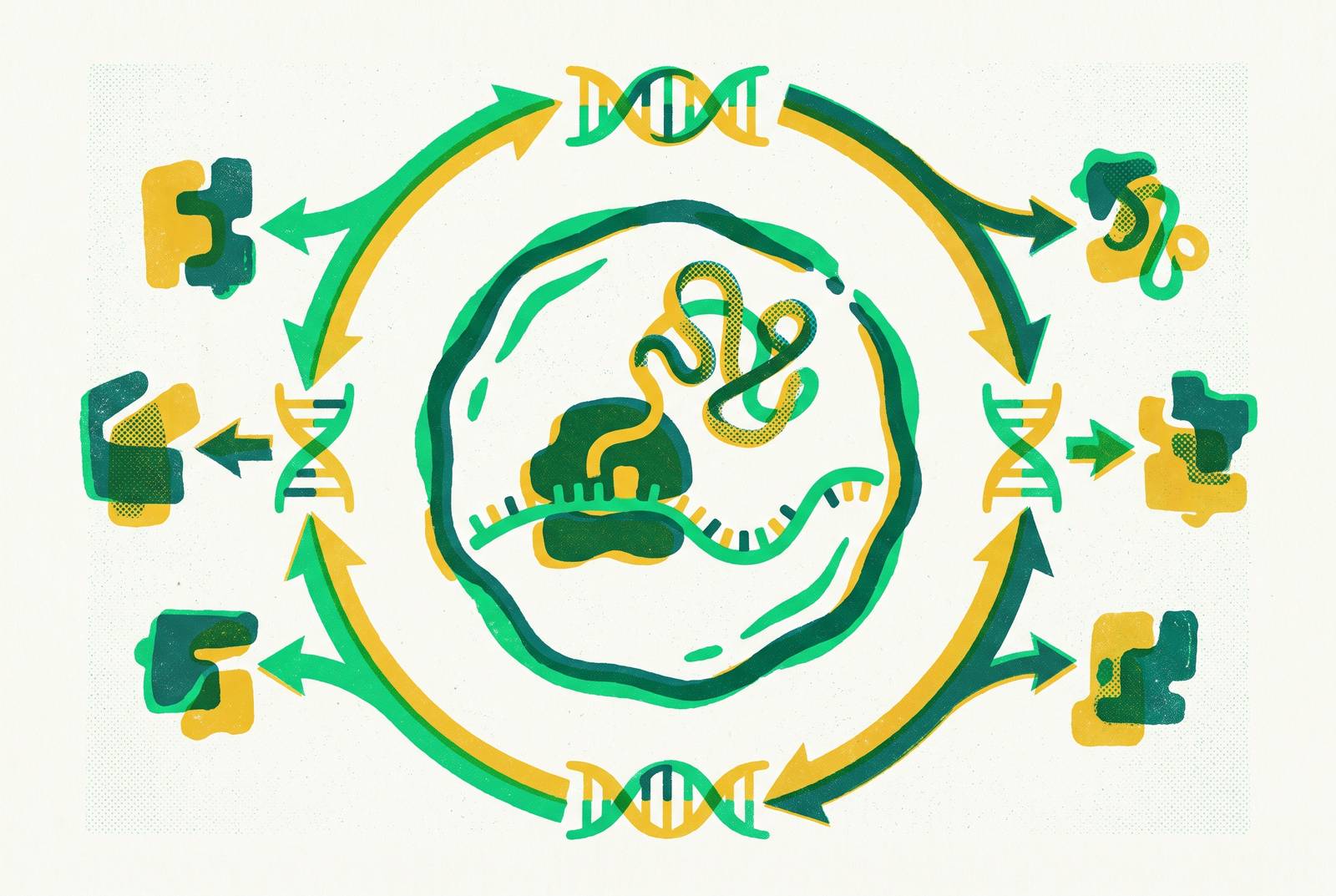
Directed evolution campaigns are limited less by biology than by logistics: the number of variants a lab can physically clone, express, and screen inside a living cell per cycle. Cell-free protein synthesis removes that constraint by taking the cell out of the loop entirely, and the consequences for how fast and how far a fitness landscape can be mapped are now documented across several published campaigns.
The cell-viability constraint as the binding limit on directed evolution throughput
A standard cell-based directed evolution round runs through cloning, transformation, culture growth, induction, and in many cases purification before anyone can measure whether a given variant does anything useful. That sequence takes about a week per round, and it has to run for every single variant in the library. The living host turns the screen into a negotiation: the cell has to survive whatever protein it's been told to make, and the protein has to survive the cell's own quality-control and degradation systems before it ever reaches a plate reader. Toxic proteins, membrane proteins, and anything prone to misfolding into inclusion bodies run straight into this negotiation and usually lose, because the cell actively resists producing the very thing the engineer is trying to improve.
Only a small slice of sequence space ever gets tested in a given campaign, because only a small number of variants can be pushed through the pipeline before time or budget runs out. Wittmann's retrospective on machine-learning-assisted directed evolution traces much of the field's underperformance to exactly this mismatch: researchers building models that propose thousands of candidate sequences, deployed into workflows that were never built to synthesize or screen anything close to that number, with DNA synthesis costs among the practical constraints the models tend to ignore. A model's predictions are only as useful as the lab's capacity to test them, and cell-based capacity has a hard ceiling.
CFPS and the molecular architecture that removes the viability constraint
Cell-free protein synthesis takes the transcription and translation machinery out of the cell, either as a crude lysate from broken-open cells or as a reconstituted mixture of purified components, and runs it in an open reaction vessel that has no membrane to maintain, no growth curve to sustain, and nothing resembling an immune system to manage. There is no organism in the tube to keep alive, so there is no competing objective between host survival and protein output.
Two architectures dominate current practice. Lysate-based systems use crude extract, cost less, scale to large reaction volumes, and support milligram-scale protein production. Reconstituted PURE-type systems assemble only purified components, which makes them fully defined, free of contaminating nucleases and proteases, and more reproducible and controllable in composition, at a higher cost per reaction. Both share the property that matters most for directed evolution: the reaction is open. A researcher can drop in folding chaperones, cofactors, detergent micelles for membrane targets, or unnatural amino acids directly into the mix, interventions that a living cell either blocks outright or tolerates only under narrow conditions. That openness amounts to a single advantage: direct control over the chemical environment a protein folds in, exercised in real time rather than negotiated through a cell's own regulatory machinery.
Because no input energy gets diverted to keeping a cell alive, the theoretical ceiling on protein yield per unit of energy put into the reaction runs higher in CFPS than in cell-based systems, even though current production-scale titers still lag behind fermentation.
The DBTL cycle when variant synthesis is decoupled from cell culture
A cell-based design-build-test-learn round takes about a week to get from a proposed variant to a functional readout. A CFPS-based round, by contrast, has been run start to finish in six hours. Replacing cell culture with direct PCR-to-expression synthesis collapses the build and test stages of that cycle from days into hours, and turns true parallel screening across hundreds of variants into something that is both affordable and logistically ordinary rather than a special undertaking.
The six-hour figure covers both the expression step and the functional assay running at the same time in the same plate, rather than one step waiting on the other to finish. The whole process runs in standard microplate format, so it maps onto liquid-handling robots and fluorescence plate readers that most molecular biology labs already own, and no bioreactor or specialized fermentation hardware is required.
What that compression does to the campaign as a whole matters more than the hours saved on any single round. When each cycle takes six hours instead of a week, a lab can run far more design-build-test-learn iterations inside the same calendar time, and each additional iteration samples a region of sequence space the previous cycle hadn't reached. Machine learning models built into these pipelines now propose the next round of variants before the current round's data has even finished coming in, so the pace of the whole campaign is set by how fast the model can generate a prediction rather than by how fast the bench can process a plate.
What published ML-guided CFPS campaigns achieved
Four recent campaigns show that pairing machine learning with CFPS does more than speed up a process that cell-based directed evolution could already do slowly. Each one reaches a scale or a result that a week-per-cycle workflow could not reach inside any reasonable budget or timeline.
Landwehr et al., writing in Nature Communications in January 2025, built a platform combining cell-free DNA assembly, cell-free expression, and functional assays to engineer amide synthetases. The platform measured substrate preference across thousands of enzyme variants in tens of thousands of distinct reactions, and the resulting machine learning models predicted variants with up to 42-fold improved activity over the parent enzyme across nine pharmaceutical target compounds.
Thornton et al., publishing in ACS Synthetic Biology in May 2025, engineered TEV protease inside a fully automated biofoundry pipeline that covered DNA assembly, expression, screening, ML modeling, and redesign in one continuous system. An initial round of random variants fed a larger library tested with a FRET-based activity assay, and the resulting sequence-fitness data trained an Active Learning-assisted Directed Evolution framework, which then proposed further variants that showed meaningful gains in kinetic properties. What's new here is the automation: the entire loop, from DNA to redesigned sequence, ran without a human moving a plate between instruments.
A 2026 study in FEBS Open Bio screened staphylokinase variants using the PUREfrex reconstituted system and found that activity rankings generated from crude, unpurified CFPS reaction mixtures closely matched rankings obtained from purified protein. That result removes purification, historically a required step before any functional measurement, from the screening loop altogether, so a lab can rank variants directly out of the reaction tube.
A January 2025 paper in Trends in Biotechnology described a cell-free system for synthesizing M13 bacteriophage, producing phage three times faster than conventional in vivo methods. Researchers used the system to evolve T7 RNA polymerase to twofold higher read-through activity at the T7 terminator, and separately evolved a tryptophan tRNA into a suppressor tRNA with an eightfold increase in UAG stop-codon read-through. This case extends the architecture furthest: it isn't protein function being screened directly but a phage-based evolutionary substrate, run entirely outside a living host.
Different as these four campaigns are in target and method, they share one underlying loop: variants get synthesized directly from DNA templates in parallel, activity gets measured with a plate-compatible fluorescence assay, the resulting data trains a machine learning model, and the model's output gets redeployed into the next round, all without a living cell appearing anywhere in the cycle.
Difficult protein targets, toxic, membrane-associated, and aggregation-prone
For a specific and important set of targets, cell-free synthesis doesn't just get you faster to the result a cell-based workflow would eventually produce. It is often the only workflow that produces a usable result at all.
Consider a cytotoxic protein. A cell-based directed evolution campaign depends on the cell surviving long enough to be measured, but the most productive variants of a toxic protein are precisely the ones that kill the host or stall its growth, and a dead or arrested cell never appears in the screen. The host doesn't just fail to help here, it actively filters out the variants an engineer most wants to find. CFPS carries no survival requirement, so it carries no corresponding bias against toxic variants.
Membrane proteins, including GPCRs, ion channels, and transporters, face a different kind of resistance in a living host. Expressing them in E. coli routinely drives them into inclusion bodies or demands a heavily engineered strain built specifically to tolerate that one class of protein. CFPS reactions can include detergent micelles or nanodiscs added directly to the tube, which bypasses the membrane-insertion machinery that causes the trouble in vivo and lets the protein fold straight into a membrane-mimetic environment. Directed evolution of a membrane protein becomes workable once variant synthesis no longer depends on finding a host strain that can tolerate the protein in the first place.
Aggregation-prone and multi-domain proteins run into a related problem: pushing a cell to overproduce them exhausts its chaperone supply, triggers stress responses, and leads to inclusion body formation. In a CFPS reaction, pH, temperature, chaperone concentration, and substrate supply are all parameters the researcher sets directly and adjusts in real time, none of which can be tuned independently inside a living host without disturbing its growth. Difficult targets and directed evolution intersect at exactly the point where the cell-viability constraint does the most damage: a cell-based workflow doesn't just run slower on these proteins, it removes from the candidate pool any sequence that challenges the host's own stability.
Reproducibility and reagent transparency as practical barriers to deploying CFPS at scale
CFPS only delivers its throughput advantage across a multi-round directed evolution campaign if activity measurements stay comparable from round to round. That consistency, rather than raw speed, is the field's most contested open question.
Crude lysates are the source of most of the concern. Their composition isn't fully defined, and lot-to-lot differences in nuclease activity, translation factor levels, and energy regeneration capacity introduce noise that can bury a real fitness signal under batch variation. That problem compounds when a machine learning model trains on data from one lysate batch and then gets deployed to guide variant selection against a different batch entirely. Reconstituted PURE-type systems solve the problem that lysate composition is undefined, since every component is purified and known, but they cost substantially more per reaction and scale less easily than crude lysates, so the field hasn't treated them as a universal fix.
The i-POPFLEX system assembles 34 individually synthesized translation factors through automated liquid handling, generating a complete, ready-to-use reconstituted system within two days and producing enough output for 50 cell-free reactions at 25 microliter scale, a roughly five-fold improvement in productivity and reagent use over the standard PURExpress kit (E6800S) at the same reaction volume. It also showed higher sfGFP fluorescence and tighter reproducibility across replicates than both reference systems it was compared against. Separately, the 2026 staphylokinase study found that activity rankings from crude CFPS reactions tracked rankings from purified protein closely, which suggests that for at least some target classes, lysate noise affects absolute yield without corrupting the rank order a screening campaign actually depends on.
Technical reproducibility alone doesn't settle whether industrial users adopt the technology. The field still has no CFPS-specific quality standards or regulatory benchmarks, and standardization paired with systematic benchmarking has been identified as a prerequisite before companies take on the risk of adopting the technology at scale. Undisclosed reagent formulations make this worse: when a lab doesn't know what's in its lysate, a failing batch gives it nothing to troubleshoot against, and there's no way to tell whether a bad result came from the reagent or from the protein being tested, whereas documented formulations and lot-level quality control data are what let a team distinguish a reagent problem from a protein problem.
Sepia Biosciences' OpenCFPS™ is built around that distinction: it publishes its formulation and lot-level QC data, which gives a directed evolution team a documented baseline to compare results against from one run to the next, and its reagent cost per variant screened is set up to support high-throughput campaigns involving thousands of reactions across multiple design-build-test-learn cycles rather than limiting how many a lab can afford to run. A lab needs to trust that a result from round three means the same thing a result from round one meant, and transparency, set beside i-POPFLEX's engineering fix and the staphylokinase result's statistical reassurance, is a third, complementary route to that goal.
The reagent economics of high-throughput CFPS screening
The economic question for CFPS in directed evolution is the cost per functional data point once every hidden step of a cell-based alternative gets counted, not the price per microliter of reagent, and that calculation tends to favor CFPS once the comparison is made honestly.
Cell-based expression carries overhead that rarely appears in a simple per-run budget: cloning consumables, failed transformations, culture media, induction time, and downstream purification all scale linearly with the number of variants tested, and CFPS removes most of these steps from the workflow entirely. Crude lysate costs run around USD 0.03 per microliter, a price point that makes campaigns involving large numbers of reactions financially realistic rather than aspirational. Reconstituted PURE systems cost substantially more per reaction. High-throughput screening campaigns currently lean toward lysate-based formats when reaction count is the priority.
Reagent reuse adds another lever. Recycling key components, particularly T7 RNA polymerase and plasmid DNA, can cut total reaction cost by as much as roughly a third, which argues for building reuse into a workflow's standard design rather than treating it as a later optimization. Because CFPS reagents such as OpenCFPS™ are fully documented and priced for bench-scale use, a lab can run variant libraries across dozens of parallel conditions, cofactor concentration, temperature, and other variables, without reagent cost becoming the factor that limits the experiment's design, and the same transparency lets scientists troubleshoot and tune their own protocols instead of treating the reagent mixture as a sealed box.
The ML-guided campaigns described earlier in this piece ran into the thousands of reactions per study. At that scale, the per-reaction cost of the reagent system is the single largest variable in total campaign cost, which makes the choice between lysate-based and reconstituted formats, and between transparent and undisclosed formulations, a strategic decision about what a campaign can afford to run rather than a minor procurement detail.
Sources
- Microbial cell-free protein synthesis and its progression toward industrial use
- Cell-Free Protein Synthesis as a Method to Rapidly Screen Machine Learning-Generated Protease Variants
- Rapid screening of staphylokinase protein variants using an unpurified cell‐free expression system - Tomková - 2026 - FEBS Open Bio - Wiley Online Library
- Accelerated enzyme engineering by machine-learning guided cell-free expression
- Cell-Free Protein Synthesis as a Method to Rapidly Screen Machine Learning-Generated Protease Variants
- A cell-free bacteriophage synthesis system for directed evolution: Trends in Biotechnology
- Advances in Machine Learning for Directed Evolution: A Five-Year Retrospective