Cell-Free Biosensor Prototyping for Small Molecule Detection
Rapid prototyping without cells lets researchers test biosensor designs in hours instead of days.
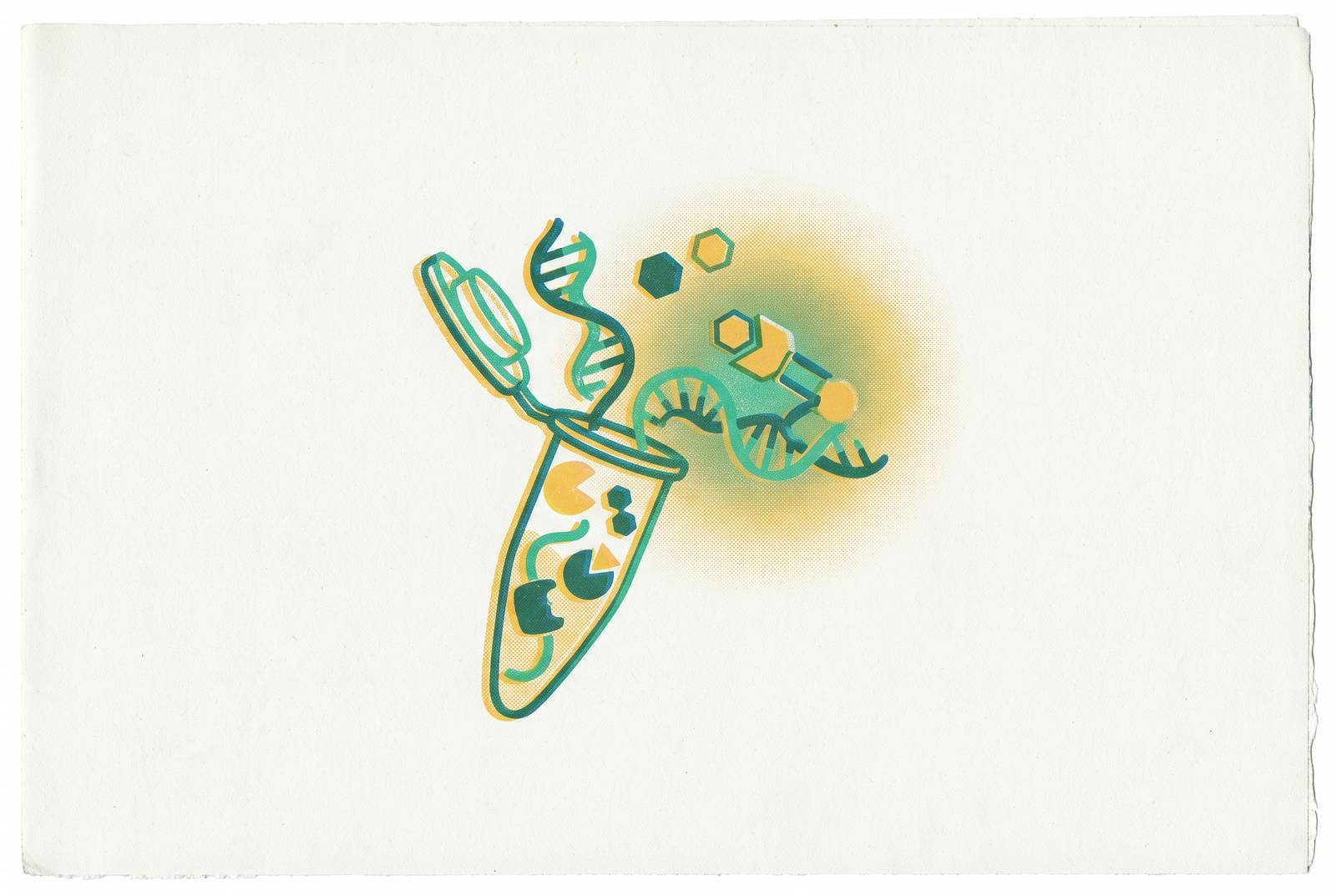
Biosensor development lives and dies on iteration speed, and cell-based systems are slow by design. Cell-free protein synthesis strips out the parts of that process that have nothing to do with the actual biology, cloning, transformation, colony picking, and lets researchers move straight from a genetic design to a working sensor in hours rather than days. That shift determines which sensing problems are worth attempting.
Cell-based prototyping bottlenecks in biosensor development
A biosensor has three parts that all need tuning at once: the sensing element that recognizes the target, the reporter that makes recognition visible, and the specificity that keeps the sensor from firing on the wrong molecule. None of these get solved on the first try. Development means running the same loop, design, build, test, learn, dozens or hundreds of times before something works well enough to trust.
In a cell-based workflow, every one of those loops has to pass through gene cloning, transformation into a host, colony selection, culture growth, and, if the sensor is a protein rather than a whole-cell reporter, purification. Each of those steps is a place where things go wrong for reasons unrelated to whether the sensing design itself is any good. A colony fails to grow. A ligation doesn't take. A prep yields nothing.
Living cells also come with constraints that have nothing to do with sensor performance and everything to do with keeping the host alive. A protein that's toxic to the host can prevent accumulation to the levels a strong signal requires. The cell wall and membrane mean the sensor never encounters the target molecule exactly as presented, so what gets tested inside the cell may not reflect what would happen in a real sample. Stress responses triggered by expression itself can quietly distort a fluorescent readout, so a "hit" in the screen might just be a stressed cell, not a working sensor.
Stacking these constraints on top of the workflow bottleneck makes the cost compound fast. Testing a single hypothesis about an allosteric transcription factor variant, for instance, whether one point mutation improves binding to a target ligand, is slowed substantially when the rate-limiting step is transformation and culture time rather than the biology being tested.
Cell-free protein synthesis as a reaction platform
Cell-free protein synthesis (CFPS) runs transcription and translation in a tube, using cell extracts or purified components mixed with nucleotides, amino acids, an energy source, and a DNA or RNA template. No living cell is involved at any point. The reaction produces protein directly from the genetic instructions handed to it.
The operational detail that matters most for prototyping: CFPS reactions accept both plasmid DNA and linear PCR product as templates. That means a researcher can amplify a genetic circuit design straight off a PCR reaction and drop it into a cell-free tube, skipping cloning and transformation. Transcription and translation happen linked, in the same pot, and a finished protein comes out in a matter of hours rather than the day or more a bacterial culture cycle demands.
Two broad system types dominate the field. Crude lysate systems, made by breaking open cells and keeping the machinery intact, are the workhorse option: E. coli lysate is the most common choice for its yield and speed, though wheat germ, rabbit reticulocyte, insect, plant, and human cell-derived lysates all see use depending on what the protein needs to fold correctly. Reconstituted systems, built from individually purified components rather than crude lysate (commercial PURE kits are a well-known example), trade some of that speed and low cost for tighter control over what's in the reaction, since nothing extra from the host cell is along for the ride.
The specific properties of CFPS that make it well-suited to biosensor prototyping
Speed is the headline property, but it's not the only one that matters. A design change made in the morning can produce a protein, and a testable signal, by the afternoon. That kind of turnaround changes the economics of trying something speculative.
Because the reaction happens in an open tube rather than inside a living cell, the small molecule being sensed can be pipetted directly into the mix. There's no membrane to cross, no transporter to rely on, no question of whether the compound even gets into the cell at a concentration that matters. What's added to the tube is what the sensor sees.
The same openness makes the system programmable in a way cell-based screening isn't. Genetic circuits encoded on linear DNA fragments can be swapped in and out of parallel reactions without a single cloning step. A plate of 96 or more distinct designs can be running at once, side by side, under identical conditions.
CFPS reactions also survive being freeze-dried. As ROSALIND demonstrates, a lyophilized cell-free reaction can be stored at room temperature and reactivated with nothing more than the addition of water and sample. That's not a side benefit bolted on for field use, it's the same reagent used on the bench for prototyping, repackaged for deployment. The prototyping platform and the deployment platform are, in a real sense, the same chemistry.
The main genetic circuit architectures used to sense small molecules in cell-free systems
Allosteric transcription factors, aTFs, are the workhorse sensing element behind most cell-free small-molecule biosensors. An aTF binds its target ligand, changes shape, and as a result either represses or activates transcription of a reporter gene sitting downstream. The chemistry is well understood and has been for decades, but re-engineering an aTF to recognize a new, non-native ligand has historically been hard: it takes screening through large libraries of variants to find one that binds the new target without losing the switch-like behavior that makes the sensor work. A 2024 study in Nature Communications demonstrated exactly this, screening large aTF variant libraries to find sensors for non-native ligands including naltrexone and quinine.
The ROSALIND platform (RNA Output Sensors Activated by Ligand Induction) builds on the same aTF logic but reads out through in vitro transcription rather than a full protein reporter, detecting environmental contaminants such as heavy metals, antibiotics, and other small molecules. ROSALIND reactions are prepared in advance, freeze-dried, and stored at room temperature until a sample is added to rehydrate and activate them. This makes the platform a clear example of how a cell-free prototyping architecture can become a field-ready format without changing the underlying chemistry.
Riboswitches and toehold switches work at the RNA level instead of through a protein transcription factor: the RNA folds in response to the analyte's presence, and that fold either exposes or hides the sequence needed to start translation of a reporter. These pair well with fluorescent RNA aptamers or standard fluorescent proteins as the visible output.
CRISPR-based designs are the newest addition, and two approaches stand out. In one, an aTF's ligand specificity gates the trans-cleavage activity of Cas12a, using the enzyme's cutting behavior to amplify a weak signal into a strong one; this approach has been demonstrated for small molecules and heavy metals in cell-free formats. In the other, Cas14a combined with an aTF sensing element was used by Wang et al. in a study in Biosensors and Bioelectronics to build an electrochemical sensor for progesterone across multiple sample types.
How readout engineering expands what cell-free biosensors can report
The standard reporters, a family of fluorescent proteins and fluorescent RNA aptamers, work, but they have real ceilings. Biological fluorescent molecules have comparatively low quantum yield, so the signal-to-noise a researcher gets per molecule of reporter is limited, and there's a hard cap on how many distinct aptamers can be read out at once in the same reaction before their spectra start overlapping.
Quantum dot-based reporters offer a way around both limits. Srivastava et al. demonstrated a system called QD-PDD (Peptide-PNA DNA Dye) that works fully inside a cell-free transcription-translation reaction, using nucleic acid specificity to trigger a FRET signal change between a quantum dot donor and a Cy3 acceptor when a restriction enzyme, BamHI, gets expressed in response to the analyte. Applied to cadmium detection in water, the design uses a cadmium-sensitive operon to drive BamHI expression, and the enzyme's activity flips the QD-PDD signal. Compared to fluorescent proteins or RNA aptamers, quantum dots offer higher quantum yield and more room to multiplex several targets in one reaction.
Electrochemical readouts are the other major direction, and they're a natural fit for CFPS because the reaction is already happening in a tube that can sit on top of, or next to, a small electrode. The Cas14a-aTF progesterone sensor mentioned above represents this broader direction of non-optical readout integration. Colorimetric and paper-based formats round out the picture: cell-free reactions dried onto paper substrates give a readout visible to the naked eye, no plate reader or electrode required, which matters most in field settings where instrumentation isn't available.
High-throughput variant screening: how CFPS compresses the design-build-test cycle for aTF engineering
Engineering a better aTF means mapping a sequence-function landscape that's too large to explore by intuition alone: which residues control which ligand's specificity, which mutations improve sensitivity without wrecking the on/off switch, where the cross-reactivity that ruins a real-world sample actually comes from.
Cell-free screening removes transformation and colony selection from that loop. Because linear DNA templates can be tested directly, a design-build-test-learn cycle that used to take days shrinks down to hours. In a typical plate-based cell-free screen, a library of aTF mutants gets tested against a fixed set of analyte concentrations, and each mutant's activity is scored as a fold change in fluorescence relative to the wild-type sequence.
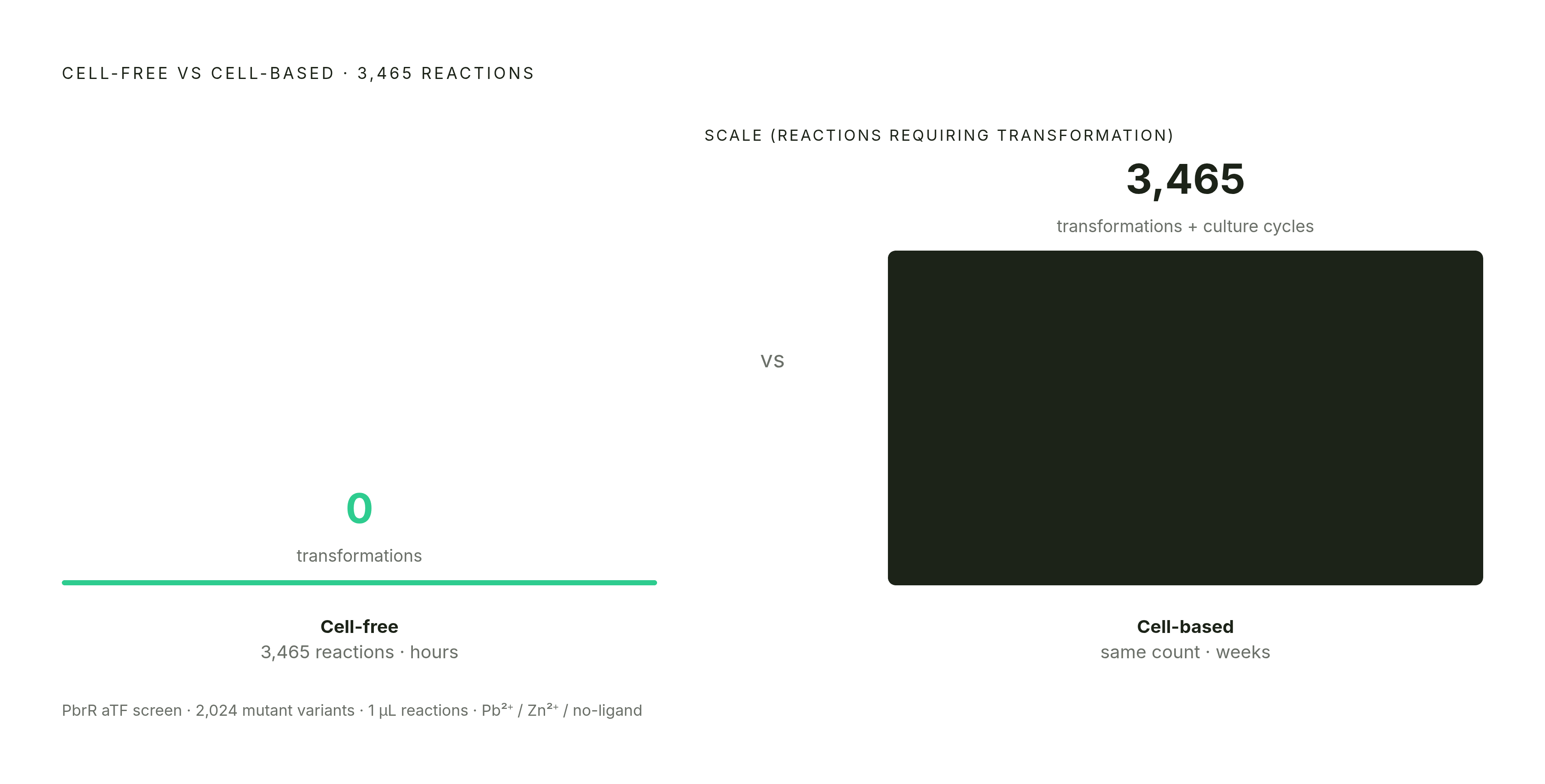
The scale this unlocks is visible in work done on PbrR, a lead-sensing aTF. A machine-learning-guided design-build-test-learn workflow explored mutations across every residue position in the protein, assaying 2,024 mutants in total to map out which changes helped, which hurt, and which did nothing. The cell-free screen behind that dataset ran 3,465 individual reactions at a 1 microliter scale, each one tested against 1 micromolar lead (a low, realistic concentration), 30 micromolar zinc (a high concentration of a chemically similar, competing ion meant to stress-test specificity), and a no-ligand control. A machine learning model trained on that dataset picked up on sequence-function patterns that rational, hypothesis-driven design would have missed. None of that screening scale is realistic in a cell-based format, where each of those 3,465 reactions would otherwise need its own transformation and culture step.
Difficult sensing targets: where cell-free expression is the only practical path
Some of the proteins that make good sensing components, receptors, binding domains, signal transducers, simply won't express in a living cell. They're toxic, they misfold, they refuse to stay soluble, or they need to sit inside a membrane to function.
Toxic proteins are the clearest case. In a cell-based system, toxicity puts a hard ceiling on expression, because past a certain concentration, the protein kills the host before it can accumulate to useful levels. Refolding a toxic protein out of inclusion bodies is possible but inefficient, and it can shrink the fraction of correctly folded, active protein substantially. CFPS sidesteps the problem completely, since there's no host viability to protect.
Membrane proteins carry their own, different difficulty: they need to insert into a lipid bilayer to fold and function correctly, which cellular expression handles naturally but often inefficiently and unpredictably. Cell-free reactions can be supplemented directly with supported lipid bilayers, hydrogels, or artificial cell constructs, an area Green et al. note as one of the more active fronts in expanding what cell-free biosensors can be built from.
Multi-domain proteins face a subtler problem: in the crowded interior of a living cell, one domain can start folding before its neighbor is even translated, and that timing mismatch can produce a misfolded, nonfunctional protein. Cell-free reactions let a researcher add chaperones or other folding-assist factors directly to the tube, at whatever concentration and timing the protein actually needs.
Choosing between CFPS and cell-based expression at each stage of biosensor development
CFPS is the better choice whenever iteration speed is the bottleneck, when a design needs testing in hours or days rather than weeks. It's also the only realistic option when the sensing protein itself is toxic, insoluble, membrane-bound, or needs a non-standard amino acid incorporated into its sequence. Large variant libraries, the kind needed to find a lead aTF sequence worth committing to, are far cheaper and faster to screen cell-free. And when the end goal is a lyophilized, room-temperature-stable, point-of-care sensor, CFPS isn't just the prototyping tool, but also the production format.
Cell-based expression still holds its ground where CFPS can't compete on biology rather than speed. Complex post-translational modifications that living cells handle natively may not be fully replicated in most cell-free lysate systems. Sensing proteins with demanding folding or modification requirements may still be better served by a living cell's native machinery. And once a sensor construct is finalized and the question shifts from prototyping to manufacturing at scale, cell-based fermentation remains the more established, cost-effective route.
The two approaches aren't really competing for the same job. A sound strategy runs CFPS through the early stages, sensing circuit design, reporter selection, aTF variant screening, where iteration speed and direct analyte access decide how fast a working design gets found, and reserves cell-based expression for the later question of how to make the finished sensor at volume.
Sources
- Recent Advances in Developing Cell-Free Protein Synthesis Biosensors for Medical Diagnostics and Environmental Monitoring
- Recent Advances in Developing Cell-Free Protein Synthesis Biosensors for Medical Diagnostics and Environmental Monitoring
- Cell-Free Protein Synthesis-Based Biosensing Platforms for Clinical Diagnostics | ACS Sensors | ACS Publications
- Quantum Dot and Nucleic Acid Optical Readout for Cell-Free Biosensing
- Cell-free systems for development of biosensors - ScienceDirect
- Cell-free systems and genetic biosensors for accelerating enzyme and pathway prototyping - ScienceDirect
- science.org