On-Demand Protein Production With Cell-Free Reagents
Lyophilized cell-free systems enable on-demand protein synthesis without living cells.

Cell-free protein synthesis produces protein without a living cell, by reconstituting the transcription and translation machinery in a tube and letting it run on a template a researcher supplies. Once protein synthesis is separated from cell growth, the reaction starts on the researcher's schedule, accepts protein targets a living cell would reject, and scales in ways a culture flask cannot.
What cell-free protein synthesis does inside a reaction tube
A CFPS reaction takes two inputs: a template and a lysate. The template can be mRNA or DNA, and the DNA can be a linear PCR fragment rather than a plasmid cloned into an expression vector, so a researcher can go from a DNA fragment to protein without the cloning step that normally opens a cell-based expression project. The lysate supplies the machinery itself: ribosomes, aminoacyl-tRNA synthetases, translation factors, and the enzymes that support them. The researcher adds amino acids, energy substrates, and the template, and the reaction does the rest.
Keeping that machinery running for hours rather than seconds requires solving a specific engineering problem: energy regeneration. Protein synthesis consumes ATP continuously, and a reaction tube has no metabolism of its own to replenish it.
Because the reaction happens in an open tube rather than inside a membrane, a researcher can add things to it that a cell would never tolerate. Non-canonical amino acids, for instance, can be incorporated directly into the growing protein chain, a manipulation documented in reviews of CFPS reactor formats as something the open cell-free environment permits and a living cell does not. That one capability points to the deeper fact underlying everything that follows: once there's no cell wall to cross and no cell viability to protect, the reaction can be opened up, formulated around, and pushed toward protein targets that a cell-based system would never produce.
How lyophilization turns a bench reaction into an on-demand format
The mechanism above still describes a wet, actively running reaction. Lyophilization is what makes that reaction available on demand in a practical sense, by converting it into a dried reagent that can sit on a shelf until the moment a researcher needs protein. Before lyophilization became standard, CFPS still meant preparing fresh lysate close to the time of use, which tied the reagent's usefulness to the same kind of logistics that slow down cell-based work. Freeze-drying removes that constraint.
A 2026 review in Microbiology names storage and transport of lyophilized reagents as a specific advantage CFPS holds over cell-based systems, which depend on maintaining a living culture. A living culture needs feeding, monitoring, and a narrow window of use. A freeze-dried reagent needs a freezer, and later, water.
That storage advantage has started to shape regulation as well as lab practice. In July 2025, the UK introduced a legal framework for point-of-care manufacturing, opening the door to on-site manufacture of advanced therapies, including cell and gene therapies and blood products, in clinical settings. For the bench researcher, the relevant signal isn't the clinical application itself but what the policy shift says about the field's maturity: regulators are now writing rules around the assumption that protein and biologic manufacture can happen outside a conventional production facility, on a timescale fast enough to matter at the point of use.
The contrast with cell-based production comes down to what has to happen before protein synthesis even starts. A cell-based workflow needs time to grow a culture before a single molecule of target protein appears. A lyophilized CFPS reagent needs only rehydration, and protein synthesis begins within minutes of adding water. For a lab running multiple experiments a week, that difference changes how experiments get scheduled, not just how fast any one of them finishes.
Why removing cell viability as a constraint changes which proteins can be made
Speed is one axis of CFPS's advantage. Because there's no living cell to keep alive, CFPS can synthesize proteins that are toxic, membrane-bound, rapidly degraded, or otherwise incompatible with cell-based expression. Each of these categories represents a case where cell-based expression doesn't just underperform, it fails outright, because the biology of a living cell actively works against producing the target.
Toxic proteins illustrate the problem most directly. In a living cell, a protein that kills its host terminates the production run before useful quantities accumulate. In a CFPS reaction, there's no host to kill, so the reaction proceeds regardless of how cytotoxic the product is. Work by Jin, Kightlinger, and Hong in 2019 went further, showing that adding an immunity protein, such as the one that binds colicin, can actually improve the yield of a cytotoxic product rather than merely tolerate it.
Membrane proteins fail in cell-based systems for a different reason: their hydrophobic domains need a lipid or lipid-like environment to fold correctly, and overexpressing them in a cell often overwhelms the membrane insertion machinery. In an open CFPS reaction, detergents, nanodiscs, or liposomes can be added directly to stabilize those domains, without any strain engineering and without extending expression time.
Disulfide-bonded proteins present a folding problem rather than a toxicity problem. Many therapeutically relevant proteins depend on multiple correctly paired disulfide bonds, a modification that standard bacterial cytoplasm doesn't support well. Adding DsbC, the enzyme that catalyzes disulfide bond exchange in E. coli, to the reaction has enabled production of proteins with as many as 24 disulfide bonds, spanning roughly 14 to 53 kDa in size. That range reflects a genuine expansion of structural complexity CFPS can handle.
Rapidly degraded proteins round out the list. Inside a living cell, intracellular proteases are constantly at work, and an unstable protein may be cleared faster than it accumulates. Without that proteolytic machinery acting on the product, unstable proteins have a better chance of reaching measurable levels in a CFPS reaction.
The honest counterpoint concerns post-translational modifications. Glycosylation and other complex folding steps that depend on eukaryotic cell biology are harder to reproduce in prokaryotic lysates, and that limitation is real for anyone working with E. coli-based CFPS. The platform's answer has been to extend beyond bacterial lysates: wheat germ, insect cell, CHO, and HeLa lysate systems bring eukaryotic machinery into the cell-free format, and HeLa lysates in particular support mammalian-like PTMs at yields higher than other mammalian cell-free systems. The constraint that removing cell viability solves for toxicity and folding doesn't disappear entirely for PTMs, but choosing the right lysate narrows the gap considerably.
Simplifying the reaction formulation for accessibility and reproducibility
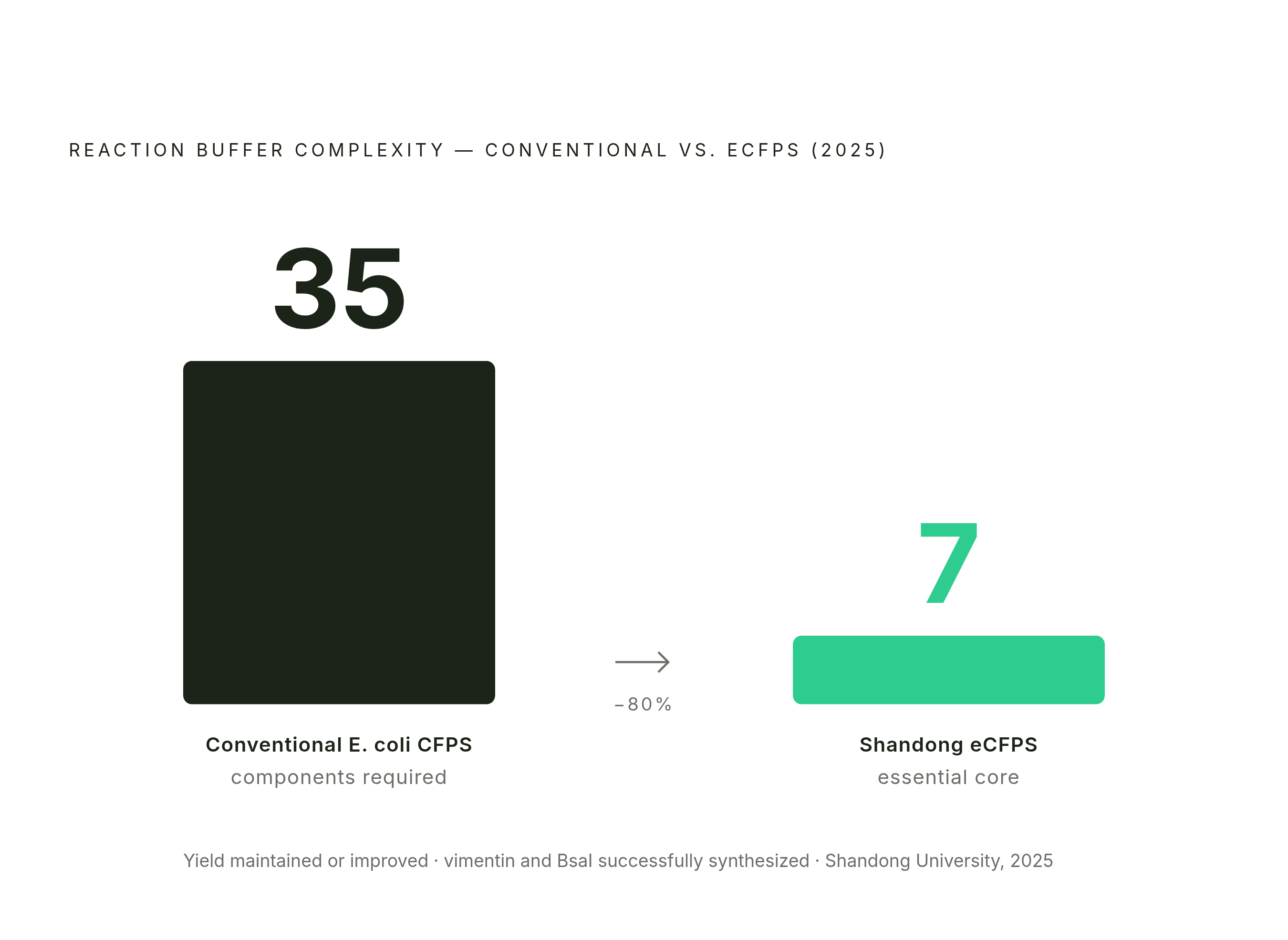
CFPS can make proteins cell-based systems cannot, but that capability has not translated into widespread adoption, largely because conventional E. coli CFPS systems have historically demanded reaction buffers with a large number of components, which made the reactions hard to optimize, troubleshoot, and reproduce from lab to lab.
A 2025 preprint from Shandong University quantified the problem and then addressed it directly. Conventional E. coli CFPS systems were shown to rely on buffers with up to 35 components, and the team's optimized eCFPS system cut the essential core down to 7, without losing yield, and in many cases improving it. The same work introduced a "fast lysate" protocol that skips the traditional runoff and dialysis steps, which had been a time-consuming part of preparing bacterial cytosolic extracts and a further barrier to labs adopting the method on their own.
Simplifying the formulation did not narrow what the system could produce. The eCFPS system successfully synthesized challenging proteins including self-assembling vimentin and the cytotoxic restriction endonuclease BsaI, confirming that simplification did not come at the cost of functional range.
What's actually at stake in this simplification is reproducibility, across batches, across users, and across physical locations. Reproducibility across batches, users, and locations is the practical consequence at stake: the 2026 Microbiology review identifies cross-laboratory reproducibility as essential and batch-to-batch lysate variability as a persistent barrier to industrial adoption. A simpler formulation is easier to characterize, and an easier-to-characterize formulation is easier to reproduce reliably outside the lab that invented it.
One alternative approach to the same reproducibility problem is the PURE system (Protein synthesis Using Recombinant Elements), which replaces the undefined lysate entirely with a fully defined set of purified enzymes. That substitution buys transparency, since every component in the reaction is known and controlled, at the cost of higher per-reaction expense. Lysate-based and fully reconstituted systems represent two different answers to the same underlying question: how much of the reaction's contents does a researcher need to see in order to trust the result.
Visibility into lot-level quality control data and documented formulations is what lets a researcher tell a bad batch of reagent apart from a bad protocol; without that information, troubleshooting a failed reaction is guesswork. OpenCFPS™ from Sepia Biosciences has taken the position that this information should be published rather than withheld, releasing lot-level QC data and open formulations where most commercial kits keep both proprietary. That transparency doesn't change what the reaction can produce, but it changes how quickly a researcher can trust, or diagnose, a given result.
Plate-based formats and automation that make high-throughput variant screening practical
The same openness and simplicity that make a single CFPS reaction easy to run also make a thousand of them easy to run in parallel. Because each reaction needs only template and reagent, with no upstream cell culture to grow, the format scales horizontally into plates and automated liquid handling without much added complexity. A cell-based screen has to carry every variant through cloning, transformation, and selection before expression even begins; a CFPS screen skips straight to expression, variant by variant, well by well.
Well-plate reactors have become the standard platform for high-throughput CFPS work, and 384-well formats now support protein array construction and antibody validation at the scale those applications require. Off-the-shelf reagents built to work with standard liquid handling equipment and microfluidic systems have made automated synthesis and purification workflows practical; Maharjan and Park, writing in 2023, point to combined expression and magnetic-bead purification systems as one working example of this kind of automated pipeline.
Miniaturization has pushed further still into microfluidic and droplet-based platforms. One such system, DropAI, has demonstrated screening of 100,000 picoliter-scale reactions, with the reactions themselves designed using AI. That example illustrates a direction the field is heading in, toward reactions small and numerous enough that computational tools, rather than a researcher's bench time, become the limiting factor in how many variants get tested.
Computational design tools are appearing earlier in the workflow, in reaction design itself. Neither example suggests that every lab running CFPS needs an AI pipeline. They show that the reaction format is compatible with computational design tools at a scale cell-based screening could not support.
For a protein engineer running directed evolution or variant library screening, the comparison that matters is CFPS against the days of cloning, transformation, and selection a cell-based system requires to evaluate even a single variant. OpenCFPS™ is built to work within standard plate and automation infrastructure, which makes it usable at this kind of throughput without requiring equipment built specifically for it.
Reaching milligram-scale yields
Screening thousands of variants identifies which protein to pursue. Characterizing that protein, by NMR, surface plasmon resonance, crystallography, or an animal model, requires a different kind of output: not many small reactions, but one reaction producing enough material to work with. Milligram-per-milliliter yields, the threshold those characterization methods generally require, are now achievable in CFPS, so the same reagent system that runs the screen can also supply the material for the follow-up assay.
The 2026 Microbiology review reports that improvements in translation efficiency now allow more than a milligram of protein per milliliter of reaction mix. Continuous-flow reactor formats push that further by extending the reaction from hours into days, and have demonstrated yields up to 700 mg/L for complex therapeutic proteins, a five-to-tenfold increase over standard batch reactions. A 2025 review of reactor formats lays out a comparative analysis of thirteen major CFPS reactor configurations, batch and continuous alike, across productivity, scalability, and technical complexity.
A 2026 automated reconstituted system called i-POPFLEX, described in ScienceDirect, reported protocols yielding 250 µl of purified protein solution at 10 to 12 mg/ml starting from 500 ml of culture, enough material for up to 50 cell-free reactions at 25 µl scale. That represents a meaningful gain in productivity and reagent efficiency measured against the standard PURExpress kit.
None of this makes CFPS a substitute for gram-to-kilogram commercial manufacturing; that remains a separate conversation with its own economics. What these yields do support is a complete early-stage workflow in one platform: a researcher can screen hundreds of variants in plates, identify the leads worth pursuing, and then produce those same leads at milligram scale without switching to a cell-based system to do it.
Reagent cost and recent formulation changes
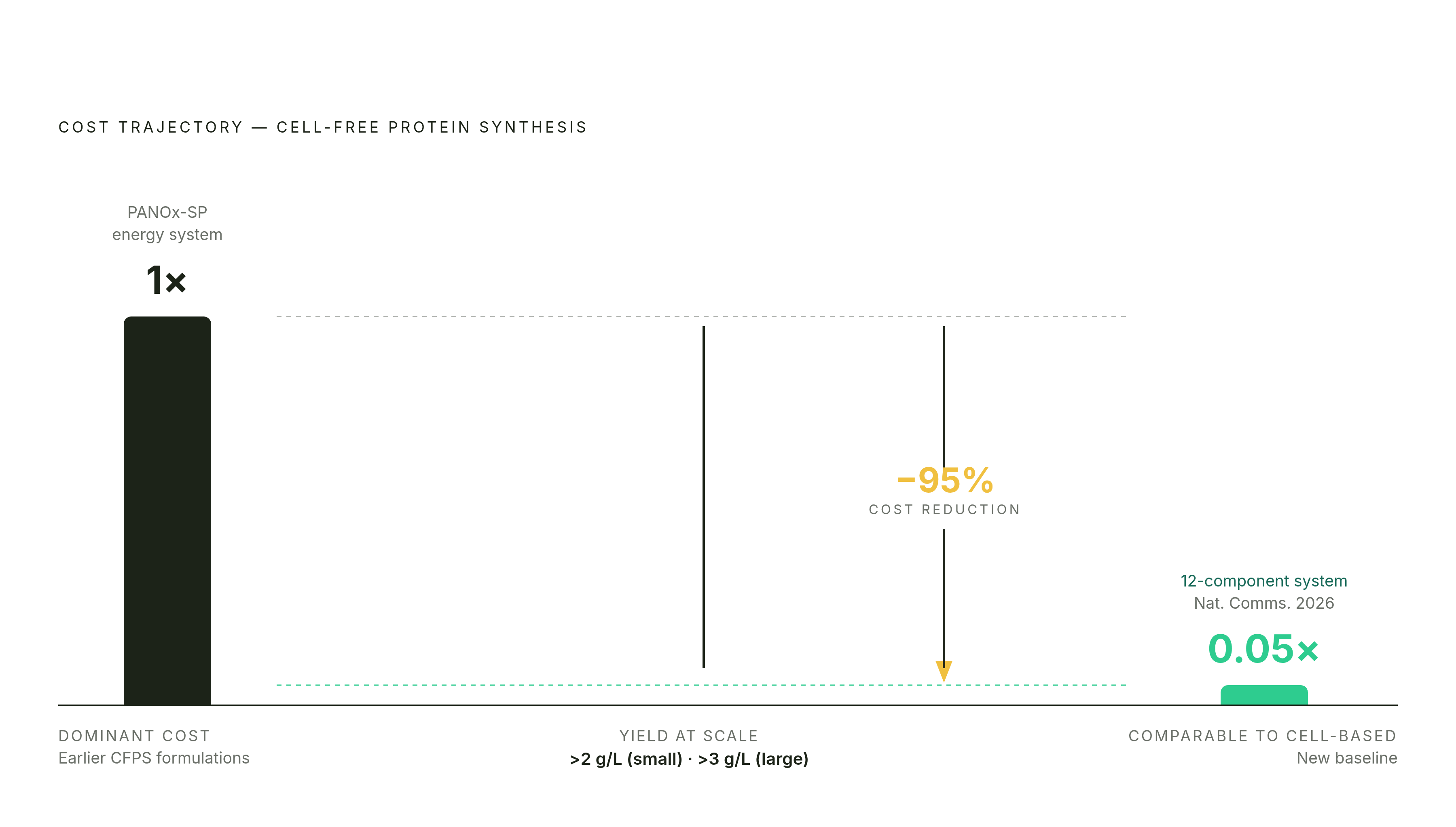
Cost has been the most durable argument against CFPS, and it has been a fair one. Recent formulation work, though, has cut the cost per gram of protein by more than an order of magnitude relative to the systems that gave CFPS its reputation for being expensive. The benchmark against which that reputation was built is the PANOx-SP phosphorylated-energy system, which the 2026 Microbiology review identifies as a major cost driver, responsible for the large majority of all material costs in cell-free expression.
A 2026 Nature Communications study screened over a thousand reagent formulations in search of a cheaper alternative and landed on a twelve-component system that achieved yields above 2 g/L at small scale and above 3 g/L at larger scale with oxygen supplementation, at a cost roughly comparable to cell-based production, an average reduction of about 95% over earlier cell-free reagent formulations. A separate 2026 Science Advances multisite study demonstrated CFPS-produced diagnostic enzymes at a low cost of goods per batch, with performance matching commercial gold-standard reagents.
The gap that remains at full commercial scale, grams to kilograms, hasn't closed. The 2026 review notes that most published yields still sit below 2 g/L and that cost continues to exceed cell-based production for high-volume commodity proteins. For early-stage work, the fair cost comparison is against the total development cost of getting a cell-based system running at all, the days of cloning, culture, and induction that have to happen before a single milligram of protein exists. Measured against that baseline, the economics behind CFPS no longer argue for avoiding it. They argue for reconsidering it.
Sources
- A simplified and highly efficient cell-free protein synthesis system for prokaryotes
- Microbial cell-free protein synthesis and its progression toward industrial use - PMC
- Cell‐free protein synthesis system: A new frontier for sustainable biotechnology‐based products - Maharjan - 2023 - Biotechnology and Applied Biochemistry - Wiley Online Library
- Cell-Free Protein Synthesis Reactor Formats: A Brief History and Analysis
- Robust production of recombinant phosphoproteins using cell-free protein synthesis