Acoustic Dispensing and Liquid Handling Automation for CFPS
Acoustic droplet ejection solves the precision problem holding back cell-free protein screening.
Cell-free protein synthesis has a dispensing problem, and until recently, most labs papered over it with the wrong tools. CFPS reactions aren't just small-volume assays that happen to be awkward to pipette by hand: they're chemistry running at a scale where hand-pipetting error and biochemical tolerance collide directly. A 2026 staphylokinase variant screening study published in FEBS Open Bio found that the old purify-then-assay approach took substantially longer, while the CFPS workflow (expression straight through to in-plate assay) took five to six hours. That gap doesn't stay flat as you scale up. It compounds, plate after plate.
Crude lysates behave nothing like the aqueous buffers most liquid handlers were built around. They're viscous, they vary batch to batch, and they clog or drag in ways that throw off a pipette tip mid-aspiration. Inside a working reaction sit ribosomes, tRNAs, energy substrates, amino acids, cofactors, and nucleotides, each one needing to land at a specific concentration relative to the others. If one component's volume drifts even slightly, the stoichiometry shifts enough to tank expression. Batch-mode CFPS yields already range from low micrograms per milliliter up to milligram scale depending on the system and target, so the biochemistry is often running close to its ceiling before dispensing error even enters the picture. Sloppy pipetting on top of that makes the losses stack fast. Worse, transcription and translation run continuously once the reaction starts, often wrapping up within hours. There's no midpoint where a tech can pause, check for a dispensing error, and fix it. Whatever goes into the well is what comes out.
Multichannel pipettes and pin tools make this worse once a lab scales to a full plate. Tip-to-tip carryover, dead volume trapped in the tip after aspiration, inconsistent draw from a viscous lysate stock: each one chips away at reproducibility, and by 384 wells, pipetting variance alone is enough to wreck well-to-well consistency. Hands and pipettes cannot dispense reliably at nanoliter volumes, no matter how careful the technique. CFPS only becomes a genuine high-throughput screening platform once the dispensing step can match the precision the biochemistry already demands, and that's the argument the rest of this piece is built on.
What acoustic droplet ejection does mechanically and why it fits CFPS
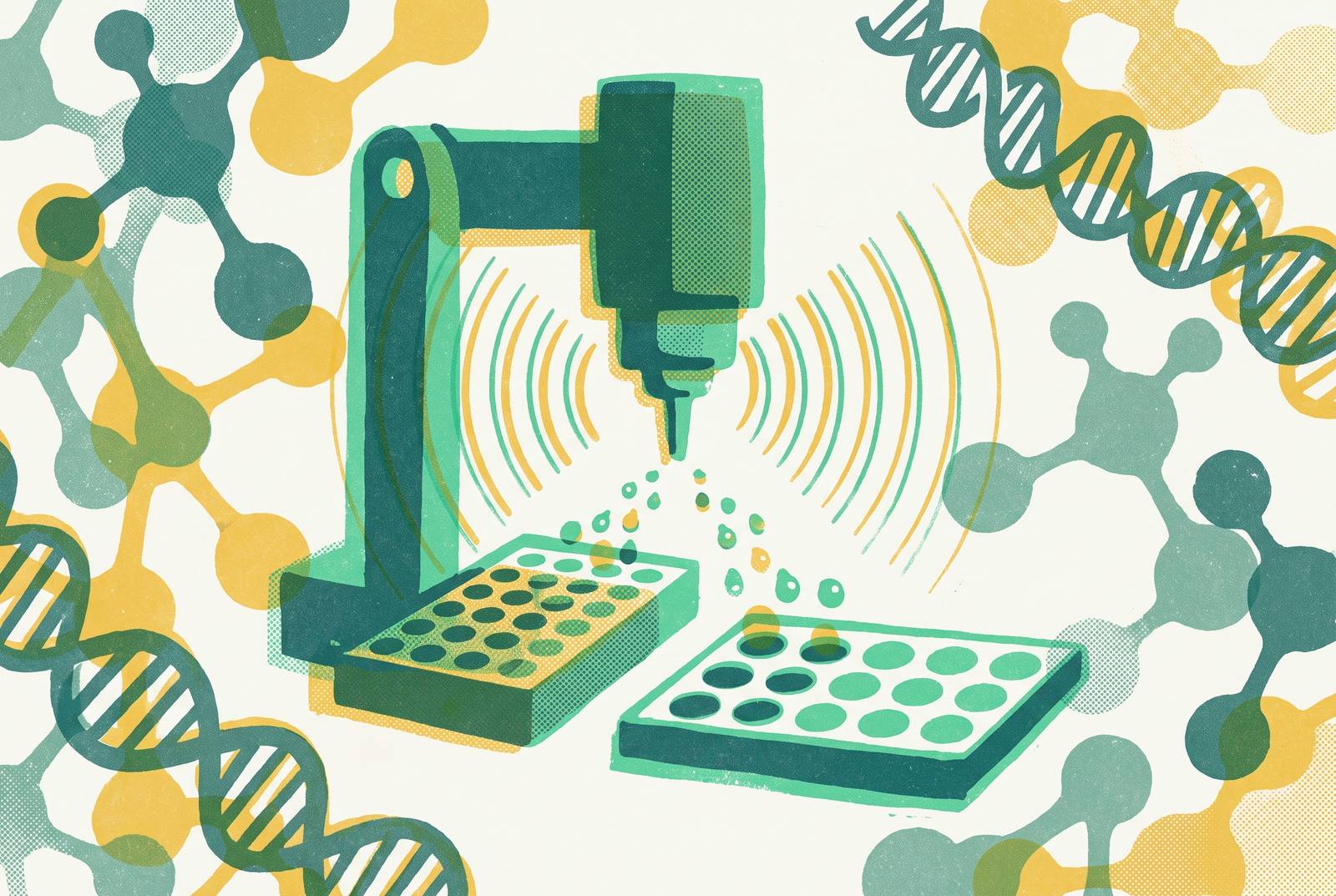
Acoustic droplet ejection, or ADE, uses a focused pulse of acoustic energy to eject a discrete droplet straight out of a source well and into a destination well. No tip ever touches either well. The energy pulse does the job a pipette tip used to do, at droplet volumes starting as low as 2.5 nanoliters per ejection, which is roughly the range where CFPS miniaturization starts to actually matter.
Removing the tip removes a whole category of failure, not just a minor one. There's no carryover between a lysate stock and a template variant sitting two wells over, which matters a great deal when a plate is running dozens of different constructs side by side. There's no dead volume lost to tip wetting, which matters when the fluid in question is an expensive, hard-to-replace CFPS component rather than water. And there's no tip-to-tip drift in how much viscous lysate gets pulled up on any given pass.
Instruments built for this, like the Echo 650, run something called Dynamic Fluid Analysis: before dispensing, the machine acoustically interrogates each source well and adjusts its power on the fly. That's what lets a crude lysate, thick and inconsistent lot to lot, get dispensed with the same accuracy as a clean aqueous buffer, with nobody standing there recalibrating between runs. A 2025 study published in ScienceDirect documents exactly this setup for AI-driven CFPS work, with nanoliter volumes of CFPS components transferred into 384-well plates, the plates getting sealed and incubated, and a multi-mode plate reader quantifying expression by fluorescence afterward. That throughput capacity turns iterative variant screening from a bottleneck into a routine step.
The fit with CFPS comes down to three things working together, and none of them alone would carry the job. Nanoliter dispensing lets a reaction shrink without forcing a lab out of the standard 384-well format that every incubator, sealer, and plate reader already handles. No-contact transfer means lysate, template DNA, and energy mix can go in one after another without any well touching its neighbor's contents. And acoustic interrogation absorbs the lot-to-lot viscosity swings that crude lysate preps always carry, so the dispensing step doesn't need constant babysitting.
Miniaturization and plate format's effect on CFPS economics and throughput
Reagent cost scales with volume. Shrinking the reaction lowers the cost per data point right along with it. That's the entire economic argument for acoustic dispensing in CFPS: it turns what used to be a hard ceiling, how much lysate and amino acid stock a lab could afford to burn through per screen, into something closer to a floor.
Reported gains run 50 to 100 times more reactions per run once acoustic dispensing replaces manual methods, and that changes what "high-throughput" even means for a CFPS lab. Resource availability, not biochemistry, becomes the limiting factor. And resource availability is a budget line, which is a very different problem to solve than a biochemical one.
The 384-well plate does more work here than it looks like it's doing. As a widely adopted standard format, a lab doesn't need exotic hardware to run acoustic CFPS at scale. Each well acts as its own independent nanoliter-scale reaction, and fluorescence readout tells you whether expression happened with no purification step in between. The approach means protein produced in this single-plate format can, in some cases, go straight into plate-based enzymatic assays without an intervening purification step.
None of that holds up, though, if the reagent going into each well is inconsistent from one lot to the next. Running hundreds of reactions per plate only tells a lab something useful if well-to-well variance comes from biology and not from a reagent batch that quietly drifted underneath the experiment. Lot-level QC data stops being optional at that point. OpenCFPS™ from Sepia Biosciences is built around exactly this requirement: plate-compatible and built for high-reaction-count screening, with a consistent formulation so a lab can standardize across runs instead of guessing at what changed. The cost logic follows from there. Fewer milliliters burned per data point means more variants tested per budget cycle, and variant count per cycle, not raw instrument speed, is the actual bottleneck in iterative protein engineering.
A fully assembled acoustic CFPS screening workflow in practice
Start with the template. PCR products or plasmid DNA encoding each protein variant go straight into a source well, and PCR products in particular can go in directly, no cloning, no transformation. That alone strips out a multi-day bottleneck that used to sit at the front of every screening campaign.
From there, lysate, energy mix, amino acids, and template DNA get arrayed across separate source wells, each one destined for independent dispensing. An acoustic liquid handler reads the fluid properties of each source well and fires nanoliter volumes of each component into its matching destination well on a 384-well plate. No tip changes happen anywhere in that sequence, so there's no carryover and no dead-volume waste sitting between wells.
Once the plate is filled, it gets sealed and moved into a standard incubator. Reaction time runs in hours, not days. Readout comes from a multi-mode plate reader measuring fluorescence, and for enzymatic targets, chromogenic or FRET-based activity assays can run right in the plate without ever purifying the protein first.
None of it works, though, unless every component behaves the same way from well to well, which is exactly where reagent lot standardization and acoustic fluid interrogation have to work together rather than in isolation. And because the acoustic dispenser is just one station in the line, it slots easily between plate handlers, sealers, and readers to build a walkaway pipeline that can run overnight, or continuously, without anyone standing over it.
Published evidence that acoustic CFPS screening produces reliable functional data
Two published studies make the case that this setup is fast and accurate, and the two claims turn out to depend on each other.
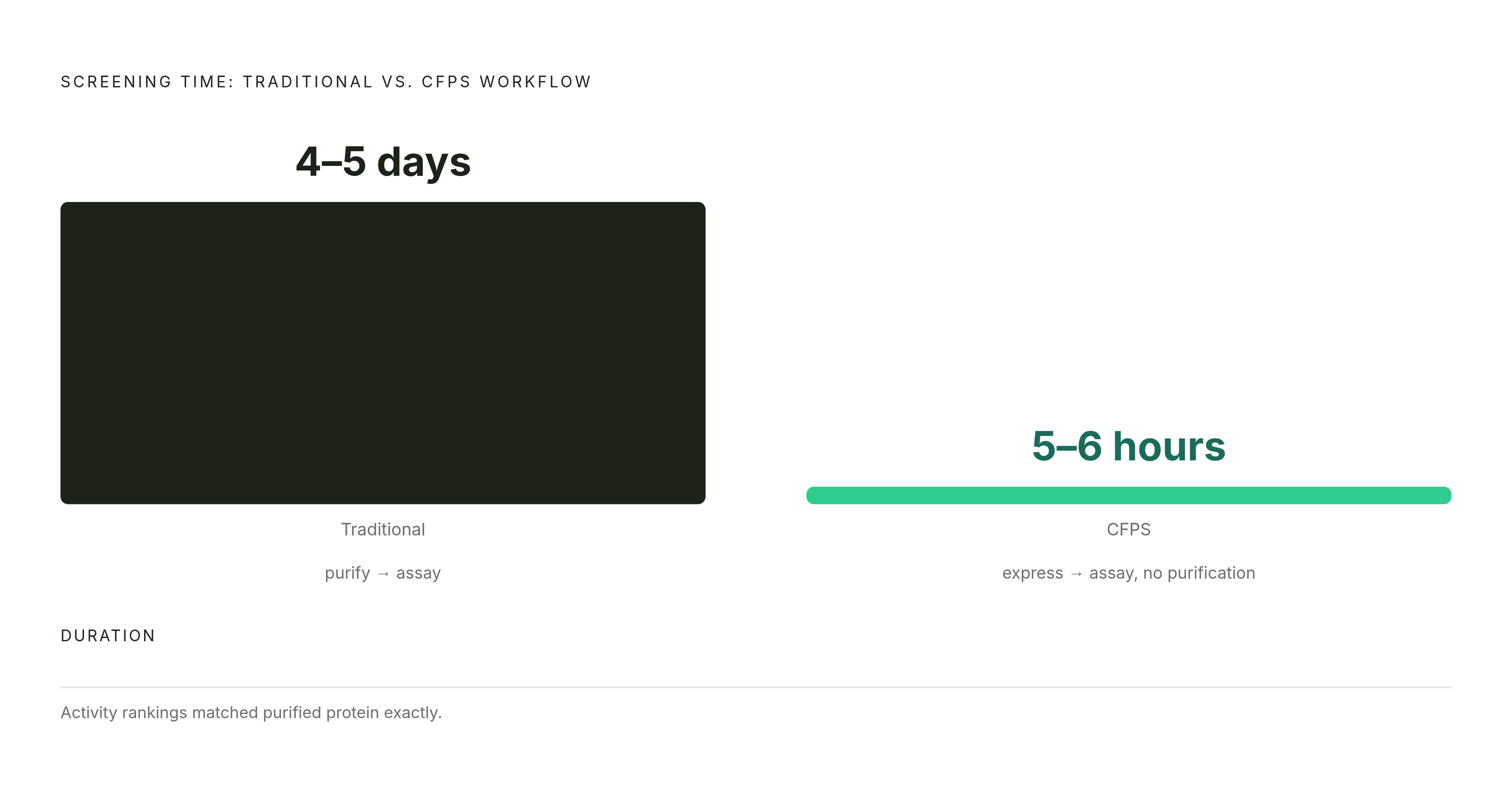
The first looked at staphylokinase, a fibrin-specific thrombolytic agent with real therapeutic interest, using a PUREfrex-based CFPS system paired with a chromogenic plasminogen-activation assay run directly on crude, unpurified CFPS mixtures. The activity rankings the crude assay produced matched the rankings from purified protein exactly. No purification step was needed to correctly identify which variants worked best. The whole workflow ran in five to six hours against four to five days for the traditional route, and the finding that matters is that the functional signal needed to identify a genuine hit survived the shortcut intact.
The second study, published in ACS Synthetic Biology in 2025, used an Active Learning-assisted Directed Evolution model, an ensemble deep learning system, to propose 32 new protease variants. The best of those, a variant called TB27, showed four times the activity of wild-type Con1 protease. Activity assays run on CFPS-expressed protein validated CFPS as a dependable functional screen at scale. Just as important, CFPS screening was the step that made the entire machine-learning-guided design-build-test-learn cycle workable. Without nanoliter-scale dispensing, testing those 32 variants through conventional cell-based expression would have taken weeks instead of a single afternoon's run.
The pattern across both studies holds steady. Batch-mode CFPS yields already sit close to their ceiling, low micrograms per milliliter up to milligram scale depending on system and target, and the dramatic compression in turnaround time down to five to six hours doesn't cost anything in signal quality. Speed and accuracy aren't a trade-off here. Both studies got both, and that's the point most people writing off CFPS as "fast but sloppy" have gotten backwards.
Acoustic CFPS screening's place in the AI-driven design-build-test-learn cycle
The design-build-test-learn cycle only moves as fast as its slowest step, and for a long time, testing was that step, full stop. A machine learning model can propose dozens or hundreds of variants in a single iteration. Cell-based expression can't test them at anywhere near that pace, and no amount of automation on the modeling side fixes a bottleneck sitting downstream in the wet lab.
Acoustic CFPS is what closes that gap. The 2025 ScienceDirect study on AI-driven CFPS names the Echo 650 directly as the technology that makes a high-throughput, low-volume platform possible, one that can feed results back into the model fast enough to actually matter for the next design round. The field is pointing toward a fully automated, AI-integrated discovery platform running iterative DBTL cycles with minimal human intervention, and CFPS is the in vitro expression layer that makes that realistic rather than aspirational.
Two technical goals produce that vision. One is keeping expression consistent across thousands of parallel reactions in a single run. The other is pushing reaction volumes down further without losing yield, and acoustic dispensing at its 2.5-nanoliter floor already sits close to that mark.
A quieter constraint hides inside this loop, and it's easy to miss until it bites. If the lysate lot changes between one iteration and the next, the model starts learning from reagent noise instead of biology, and it has no way to tell the two apart. Lot-level QC documentation is a requirement here. It's a data quality requirement for the machine learning layer sitting on top of the screen, no different from garbage-in-garbage-out in any other training pipeline. OpenCFPS™ addresses this directly, with a consistent, well-characterized formulation that gives researchers a stable baseline across an entire campaign, so a shift in results can get traced back to a real biological difference rather than a reagent that changed underneath the experiment without anyone noticing.
Practical considerations when setting up acoustic CFPS dispensing in a lab
Getting an Echo liquid handler, made by Beckman Coulter, part of Danaher, on a bench isn't always as simple as placing an order. Plenty of labs access this equipment through a shared core facility rather than owning a dedicated unit, so scheduling and plate format compatibility with that core's existing setup need sorting out before a screening campaign gets designed around it.
Source plate prep deserves its own attention. Crude lysate varies in viscosity from lot to lot and from organism to organism, whether it's E. coli, wheat germ, CHO, or insect cell-derived. Acoustic interrogation compensates for a good deal of that automatically, but source wells still need to be filled consistently and kept cold so the reaction doesn't start prematurely. Template DNA, dispensed directly from PCR product with no cloning step, needs consistent concentration and quality across every source well, or inconsistent concentration and quality across source wells raises template-driven variation in the destination plate, where it gets mistaken for something biological. Energy mix and amino acid stocks should stay concentrated to minimize dispensed volume, and it pays to confirm those concentrations sit inside the acoustic handler's droplet ejection window for that fluid's viscosity.
At nanoliter scale, evaporation isn't a minor annoyance, it's catastrophic to the reaction. Seals need a rating that matches the actual incubation temperature and duration being used. Incubators themselves need reasonably even temperature across the plate, since reaction kinetics at this scale are sensitive to small swings.
For readout, a fluorescent reporter protein gives a direct expression signal with no purification needed. For enzymatic targets, chromogenic or FRET substrates added after incubation allow functional ranking right in the plate, the same approach both published case studies above relied on. And across a long campaign, if reagent lots change partway through, inter-lot controls belong on every plate. Without documented QC, a lot shift stays invisible until it has already corrupted the comparison between screening rounds.
Nanoliter screening finds candidates. It doesn't produce them at scale. Milligram-quantity production for downstream work (binding assays, structural studies) is a separate workflow, and the handoff point between screening and scale-up is worth mapping out before the campaign starts, not after a hit appears and nobody's ready to move on it.
Choosing reagents that can support acoustic CFPS at scale
Once the instrument side is solved, the reagent becomes the thing that actually caps how far the platform can go. Acoustic dispensing is only as precise as what's being dispensed, and a reagent carrying hidden lot-to-lot variability undoes a good chunk of the precision the instrument just paid for.
Lot-level QC data matters most, because without it there is no clean way to separate well-to-well variance from lot-to-lot variance, and that problem compounds across a machine-learning-guided campaign where each plate's results train the next round of decisions. A documented formulation matters just as much. A reagent with a published or disclosed composition gives a researcher something to troubleshoot against when dispensing looks off or expression fails, rather than guessing blind against a sealed black-box kit. A sealed kit with no disclosed formulation is a liability disguised as convenience, and labs running iterative campaigns pay for that later in wasted plates.
Pricing at scale is its own factor, but the harder test is this: does a functional readout during screening predict how the purified protein will actually behave later? A hit found during screening needs to hold up downstream, or the screen was never measuring the right thing to begin with. Performance on harder targets counts just as much. Toxic proteins, multi-domain constructs, and proteins needing non-standard amino acids are usually exactly the cases that push a researcher toward CFPS. A reagent that only performs well on easy, well-behaved proteins isn't solving the problem most labs actually walked in with.