Cost per Reaction Analysis for Commercial CFPS Kits
Lysate cost and DNA template dominate cell-free protein synthesis economics.

Catalog price is the wrong number to compare when evaluating cell-free protein synthesis (CFPS) kits. The figure that actually governs experimental economics is cost per reaction, not cost per kit and not even cost per milliliter, because neither of those accounts for how much usable protein a researcher gets out of a given volume under real operating conditions. A kit that looks cheap on the shelf can turn out to be the expensive choice once reaction volume, format, yield, and lot reliability enter the picture. This piece builds the framework for computing cost per reaction, calculated from the full set of variables that determine it.
Cost per reaction is a derived number, built from several inputs that each shift independently of list price. Treating it that way, rather than defaulting to the sticker price on a vial, is the first practical skill required before any kit comparison means anything.
The two architectures that set the cost ceiling and floor
Before any vendor comparison or format decision, one structural choice does more to set CFPS cost than anything else: whether the reaction runs on crude E. coli lysate or on the PURE system. PURE, short for Protein synthesis Using Recombinant Elements and developed by Shimizu and colleagues, builds translation from individually purified components. Crude lysate systems keep the native mix of ribosomes, enzymes, and cofactors that a cell already produces, with far less purification work before the reaction even starts.
That architectural difference sets the cost ceiling and the cost floor for the entire category. PURE's purified-component approach strips out much of the nuclease and protease activity that crude lysate carries over from the cell, a real advantage for degradation-sensitive proteins or for mechanistic work that needs a fully defined reaction mix. That benefit comes at a steep price: assembling a reaction from individually purified translation factors costs dramatically more per reaction than the lysate alternative, because each purified component carries its own manufacturing cost.
Lysate systems, in turn, have their own cost structure. Research published in Nature Communications found that cell lysate and DNA template together account for more than 90% of total CFPS reaction cost in current formulations. Every other reagent, every salt, cofactor, and energy-system component, is a rounding error next to those two line items. That concentration of cost into two inputs is itself a useful piece of information: it tells a researcher where to focus when trying to bring cost down, and it explains why lysate-based systems can be priced so much lower than PURE at comparable yield.
The practical consequence follows directly from the architecture split. Choosing PURE for a project that doesn't specifically need its low-protease, defined-composition properties costs far more than necessary. Many labs default to PURE anyway, often because it carries a reputation for cleaner results, without running the cost comparison that would show a lysate-based system meets the same experimental need at a fraction of the price. Before comparing any two commercial kits on price, a researcher needs to know which architecture each one uses, because that decision moves cost more than any other variable in this analysis.
How per-mL list prices translate into per-reaction reality
A per-mL list price tells a buyer almost nothing about what a single reaction costs until it gets multiplied by a reaction volume, and that volume is not fixed. It changes with plate format, with application, and with how much the researcher is trying to scale a given screen.
Commercial lysate-based CFPS kits and commercial PURE system kits run at very different per-microliter prices, and both cost well above in-house-prepared E. coli extract. That gap has been directly benchmarked in the literature, and it holds at the small-batch scale most researchers actually buy at: estimated cost per milligram of protein for commercial kits runs far above what in-house extract preparation achieves at the same scale. Across a screening campaign running dozens or hundreds of variants, that multiple compounds fast, turning what looked like a marginal price difference on the bottle into a meaningfully different total spend by the end of the project.
The Cayman Chemical Cell-free Protein Synthesis (E. coli) Kit, catalog #41534, is a useful fixed point for walking through this arithmetic, because its pricing and volume are published and its performance is documented: an E. coli extract-based system that produces target protein within several hours, detectable by SDS-PAGE, Western blot, or FSEC. Take the kit's per-mL price, divide by however many microliters a single well actually needs at the format in use, and the result is the number that belongs in a budget spreadsheet, not the headline price on the product page. Running that same arithmetic against a PURE kit at its per-mL price makes the per-reaction gap between the two architectures concrete. Reaction volume is the conversion factor that turns a list price into a number that means something at the bench, and skipping that step is what leads researchers to misjudge which kit is actually cheaper for their specific plate format and throughput.
The throughput-cost relationship
Cost per reaction isn't fixed once a kit and format are chosen. It moves with how many reactions get run, in what format, and whether the reagent dispensing system can actually hit the smaller volumes that denser formats demand.
Moving from a 96-well plate to a 384-well plate cuts reaction volume to a fraction of what 96-well format uses, and in principle that multiplies how far a given volume of reagent stretches. In practice, that leverage only shows up if the liquid-handling setup can dispense accurately at the smaller volume, and if the researcher accounts for a yield trade-off that comes with miniaturization. That trade-off is well documented: batch CFPS reactions run in tubes generally produce higher protein titers than the same reaction in a 96-well plate, and 96-well plates outperform 384-well plates in turn, because surface area-to-volume ratio changes how much oxygen reaches the reaction. Shrinking the format to save on reagent volume also shrinks the oxygen available to the reaction, so the real comparison has to run on cost per milligram of protein produced, not cost per microliter of reagent consumed.
The point of that result isn't that labs need autonomous infrastructure to benefit from CFPS. It demonstrates that per-reaction cost in CFPS is not a fixed property of a kit or a format; it is a moving target that keeps dropping as throughput and systematic optimization compound against each other.
That has a direct, practical consequence for anyone planning a screen. A researcher running a few dozen variants a month is working a completely different cost equation than one running thousands per week, and the crossover point, where a commercial kit's list-price economics stop making sense relative to in-house extract or a lower-cost alternative, arrives sooner than most labs expect. Throughput, not list price, is the lever that moves cost per reaction the furthest once architecture and format are already fixed.
What lot-to-lot variability costs when it is not disclosed
Every cost-per-reaction figure in the previous two sections assumes the reaction works. When a lysate lot underperforms and that fact isn't disclosed anywhere in the product documentation, the researcher absorbs three costs at once: the wasted reagent, the time spent figuring out that the lysate, not the protocol, was the problem, and in the worst case, the cost of repeating an entire screening campaign.
The mechanism behind lot-to-lot variation in cell lysate is well understood even if it's rarely disclosed at the point of sale. Magnesium ion concentration is one of the most critical variables in a CFPS reaction, and every new batch of extract needs its own independent titration across a wide concentration range before it performs reliably. An undisclosed shift in a lot's effective Mg²⁺ behavior produces yield variation that appears at the bench with no warning and no obvious explanation.
Research on the RF_opt formulation treated this problem as a design target, not an afterthought: robustness to failure across batches of cell lysate, across different users, and across different physical locations was optimized alongside yield and cost as a first-class objective, not bolted on after the fact. The resulting system held up across more than 20 different proteins, including full-length aglycosylated monoclonal antibodies, which is a meaningfully broad test of whether a formulation's reliability generalizes beyond a single favorite protein target.
The field as a whole still struggles with this. Reproducibility remains a significant challenge in CFPS: consistency is hard to achieve even between members of the same lab, let alone across institutions, and the absence of validated extract standards, transparent costing, and lot-level QC documentation makes reagent risk almost impossible to evaluate in advance. Lot-level QC data isn't a premium add-on; it's the information a researcher actually needs to tell whether a stated per-reaction cost is the real number or a number that quietly excludes the cost of variance. Sepia Bio's OpenCFPS line addresses this gap directly: documented formulations and lot-level QC data are published alongside each lot, which gives researchers a way to standardize workflows and troubleshoot a bad run without guessing. That transparency changes the effective cost calculation by removing the risk premium that's otherwise baked into every reaction run on an undocumented reagent.
Volume flexibility and purchasing structure
A reagent priced well per microliter can still be a poor fit for a lab's budget if it's only sold in volumes larger than the lab's actual throughput needs, forcing a choice between over-purchasing reagent that will expire unused or under-running the experiments the project actually calls for.
Minimum order quantities, fixed kit formats, and the inability to buy reagent in smaller increments all turn a favorable per-reaction price into an unfavorable budget commitment, a problem that hits hardest for early-stage projects where nobody yet knows how much throughput the work will eventually need. The reverse situation matters just as much: a reagent sold at both screening scale and milligram-production scale, using the same underlying formulation for both, removes the hidden cost of switching platforms as a project matures from early screening into protein characterization. That switching cost is easy to miss in a budget until a workflow fails to port cleanly from one scale to the next and the lab has to re-validate everything from scratch.
Sepia Bio's pricing on OpenCFPS reflects a deliberate stance on this exact problem: the reagent is designed to support both rapid screening of large protein variant libraries and milligram-scale production within the same system, so the per-reaction cost doesn't reset when a project moves from screening into scale-up. Systems built from the start for high-throughput screening, including reagent formulations engineered for both 96-well and 384-well formats with documented yield profiles, make the tradeoff between format and economics visible up front. A researcher can model true cost-per-reaction across different miniaturization strategies before running a single plate, rather than discovering the real number only after the format choice has already been locked in at the bench. Purchasing structure, in other words, is a cost variable in its own right, separate from both per-reaction arithmetic and lot transparency, and standard list-price comparisons miss it.
Putting the variables together: what a real cost-per-reaction calculation looks like
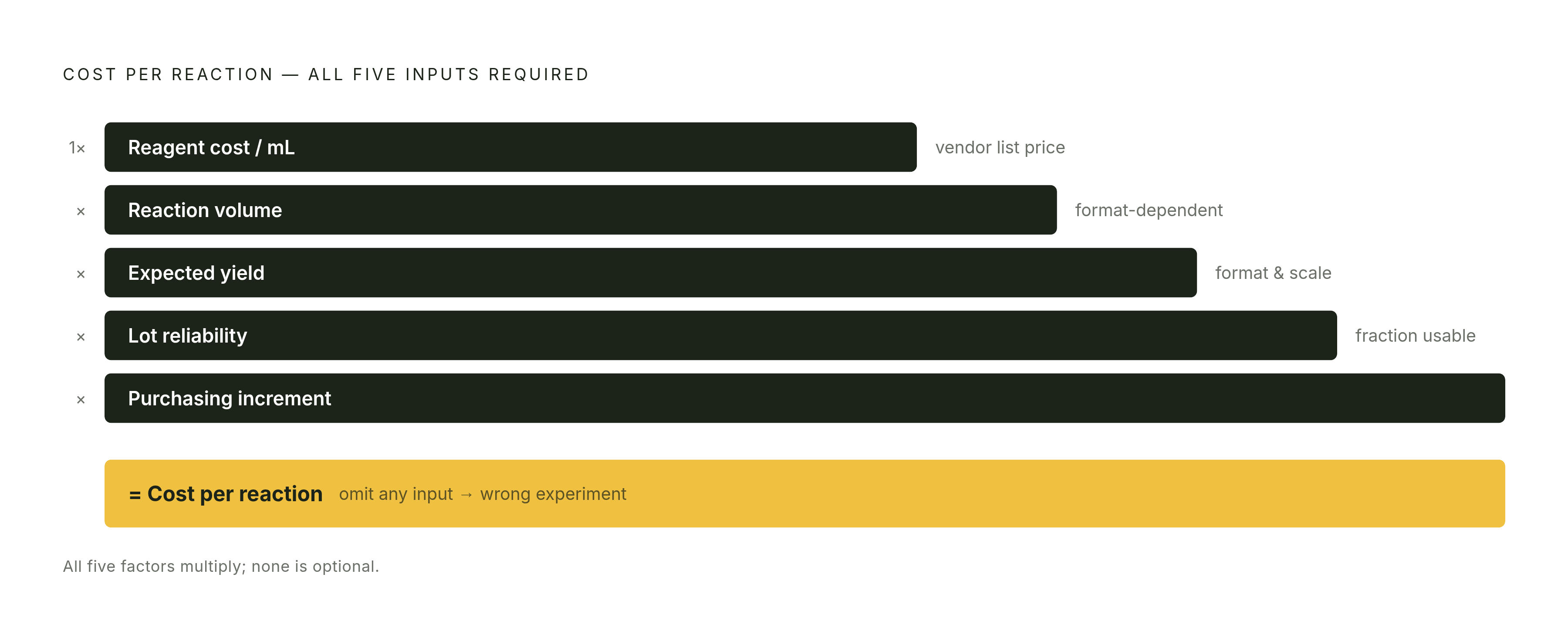
A complete cost-per-reaction figure needs at least five inputs: the per-mL reagent cost, the reaction volume set by the chosen format, the expected yield at that format and scale, the per-lot reliability (the fraction of reactions that actually produce usable results), and the purchasing increment the vendor makes available. Leaving any one of those out means the resulting number describes a different experiment than the one actually being run.
For a transparent reagent system with published formulations and lot-level QC data, every one of those five inputs is knowable before a single reaction goes on the plate. For an opaque system, some of them have to be estimated from past experience or from benchmarks in the literature, and that estimate carries its own uncertainty that belongs in the cost calculation.
The RF_opt study offers a model for what this looks like done rigorously: cost was treated as a primary design objective alongside yield, both optimized simultaneously across more than a thousand reagent formulations. Nature Communications reported that this approach delivered a reduction of 84 to 99 percent in cost compared with previous cell-free reagent formulations. The figure that matters to a working researcher is the empirically validated cost under the operating conditions the lab actually runs, not catalog price divided by a nominal, best-case yield.
For a subset of targets, toxic, unstable, insoluble, or multi-domain proteins where cell-based expression fails, the comparison changes shape. For that subset, the relevant denominator is cost per gram of the specific protein the project needs, not cost per gram of protein in general, and CFPS may be the only expression system capable of delivering it. In that situation, CFPS per-reaction economics aren't one option among several; they're the only economics on the table.
None of this is an argument for ranking kits by sticker price, and it was never meant to be. It's an argument for computing the number that actually describes a given lab's workflow: architecture, reaction volume, format, throughput, lot reliability, and purchasing structure, combined.