Recombinant Protein Purification Workflows After Cell-Free Synthesis
Affinity capture and size-exclusion chromatography polish cell-free synthesized proteins.
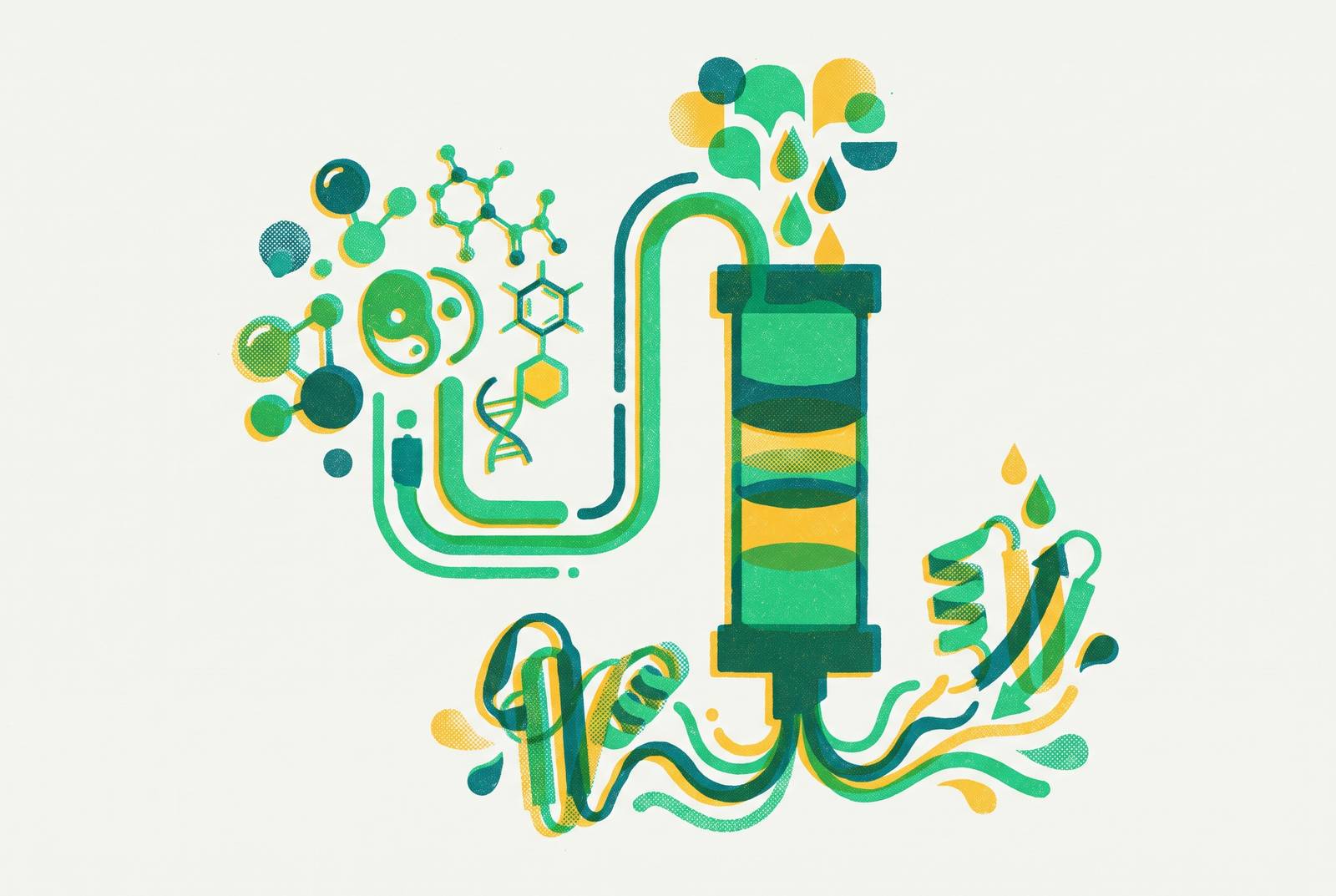
Purifying recombinant proteins after cell-free protein synthesis (CFPS) requires a workflow matched to the reaction matrix. Affinity capture does most of the work of separating the target from extract background, but what comes next depends on the target’s physical state and how it will be used. The central requirement is to design purification around the mixture that synthesis actually produces.
Why the CFPS reaction matrix is not just dilute cytoplasm
A CFPS reaction combines three interdependent modules, including a lysate that supplies translational machinery, an energy system, and a DNA/RNA template system. These operate together in an open biochemical environment. The lysate contributes most of the macromolecular background, with ribosomes, enzymes, chaperones, and endogenous nucleic acids surrounding the recombinant target. The energy system adds small molecules, cofactors, and salts that influence chromatography even when they do not bind the target.
The chemistry of the mixture can be changed throughout reaction design. Detergents, nanodiscs, redox buffers, and noncanonical amino acids can support proteins that are difficult to produce in cells. Those additions also become part of the purification load. Unlike a clarified cell lysate prepared for downstream processing, the completed reaction still has the chemical environment built to support synthesis.
How the matrix characteristics translate into concrete purification challenges
Ribosomal particles can co-pellet with the target or co-bind to certain resins, inflating apparent yield while reducing specific activity. The appropriate centrifugal force and duration depend on whether the target is soluble or itself large and particulate, as with a nanodisc complex. Template DNA, mRNA, and rRNA introduce a different interference because they can co-purify with basic proteins and foul anion-exchange resins. Nuclease treatment or precipitation addresses that burden but adds processing time and reagents.
Small molecules complicate capture through different mechanisms. Inorganic phosphate released during energy regeneration can precipitate divalent metal ions, while Mg²⁺ or Zn²⁺ carry-over can alter immobilized metal affinity chromatography (IMAC) performance. High salt may require dilution or buffer exchange before ion-exchange chromatography. Reaction additives can change the identity of the target itself. A membrane protein inserted into a nanodisc is a protein–lipid–scaffold complex, so purification must preserve that assembly rather than treat the lipid environment as removable contamination.
Affinity tags as the primary capture strategy and why they dominate CFPS workflows
CFPS offers no equivalent of cellular compartmentalization that pre-enriches a secreted or periplasmic protein. An engineered affinity handle offers a practical way to pick out the target from the extract in the first separation. Hexahistidine (His₆) tags with Ni-NTA or Co²⁺ IMAC resins are the workhorse combination, including batch capture in 96-well filter plates. After elution, dialysis or desalting spin columns remove imidazole before activity assays or secondary chromatography, and both approaches can be parallelized.
Strep-tag/Strep-Tactin capture can provide near-one-step purity for some targets, with desthiobiotin elution offering milder conditions for unstable proteins. Streptavidin capture of biotinylated targets provides essentially irreversible binding when immobilization itself supports the readout. GST fusions permit glutathione-sepharose capture and on-resin cleavage by thrombin or PreScission protease, although their added mass and potential dimerization are disadvantages for membrane proteins or small peptides. Tag placement also requires a deliberate decision, especially when assembly into a nanodisc may limit access to the affinity handle.
When a single affinity step is sufficient and when it is not
Roughly 90% purity can suffice for enzyme kinetics, binding assays, or AlphaLISA when the signal tolerates low-level background contamination. Affinity-only material can also answer an early go/no-go question about expression and solubility. In these settings, throughput may justify stopping before polishing. Each additional chromatographic step consumes time, loses target, and introduces buffer-exchange requirements that accumulate across a variant panel.
Defined oligomeric state requires a different standard because affinity resins do not distinguish intact target from tagged aggregates or degradation products. Milligram-scale material for NMR, SPR, or animal studies can also require further purification as the absolute amount of residual host-cell protein increases. Structural work nevertheless requires a distinction between preparative purification and analytical quality control. Guilliam et al.’s 2026 bioRxiv preprint describes affinity capture followed by cryo-EM grid vitrification, with fluorescence-detection size-exclusion chromatography (FSEC) used for biophysical assessment and preparative polishing remaining optional. For libraries, the practical compromise is affinity capture across the full panel, with secondary purification reserved for selected hits.
Size-exclusion chromatography as the secondary workhorse for polishing CFPS products
Size-exclusion chromatography (SEC) complements affinity capture because it separates by size, while affinity capture relies on tag binding. Ribosomal subunits or fragments that survive clarification and bind weakly to nickel resin can separate from monomeric target at a large-size position. Endogenous His-containing proteins and other co-purifying lysate proteins can also resolve when their sizes differ sufficiently from the target. SEC can remove aggregates and background species without adding a new eluting chemical to the sample.
Minimizing injection volume, including concentration by ultrafiltration before analytical SEC, limits band broadening that can obscure partially separated peaks. Cryo-EM preparation constrains detergent levels, while activity assays may require particular salt concentrations. For selected variant hits, small-column analytical SEC can both show how pure the sample is and yield a purified fraction, while larger production runs may need preparative separation.
Membrane protein purification from CFPS: co-translational assembly changes the workflow order
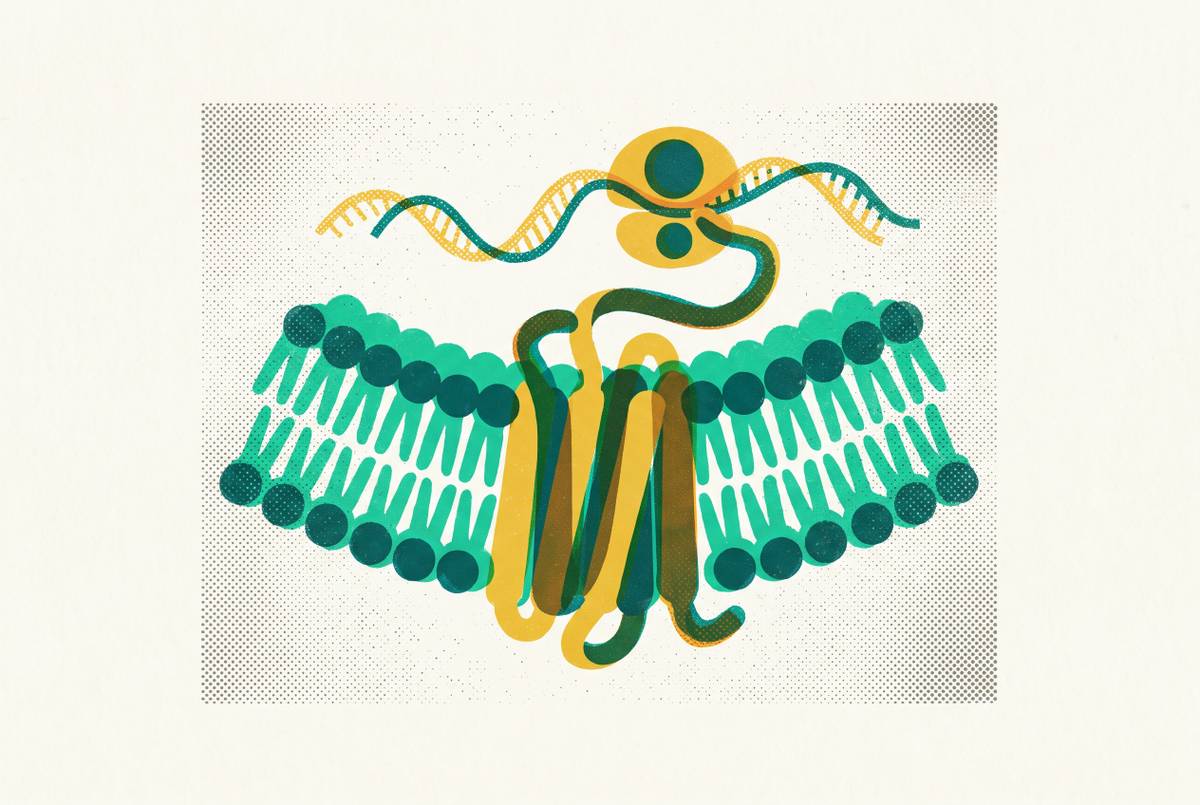
The Guilliam preprint makes reaction design part of purification design for its GPCR–nanodisc workflow. Co-translational nanodisc insertion was required for solubilization and subsequent affinity capture, bringing assembly into the synthesis phase rather than leaving detergent solubilization as a separate downstream operation. Lipid composition and scaffold selection therefore belonged in the reaction screen. The eProtein Discovery™ digital microfluidics system enabled automated nanoliter-scale screening of construct fusions and nanodisc lipid compositions.
The same workflow separates two questions, namely how to capture the assembled complex and how to assess its quality. Clarification removes ribosomes and large aggregates before affinity capture isolates the target–nanodisc material from the bulk extract. SEC can resolve the complex peak from empty nanodiscs, aggregated material, and residual co-purifying proteins, with concentration following when a purified peak fraction is used. However, the reported gene-to-grid route used FSEC analytically and did not make preparative SEC a compulsory step before vitrification.
The preprint extended the approach beyond its A2AR benchmark. It reported twelve wild-type GPCRs spanning Classes A, B, and C, plus six orphan receptors, with comparable biophysical quality across the purified targets. The four-day gene-to-grid turnaround combined gene assembly, CFPS, purification, and grid vitrification, compressing the expression phase that takes multiple weeks in cell-based systems. These findings support planning GPCR assembly and purification together, without establishing a universal nanodisc requirement for every membrane protein.
Scaling from screening purity to milligram-scale production purity
Moving from a variant panel to milligrams of one candidate changes the purification burden even when the capture chemistry stays the same. Low-level contaminants increase in absolute amount with reaction volume and can become visible on SDS-PAGE or detectable in activity assays. Concentration also increases the challenge of aggregate removal. Larger reactions and concentrated post-affinity eluates make preparative SEC necessary for most targets, while characterization requirements may call for ion-exchange or hydrophobic interaction chromatography.
At this transition, refrigerated centrifugation helps limit extract protein aggregation during clarification. Batch-mode IMAC scales better than gravity columns above a few milliliters, and elution into a smaller volume reduces the load volume before SEC. Buffer exchange remains part of the sequence. Dialysis or ultrafiltration spin columns remove imidazole, excess salt, and other species that could interfere with subsequent steps or storage. Documented formulations and lot-level quality-control data help standardize this transition by making it easier to tell whether purification changed because of the scale or the starting extract.
How extract quality and batch consistency propagate into purification outcomes
Extract variation changes more than recombinant protein yield. A batch with more ribosomal mass may need a longer or faster clarification spin to give affinity capture the same load. Differences in nucleic acid content can instead be visible during anion-exchange polishing after IMAC. The starting matrix can change the demand placed on each separation.
Levine et al.’s Cal Poly bioRxiv work addresses this source of variability through cell-free autoinduction (CFAI). Its long-lasting autoinduction medium eliminates manual intervention between inoculation and harvest, with the aim of improving reproducibility across batches, users, and institutions. The study reports a 400% increase in total extract volume relative to past workflows. This places reproducibility work upstream of the purification column. Khalil et al.’s iScience AI-driven design–build–test–learn (DBTL) pipeline tackles the related task of reaction optimization, using active learning to cut the number of experiments needed to choose reaction conditions.
Neither upstream consistency nor automated optimization removes the need for traceable reagent information. Published formulations and lot-level QC data help distinguish an extract-batch anomaly from a downstream protocol failure. Without it, changes to clarification, washing, or polishing may compensate for an upstream difference and leave a stable process defect unresolved.
Integrating purification into automated, plate-based CFPS workflows
Affinity capture can match plate-based synthesis when purification is designed for the same format. Ni-NTA-functionalized 96-well filter plates support batch-mode IMAC, with centrifugation or vacuum processing replacing individual gravity-flow columns. Magnetic bead-based IMAC offers another route to parallel handling. Beads can be added, incubated, magnetically collected, washed, and eluted within the reaction well, avoiding plate-to-plate transfers that introduce tracking errors.
The two-tier strategy preserves throughput beyond the capture step. Following removal of interfering elution components, full-panel affinity purification can feed plate-reader or AlphaLISA assays without intermediate SEC. Selected hits then go through expression at a larger scale and secondary purification. The Khalil pipeline illustrates the surrounding automation logic through experimental design, microplate layout generation, liquid handling, readout calibration, and data-driven candidate selection.
A decision framework for matching purification strategy to CFPS application
A soluble protein and a receptor–nanodisc complex require different interpretations of clarification, capture, and concentration. For a GPCR following the reported nanodisc approach, lipid and scaffold choices belong before scale-up, with accessible affinity capture planned around the assembled complex. Large variant panels work best with plate-format batch IMAC and functional readout, while production runs warrant SEC and further polishing when the application needs them.
Comparisons of relative function may work with roughly 90% purity, while a defined oligomeric state requires aggregates and degradation products to be separated out. Structural applications also need biophysical quality assessment, though the GPCR example shows that analytical SEC need not imply preparative SEC before every grid. Additional ion-exchange or hydrophobic interaction polishing depends on the target and purity requirement, with buffer exchange matched to subsequent use or storage.
Across these decisions, the chosen sequence transfers between batches only if the extract is reproducible. Lot-level QC provides the context for interpreting a change in purification behavior and deciding whether the downstream protocol needs adjustment.
Sources
- Rapid Production and Cryo-EM Structure Determination of
- Redesigned upstream processing enables a 24-hour workflow from *E. coli* cells to cell-free protein synthesis
- An AI-driven workflow for the accelerated optimization of cell-free protein synthesis: iScience
- An AI-driven workflow for the accelerated optimization of cell-free protein synthesis