T7 RNA Polymerase Promoter Choice in Cell-Free Transcription
Promoter engineering unlocks higher mRNA and protein yields without changing your polymerase.

T7 RNA polymerase promoter choice in cell-free transcription is a tunable design variable. The canonical sequence and characterized alternatives differ in transcript yield, mRNA quality, and how well they work with the expression system. Those differences give scientists a practical way to improve output without necessarily changing the enzyme, but the useful choice depends on the target and must be measured in a reproducible reagent system.
What the canonical T7 promoter actually is and why it functions as a constraint, not a neutral default
The canonical T7 promoter sequence, 5'–TAATACGACTCACTATAG–3', is 18 bp long. Its familiarity can obscure its experimental role. A fixed promoter sequence constrains transcript yield and shapes the mRNA quality profile, including which double-stranded RNA byproduct pathways dominate. Retaining that sequence is therefore an active design choice, even when the protocol treats it as a given.
T7 RNA polymerase is the workhorse of in vitro transcription and cell-free transcription–translation. Nearly all bacterial cell-free protein synthesis systems use it with endogenous sigma-70 machinery, while plant, mammalian, and insect platforms also use their translation machinery with T7 transcription. Yet precise, modular regulation of T7 RNAP has remained limited despite this broad use. Lee et al.’s 2026 Nature Communications regulatory toolbox work shows how the field is trying to close that gap through promoter engineering.
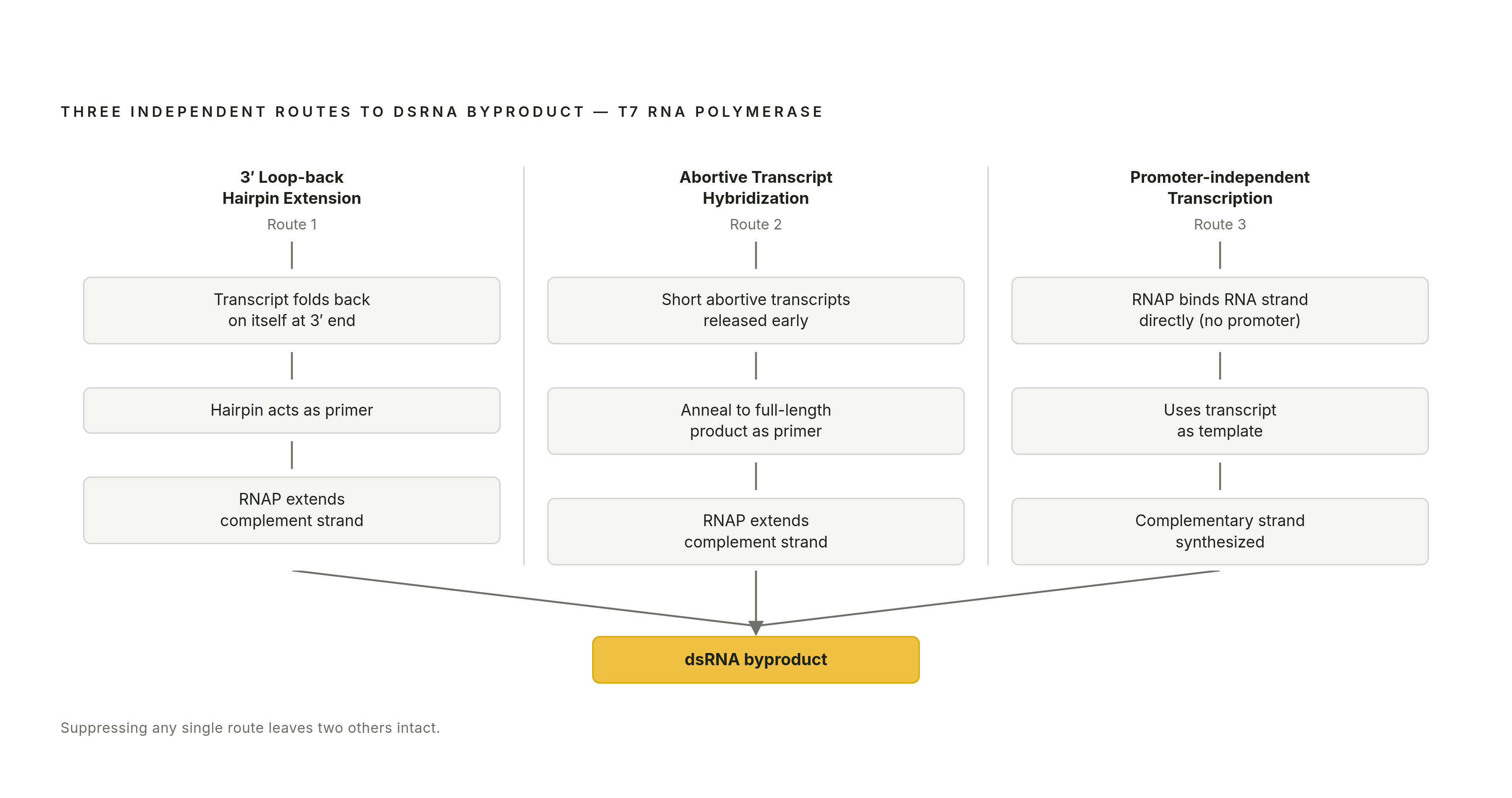
The quality constraint is structural. Three pathways associated with dsRNA byproducts are 3′ loop-back hairpin extension, hybridized abortive transcript extension, and promoter-independent transcription. Their existence means that total RNA output alone cannot describe the performance of a transcription reaction. A promoter that changes yield also needs to be understood through the quality of the resulting transcripts.
How T7Max was developed and what it changes about transcript output
T7Max, with the sequence AATTCTAATACGACTCACTATAGGGA, increases mRNA abundance and protein yield without requiring engineering of T7 RNA polymerase. It uses the standard enzyme already present in T7-based workflows. This makes promoter replacement a direct route to testing improved expression without also changing the polymerase or extract. Its value is practical, but it does not establish a universal winner.
Deich, Cash, Sato et al. at the University of Minnesota developed T7Max by screening known T7 promoter variants for fluorescent RNA aptamer yield. The three highest performers were T7wt, Uhlenbeck 117, and the sequence formerly called Uhlenbeck GG, which became T7Max. Uhlenbeck 117 initially led the aptamer screen. The team then tested translation with eGFP templates, measured mRNA abundance by RT-qPCR, and used Western blot to establish that increased protein output was not a fluorescence artifact. That progression distinguished performance in an RNA reporter assay from performance in a complete expression workflow.
The mechanism centers on greater mRNA availability. In bacterial transcription–translation systems, mRNA abundance correlates directly with protein output, so a larger transcript pool provides more templates for ribosomes. T7Max also partially compensates for linear DNA degradation by increasing transcription before template loss limits output. E. coli extracts contain active endogenous nucleases, including RecBCD, so this benefit complements inhibitors such as GamS or Chi6.
The T7Max work demonstrated activity in both lab-made and commercial E. coli extracts and validated the promoter across plant, mammalian, and insect cell-free platforms. That breadth supports its use across different systems. It does not remove the need to assess the actual target, particularly when transcript quality is as important as protein yield.
Other characterized variants — T7c62, AT-rich downstream modifications, and what each trades against the other
T7c62 changes the core promoter through nucleotide substitutions at positions -4, -1, and +2. It has been reported to deliver roughly twofold higher protein expression than wild-type in cellular contexts. That context limits what the number establishes for CFPS. The 2024 Scientific Reports study, “Comprehensive evaluation of T7 promoter for enhanced yield and quality in mRNA production,” used T7c62 as a positive control with T7Max and T7#4, placing it within a broader comparison rather than treating one variant as the default successor 123.
AT-rich downstream variants address a different combination of goals. Sequence changes downstream of the transcription start can increase mRNA yield while reducing dsRNA byproduct levels. Quantity and quality can therefore improve together. However, reducing dsRNA can also reduce other critical mRNA quality attributes, so a favorable result on that measure does not establish an improvement in the complete product.
The underlying dilemma follows from the multiple routes to byproduct formation. DsRNA can arise through 3′ loop-back hairpin extension, extension of hybridized abortive transcripts, or promoter-independent transcription, rather than through one uniform process. Changes in non-coding regions can raise production and potentially reduce manufacturing costs, but suppressing an unwanted RNA population does not guarantee that other transcript properties remain favorable.
Enzyme engineering provides a separate lever. Its workflow cost is the introduction of a non-standard enzyme. That approach is orthogonal to promoter selection, which remains the sequence-level variable scientists can change while retaining their existing T7 RNAP.
High-throughput screening as the method for finding the right promoter for a specific sequence context
Promoter–context interactions mean that no single variant is optimal for every gene. Scientists therefore need to screen candidates in the actual expression system as well as draw on published comparisons. CFPS makes that approach unusually accessible. Its open format lets scientists test promoters in a plate-based workflow without taking on a genetic engineering project.
Komura et al. at Kyoto University established a methodological foundation in 2018 by combining biased randomization of the T7 promoter with next-generation sequencing of DNA and RNA libraries. The approach quantified transcriptional activity across 7,847 promoter variants in a single NGS run. Transcriptional activity in the in vitro transcription/translation system correlated well with resulting protein abundance.
HeLa-based CFPS with automated acoustic liquid-handling extends this logic to parallel screening of T7 promoter and IRES variants. The platform also reproduces complex regulatory dynamics, including CRISPR/dCas9 transcriptional repression and L7Ae translational repression. Regulatory complexity need not disappear outside the cell. This is important when the promoter is only one part of the expression design and its performance must be interpreted within that design.
PCR products can enter CFPS directly without cloning and transformation, multiple variants can run in parallel wells, and accessory factors can be added to the reaction. These features shorten the path from sequence design to measurement. However, plate and automation compatibility are only part of the required infrastructure. Consistent extract performance, transparent reagent formulations, and lot-level QC are necessary to keep differences between wells and plates interpretable. Otherwise, a screen risks ranking reagent batches as much as promoter sequences.
What challenging protein targets reveal about the compounding effect of promoter choice in CFPS
Toxic, unstable, membrane, and multi-domain proteins show the limits of an expression system more clearly than easy reporter targets. For proteins that kill cells, aggregate in cellular environments, or need conditions incompatible with living hosts, CFPS can be the only viable production route. A lysate has no viability to protect. Toxic proteins can therefore be expressed at concentrations that would destroy a living host, while the open reaction permits direct addition of chaperones, redox buffers, detergents, and lipid supplements to support folding or solubilization.
Cell-based overexpression can be intrinsically toxic and often fails to deliver useful quantities of properly folded protein. CFPS removes the requirement to sustain a living host, but it still needs enough transcript to drive synthesis. A high-yield promoter such as T7Max, or an AT-rich downstream variant, influences how much mRNA is available during the reaction. Promoter choice therefore complements the conditions needed for a difficult protein.
CFPS typically runs for hours rather than the days available to cell culture, so transcript production must be considered against reaction lifetime. Continuous exchange partially addresses reaction durability. The Sf21 CFPS study reported that combining IRES-mediated translation with a continuous exchange format increased human EGFR yield more than 100-fold to more than 285 μg/mL.
Promoter choice governs transcript supply, while translation control and reaction format determine how effectively that supply can support protein production.
The scalability proof — CFPS producing its own T7 RNA polymerase at 1-liter scale
Rezvani et al.’s 2025 Biotechnology and Bioengineering study demonstrated a 1-L cell-free gene expression reaction producing T7 RNA polymerase at high purity, with low endotoxin levels and enhanced activity relative to commercial T7 RNAP. National Resilience, Stanford, and Northwestern took part in the work. The system produced the very enzyme on which T7-based transcription depends, linking cell-free output to a reagent needed for subsequent reactions.
The team addressed the DNA template generation bottleneck through rolling circle amplification. It also tuned temperature, additives, purification tags, and agitation to improve yields. Quality and titer remained consistent across more than four orders of magnitude in reaction volume. These results establish a scale-up proof of principle, although they do not isolate promoter choice as the cause of the reported performance. They show the production setting in which gains from promoter optimization could become useful.
The motivation also extended beyond laboratory convenience. Centralized cellular manufacturing of T7 RNAP could not meet demand during the SARS-CoV-2 mRNA vaccine surge, and the enzyme accounts for a substantial fraction of raw material cost in mRNA synthesis. Producing it through CFPS therefore has implications for both supply and cost. Because the product enables the same class of reactions used to make it, improvements in cell-free expression can feed back into the system’s own reagent supply.
Few groups scale CFPS beyond milliliter volumes, and industry still makes little use of it despite technical progress. The successful 1-L process shows what can work under the conditions developed for it. It does not by itself establish that other laboratories, extracts, or targets will reproduce that performance.
Why reproducibility is the barrier between choosing the right promoter and trusting the result
A promoter comparison cannot be trusted if extract performance changes with the comparison. Promoter-sequence effects and reagent-quality effects contribute to the same measured output, so a yield increase after a sequence switch may be indistinguishable from a good-batch effect. This is an attribution problem before it is a scale problem. Scientists need both the sequence and a documented baseline for the reaction that contains it.
Even members of one laboratory struggle to get consistent results, and doing so across groups is harder. Locally prepared extracts with opaque formulations make those differences difficult to interpret or transfer. Use in industry adds supply chains that can break down, little practice with scale-up, and no CFPS-specific quality expectations to that challenge. Reproducibility is therefore not an administrative detail appended to promoter engineering. A result must be reproducible to support a later experiment or process decision.
Reagent transparency supported by lot-level QC documentation helps make results reproducible. Publicly documented formulations and evidence that an extract lot performed to specification give scientists a reference against which to interpret a promoter change. For repeated high-throughput screening, reagents must also be priced so that scientists can afford to run parallel comparisons routinely.
The 2024 Scientific Reports evaluation examined a defined panel, while the Komura approach characterized thousands of variants. As that landscape expands and CFPS moves toward manufacturing, the opportunity is to identify sequence choices whose benefits persist in the intended system. Scientists will extract that value through standardized, documented reactions in which the reagent is not itself the variable.
Sources
- T7Max transcription system
- Comprehensive evaluation of T7 promoter for enhanced yield and quality in mRNA production
- Scalable Cell‐Free Production of Active T7 RNA Polymerase - Rezvani - 2025 - Biotechnology and Bioengineering - Wiley Online Library
- A T7 RNAP regulatory toolbox for cell-free network engineering and biosensing applications - PubMed
- T7Max transcription system