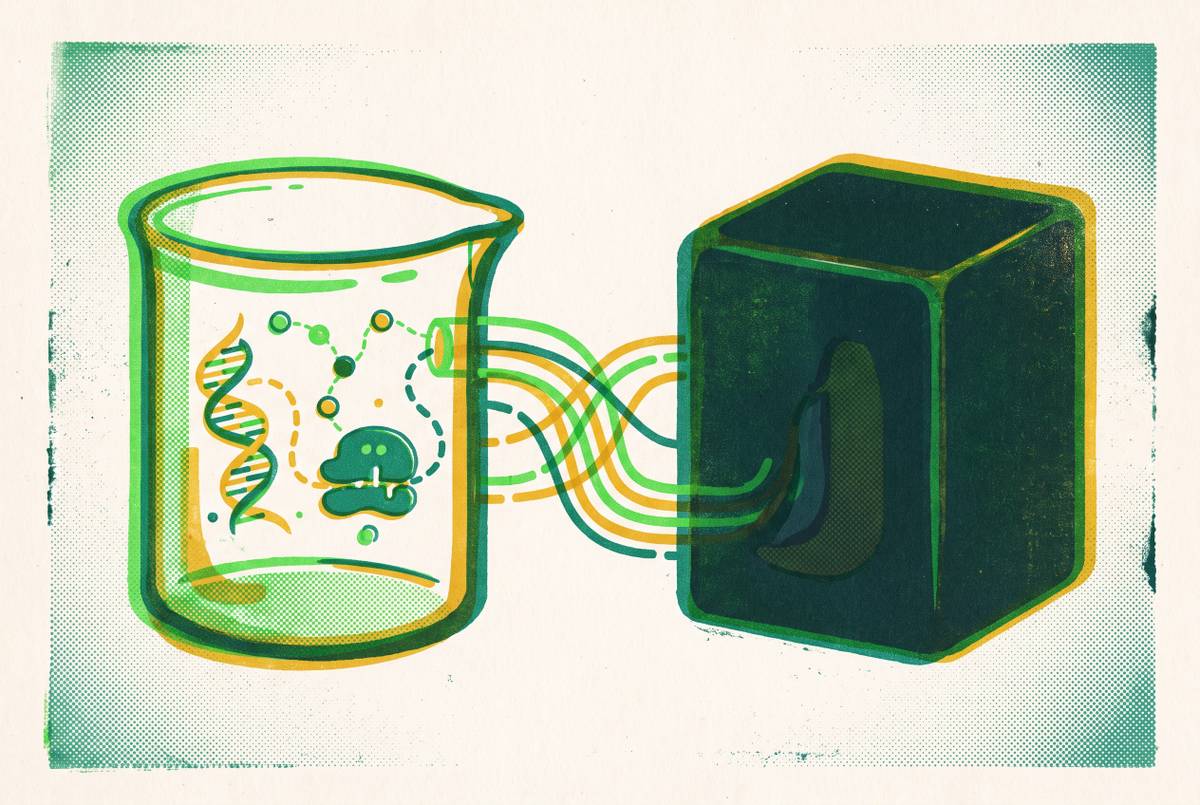
Reagent Transparency as a Reproducibility Requirement in Synthetic Biology
Documented reagent formulations are essential for reproducible synthetic biology experiments.

Affordable cell-free protein synthesis reagents need documented formulations, published lot-level QC, and a low purchase price. Crude lysate systems have historically cost less per microliter than reconstituted systems, but uncharacterized variation can undermine their use in high-throughput experiments. Reagent transparency is therefore needed for reproducibility in synthetic biology and to judge whether a low-cost CFPS system can support hundreds of reactions per week.
Why the reproducibility crisis in synthetic biology is also a reagent problem
Synthetic biology already recognizes its reproducibility crisis. In cell-free protein synthesis, a specific cause sits upstream of experimental technique, in reagents whose formulations are undocumented and whose lot-to-lot variation is uncharacterized. A protocol can specify the same reaction volume, incubation conditions, and nominal reagent concentrations while leaving the actual biochemical inputs undefined. Those omissions prevent another laboratory from knowing whether it has repeated the experiment or merely followed its written instructions. The distinction begins at the reagent layer.
CFPS is particularly exposed because its output depends on complex mixtures of lysates, energy substrates, and cofactors. The concentrations of components affect how well the system works, while undefined lysate constituents can take part in reactions the user cannot see. When the composition changes between batches, a failure may therefore originate in the supplied mixture. Better technique cannot identify an undisclosed input. The information needed to investigate this structural problem never reaches the scientist.
That structure also limits the interpretation of successful experiments. A result obtained with one lot establishes performance under that lot’s conditions, but without characterization it does not define the conditions another laboratory must reproduce. This becomes a barrier when a workflow moves beyond a single bench and depends on a continuing reagent supply. Suppliers must therefore provide full formulation disclosure and batch characterization so that work can be repeated.
How undocumented formulations corrupt data at the assay level
Reagent opacity does more than obstruct repetition. It can distort the quantitative measurements used to compare proteins and select experimental leads. Traditional total-protein concentration methods count inactive protein species along with active ones, so two lots with the same total-protein readouts can have different functional concentrations. The nominal input is the same, but the assay receives different amounts of material capable of performing the measured function. That discrepancy can appear as a biological difference.
Bristol-Myers Squibb researchers demonstrated the significance of this distinction in Analytical Chemistry in 2024. Their work showed that characterizing reagents by assay-specific functional concentration, rather than total protein, dramatically reduced lot-to-lot coefficients of variation. The finding anchors a broader data-quality concern relevant to CFPS workflows, although it is not itself a demonstration that every CFPS measurement has the same source of error. Reported binding parameters, activity rankings, and immunoassay results can change because reagents differ in how they work, even when the biology under study stays the same. A precise readout can still be misleading.
Internal controls are the strongest practical objection to this argument, because laboratories already use them to manage reagent variation. Controls remain necessary and may reveal a change while leaving its identity, cause, and the functional concentrations of unknown constituents unresolved. Assay-specific characterization supplies a different kind of evidence by defining the active input against which the measurement is interpreted. Without it, a clean-looking comparison can conceal a reagent mismatch.
Why crude lysate systems and reconstituted systems present different transparency problems
Crude lysate and reconstituted systems expose different gaps in reagent knowledge. E. coli S30 and wheat germ extracts retain substantial fractions of the cellular proteome, including components that can participate in unknown reactions. Their composition is therefore undefined by nature and varies from batch to batch, even when there is a record of the added reaction ingredients. Disclosure distinguishes the known formulation from the biological mixture that still requires functional characterization.
Mg²⁺ illustrates why this distinction is necessary. Each new crude extract batch requires independent titration because optimal yield depends on a wide concentration window, and a published reagent list cannot establish the optimum for every batch. Wheat germ extract offers a robust platform for eukaryotic proteins, but that application strength does not make its composition more documented than that of E. coli lysates. Platform capability and compositional transparency are separate properties. Neither can stand in for the other when assessing reproducibility.
PURE-type reconstituted systems start from a different position because they contain the required transcription and translation components at known concentrations. Their architecture is intrinsically more transparent, although proprietary component production can reintroduce opacity through the supply chain. The 2026 Nature Communications PURE-makes-PURE demonstration showed that a PURE system can reconstitute itself, which could remove that dependency. A defined architecture and an independently reproducible supply process remain distinct achievements.
What cross-laboratory reproducibility actually requires — the Jewett Lab formulation work as a proof point
Olsen et al.’s Jewett Lab formulation work demonstrated that low-cost CFPS can support reproducibility across laboratories through deliberate formulation design. The result depended on a documented, reduced composition. Its 12-component formulation set out the reaction ingredients and their concentrations so that laboratories could prepare and compare experiments on the same basis.
Components could be evaluated and eliminated systematically because the formulation was known, rather than treated as an indivisible mixture whose internal contributions were inaccessible. That approach connects reproducibility with simplification. When results diverge, a documented composition permits failure analysis against specified ingredients and concentrations instead of leaving the entire reagent as an unexplained variable. The experiment becomes open to diagnosis as well as repetition.
The formulation also achieved high protein yields at small and larger scales, showing that transparency need not come at the expense of performance. That evidence is narrower, and more useful, than a claim that all CFPS reproducibility problems have been solved. A successful formulation still has to be prepared consistently, supplied reliably, and evaluated in the workflow where it will be used. The proof point establishes that documented design can deliver reproducible, high-yielding expression across laboratories. Cost and production constraints still limit the approach’s practicality elsewhere.
Which CFPS system is most cost-effective for high-throughput work on a tight budget?
Crude lysate systems have historically been far cheaper per microliter than reconstituted systems. For laboratories running hundreds of reactions per week, a large premium for defined components is a genuine constraint. Cost per gram of protein captures a different outcome, and neither measure establishes whether activity comparisons remain trustworthy across lots. The least expensive mixture is not automatically the most economical experimental system.
The Olsen formulation reduced cost per gram of protein dramatically compared with previous cell-free formulations through transparency-enabled simplification. Because the formulation is published, laboratories can also use it to make their own reagents. Its economic result came from reducing and defining the reaction while keeping the existing workflow and equipment. That is evidence that disclosure can contribute directly to affordability.
The automated, modular assembly workflow described in Trends in Biotechnology in 2026 addresses the reconstituted side of the comparison. It greatly reduced reagent costs and the time and labor needed for preparation compared with earlier manual methods, with explicit support for Design-Build-Test-Learn cycles. The associated preprint suggests that automated component production could lead to cost parity, but falls short of showing that it has done so. Sepia Bio’s OpenCFPS™ represents a commercial option built around documented formulations and published lot-level QC, making affordability and transparency part of the same reagent offering.
How lot-level QC data functions as the minimum unit of reproducible science
A published formulation describes what a reagent should contain. Lot-level QC establishes whether the material delivered to a laboratory matches that description in composition and function. Components can degrade, concentrations can drift, and preparation differences can alter performance without changing the nominal specification. The recipe alone cannot reveal those changes.
This distinction becomes concrete when a new lot produces less protein. Without lot-specific performance data, the scientist has trouble telling whether the experiment or the reagent failed and must do all the troubleshooting. With relevant measurements available, the investigation can examine whether Mg²⁺ concentration, extract activity, or energy substrate concentration deviated. Those checks replace an opaque input with variables that can be assessed against the observed failure.
The BMS work supports the same principle for assays, where functional characterization of each lot reduced the variation in measurements. For crude lysate CFPS, that evidence complements formulation disclosure because the extract retains undefined cellular components. Published QC cannot convert a lysate into a reconstituted system, but it can make batch performance and functional concentration visible. This is the practical distinction between documenting a recipe and qualifying its output.
In OpenCFPS™, assay-specific functional concentration data and published lot-level QC give Sepia Bio’s formulation disclosure an operational role in standardization and troubleshooting. The practice addresses the hidden reagent variation that can otherwise be mistaken for a change in protein activity. Protein Production Sweden at the University of Gothenburg illustrates the corresponding institutional need through automated small-scale CFPS, automated purification, and standardized workflows. Such infrastructure depends on inputs that can be characterized and compared. Standardized handling cannot, by itself, establish that successive reagent lots are functionally equivalent.
What transparent CFPS infrastructure enables that opaque systems cannot
The Weitz Lab at Harvard demonstrated high-throughput droplet microfluidics screening of protein libraries in JACS in 2025. Such screens need CFPS reagents to behave the same way across thousands of reactions, because their value comes from comparing outputs under similar conditions. Uncharacterized batch variation weakens that comparison before the readout is interpreted. Throughput amplifies the consequences of input quality. The CF2H cell-free two-hybrid platform for protein binder screening similarly relies on consistent expression performance so that its functional readout can be trusted across conditions.
Tomková et al.’s staphylokinase work in FEBS Open Bio in 2026 showed that activity rankings from crude CFPS mixtures matched those from purified proteins. That result shows that rapid variant screening could give reliable functional readouts without purification. The authors still said that top hits need classical characterization. Screening and confirmation serve different purposes.
Wong et al.’s Jewett Lab work in Nature Communications in August 2025 extended high-throughput experimentation to post-translational modification engineering. The same interpretive requirement applies, because activity differences must reflect the protein variant. A liquid-handling robot distributes unknown reagent variation across more wells, making automation compatibility inseparable from documented composition and characterized performance.
Affordable CFPS reagents should be evaluated through formulation disclosure, assay-relevant functional concentration, and published lot-specific performance data together with cost. Those criteria apply to internal preparation, commercial crude lysates, and reconstituted systems, without assuming that one architecture is universally cheapest or best. OpenCFPS™ is one commercial implementation of that approach. Transparency is not an ethical luxury reserved for well-funded laboratories, but a technical prerequisite for the throughput-driven work synthetic biology is moving toward.
Sources
- 1 Automated, modular assembly of reconstituted cell-free systems
- Automated Cell-free Protein Synthesis for Distributed Biomanufacturing
- Design-driven optimization of low-cost reagent formulations for reproducible and high-yielding cell-free gene expression
- Article https://doi.org/10.1038/s41467-026-69605-8