Make-vs-Buy Decision for In-House Cell-Free Extract Preparation
Homemade extract saves money only if your lab has the equipment, staff, and volume to justify it.
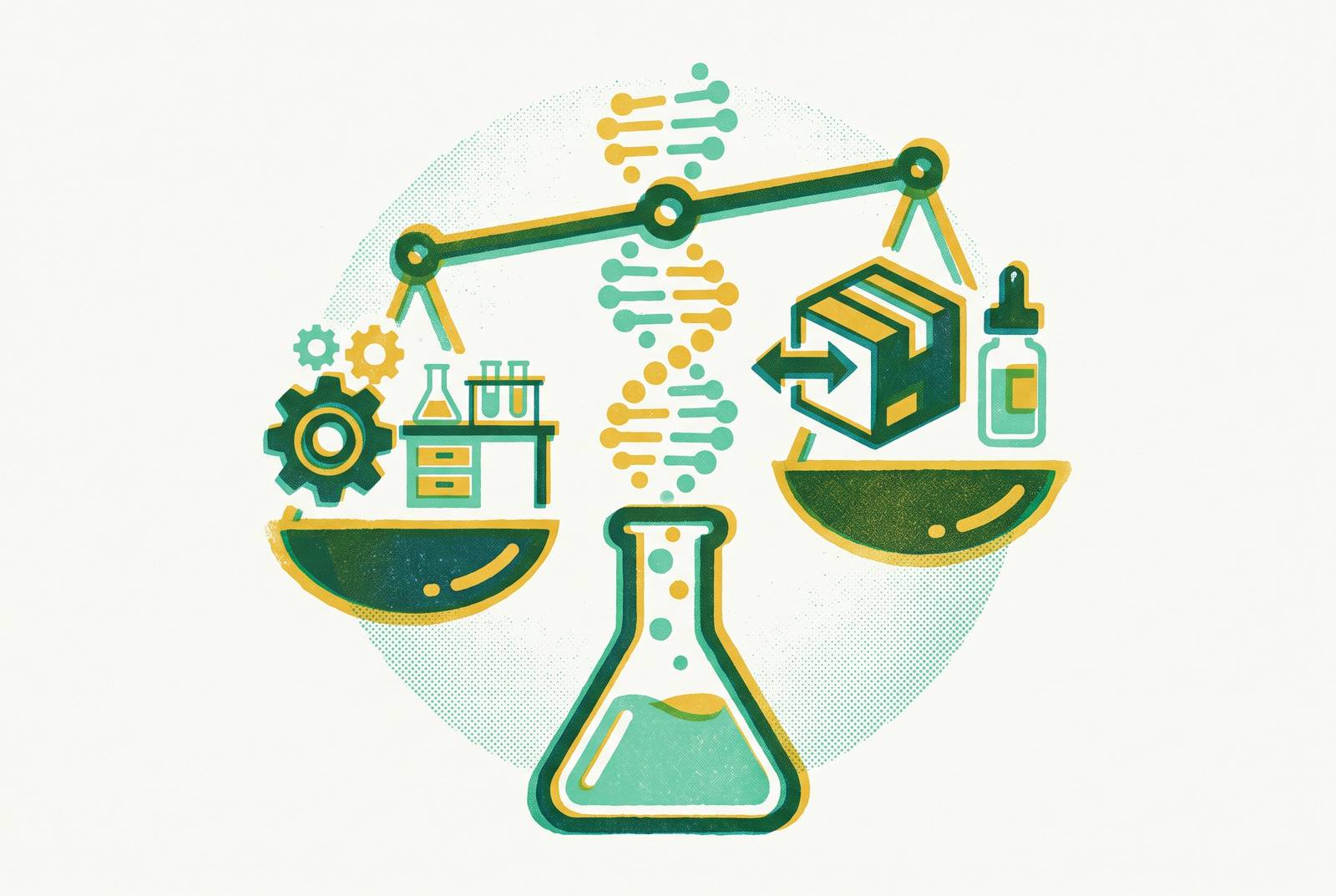
For affordable cell-free protein synthesis reagents, homemade crude extract makes the most sense on cost when reaction volume is high, the lab has lysis equipment, and staff can keep up with quality-control work. Commercial extract is more competitive when preparation labor and batch consistency dominate the budget. The make-vs-buy decision therefore turns on the cost of dependable experiments.
What cell-free extract actually is and why its source determines everything downstream
Cell-free protein synthesis uses transcriptional and translational machinery taken from lysed cells. A DNA or mRNA template, nucleotides, amino acids, and an energy regeneration system supply what that machinery needs to make protein. Crude extract, including S30/S12 lysate, is relatively inexpensive to produce and supports high-throughput screening and milligram-scale production. Reconstituted purified systems, known as PURE, have a defined composition, but their yield ceiling is lower and they cost more whether they are made in the lab or bought.
The open reaction environment permits direct control of pH and the addition of cofactors, chaperones, and lipid mimetics during the reaction. That control also exposes experiments directly to differences in extract composition and activity, without a cellular buffer to absorb variation. Sepia Bio publishes formulations and lot-level QC data so scientists can see how reagents vary and have more to go on than how the protocol was carried out when results differ. Such documentation matters because control over a reaction depends on understanding its starting material.
What is the cheapest cell-free protein expression system at sufficient scale
Before fixed costs are counted, the reported prices make homemade crude extract much cheaper. Homemade crude extract costs approximately $5/mL, compared with approximately $400–$1,000/mL for commercial crude extract. PURE carries a higher cost even when prepared in-house, at approximately $100/mL, compared with approximately $1,000–$1,200/mL commercially. For a screening program on a tight budget, crude extract is therefore the more relevant starting point for the economic comparison. That lower price saves money only when the program uses enough extract to spread out the cost of making it.
Reported laboratory-scale cost analyses frequently omit labor, bulk reagent purchases, and capital equipment. Those omissions matter most for a lab establishing extract preparation. A low materials cost cannot by itself justify an instrument purchase or the operator time needed to develop a reliable process. On the buying side, commercial reagents made for high-throughput screening, including those from Sepia Bio, can cost enough less per-mL that a lab needs to use more extract before it breaks even by making its own. The useful comparison is between the lab’s full preparation cost and the price of the commercial system it would actually use.
What it actually takes to make extract in-house, including equipment, labor, and the lysis barrier
Existing infrastructure changes this decision before the first batch is made. French press and bead crushers are the most commonly used tools for lysate preparation, and their cost and limited availability make lysis a primary barrier. A lab that already has suitable equipment faces a different investment from one that must buy it. Protocol complexity is not necessarily the limiting factor. Access to the tools that make the protocol possible can be.
Equipment also leaves a substantial preparation workload in place. Cell growth, harvest timing, lysis, and clarification all demand consistent execution, with dedicated operator time to establish and maintain the process. Although CFPS experiments are much faster than cell-based expression, homemade extract adds a phase before the experiment that buying extract removes. The lab needs to allow time and money for that phase as well as for developing the protocol. Break-even therefore depends on available personnel and infrastructure as well as annual usage, and neither resource becomes free simply because it is already present in the lab.
Why batch consistency is the most underweighted risk in the in-house case
Keeping batches consistent takes work each time, and that cost is left out when prices are compared per-mL. A bacterial CFPS system showed approximately 13% variability between lysate lots, while replicate experiments that used the same lot on different days varied much less. In that system, the lot boundary was a greater source of variation than the day boundary. Moving to a new batch of homemade extract introduces a variable that requires re-qualification.
A three-laboratory interlaboratory study also found substantially higher coefficients of variation across sites than for a single operator working across days with one set of materials. Reagent preparations were a large part of that variation, so extract preparation alone cannot account for the finding. Nevertheless, it establishes why consistency costs rise when a workflow spans operators or sites. Organizations that run CFPS at large scale use Quality by Design approaches to keep the process consistent, then adjust each reaction to account for batch differences that remain. That approach controls variability but requires work beyond producing the lysate.
Extract contains numerous enzymes whose concentrations and activities depend on culture and processing conditions. A consistent protocol does not imply dramatic batch differences, but neither does it remove the need to qualify performance. For labs that cannot keep up with that work, buying extract with records of its performance makes more sense than reagent prices alone suggest. This matters most when a screening campaign needs to compare results from different batches. Production faces a related but different problem, because variation in yield can affect each downstream use of the protein.
How the screening use case and the production use case impose different requirements on the make-vs-buy decision
Screening works best when a campaign can run many reactions at low cost and compare the results. CFPS permits plate-based workflows in which protein is made and assayed in the same well without purification. A 2025 study screened 138 protease variants in a single plate in 6 hours of total production-and-screening time and combined the workflow with machine learning to achieve a four-fold improvement in kinetic properties. At such reaction counts, reagent cost becomes an important constraint on how much of a library can be tested. One validated extract lot can last for a whole campaign, which helps limit problems with inter-lot consistency.
A fully automated CFPS method using robotics has been described for screening thousands of enzyme variants for thermal stability. Extract must therefore perform in the plate format used by the workflow, whether it is made or bought. A staphylokinase variant study found that activity rankings from crude CFPS mixtures in microplate chromogenic assays closely matched those from purified proteins.
Milligram-scale production places more weight on repeatable yield across runs. E. coli-based CFPS yields range from 100 µg/mL to up to 4 mg/mL in batch mode, while semicontinuous formats using semipermeable membrane exchange can reach up to 8 mg/mL. These yields make benchtop production feasible without fermentation infrastructure. With fewer reactions per program, the per-reaction price is less dominant, while yield variation matters directly to SPR, cryo-EM sample preparation, and biochemical characterization. Many labs perform both screening and production, but the dominant workload should determine the infrastructure investment rather than an assumption that one sourcing strategy serves both equally well.
Where challenging protein targets shift the calculus toward CFPS regardless of source
Target biology can make CFPS a production requirement. For proteins that are toxic, membrane-embedded, rapidly proteolyzed, or heavily disulfide-bonded, few other ways to make them may work. Membrane proteins make up approximately 50% of major drug targets in one widely cited estimate, yet they often aggregate or harm the host in cell-based systems. A cell-free screen of 61 eukaryotic membrane protein targets reported soluble expression of more than half in at least one lipidic mimetic format. Those formats included detergents, liposomes, and nanodiscs, illustrating how the open environment supports conditions suited to the target.
The absence of a living host also permits production of proteins that are deleterious when overproduced in cells, including onconase, pierisin variants, cecropin P1, and colicins. For disulfide-bonded targets, researchers have demonstrated large-scale production of proteins containing up to 24 disulfide bonds and ranging from 14.3–53.2 kDa using various extracts. Disulfide bond isomerases such as DsbC or oxidoreductase systems can be added directly to the reaction. These capabilities raise the value of CFPS, but they also raise the cost of re-optimizing conditions against each new extract lot. In-house preparation remains viable when its QC is rigorous enough to support the target, while documented commercial supply offers another route to that reliability.
A structured framework for making the decision, using four questions for a given lab
The first question concerns annual reaction volume. Below a usage threshold that differs from lab to lab, the per-mL savings from homemade extract are too small to cover equipment, protocol-development, and ongoing QC costs. Above that threshold, making crude extract makes more sense, especially when the lab already has lysis equipment. The second question concerns the consistency the workflow requires. Screening campaigns that use one validated lot can cope with more inter-lot variation than production programs that need batches to perform much the same across months, operators, or sites.
Standard soluble proteins leave either sourcing route open at the right scale, whereas difficult targets increase the cost of qualifying every new batch. Robotics-integrated workflows require consistent performance in low-volume, high-density plates, and homemade extract needs validation in that format. Commercial reagents with published lot-level QC data can reduce the validation burden, making operator time part of the purchasing calculation.
Together, these answers support three practical outcomes. Making extract suits labs that use high volumes, do mostly screening, already have lysis equipment, and can keep up with ongoing QC. Buying suits programs that use low-to-moderate volumes or work with difficult targets, as well as production or multi-site work that needs batches to perform much the same across runs, operators, or sites. For labs still scaling into CFPS, the hybrid route carries the least risk: they use commercial extract to set up and validate protocols, then make extract in-house once they use enough and can handle the QC.
How reagent transparency and documented QC change what “buying” actually means
The objection that commercial extract is a black box applies to opaque products. Published formulations give scientists a basis for rational troubleshooting when results deviate. Lot-level QC data lets a lab check a new batch before using it for a campaign, without having to gather all that information itself. Standard formats that work with automation can also cut the work needed to use reagents in the lab’s existing plate workflows.
That distinction is relevant to Sepia Bio’s OpenCFPS™ line, which combines pricing designed for high-throughput biology with published formulations, lot-level QC data, and compatibility with standard plates, automation systems, and incubators. Transparent supplier documentation also serves labs that decide to make extract, providing a reference for qualifying homemade batches and a fallback when internal production is interrupted. It makes consistency a criterion that can be weighed against per-mL savings. The final choice belongs to the lab’s workload, with affordability measured by the cost of sustaining reliable experiments at the required scale.
Sources
- Cell‐free protein synthesis system: A new frontier for sustainable biotechnology‐based products - Maharjan - 2023 - Biotechnology and Applied Biochemistry - Wiley Online Library
- A User’s Guide to Cell-Free Protein Synthesis
- Cell-Free Gene Expression: Methods and Applications
- Biochemical Preparation of Cell Extract for Cell-Free Protein Synthesis without Physical Disruption