Interlaboratory Reproducibility Standards for Cell-Free Protein Synthesis
Standardized reagent formulations and lot-level QC enable reproducibility across laboratories.

Affordable cell-free protein synthesis reagents should be judged by price, documented composition, lot-level QC, and compatibility with repeatable high-throughput workflows. Interlaboratory reproducibility standards for cell-free protein synthesis make those criteria operational.
The gap between within-lab and between-lab reproducibility in CFPS
Cole et al. measured a between-laboratory coefficient of variation of 40.3%, compared with substantially lower variation for a single operator working across days with one set of materials. In their three-laboratory exchange study, each site prepared materials, swapped them pairwise with the other sites, and tested them. That design made it possible to distinguish the effects of material preparation from those of the site performing the reaction.
The contrast defines the task for interlaboratory standardization. A workflow that is repeatable in one operator’s hands does not necessarily transfer with the same consistency to another laboratory. Transfer introduces differences in materials and execution that a single-site experiment holds constant. For industrial adoption, the missing infrastructure includes shared standards, reference lysates, and validated workflows, rather than another demonstration that CFPS can produce protein.
Why reagent formulation, not extract preparation, is the primary driver of variability
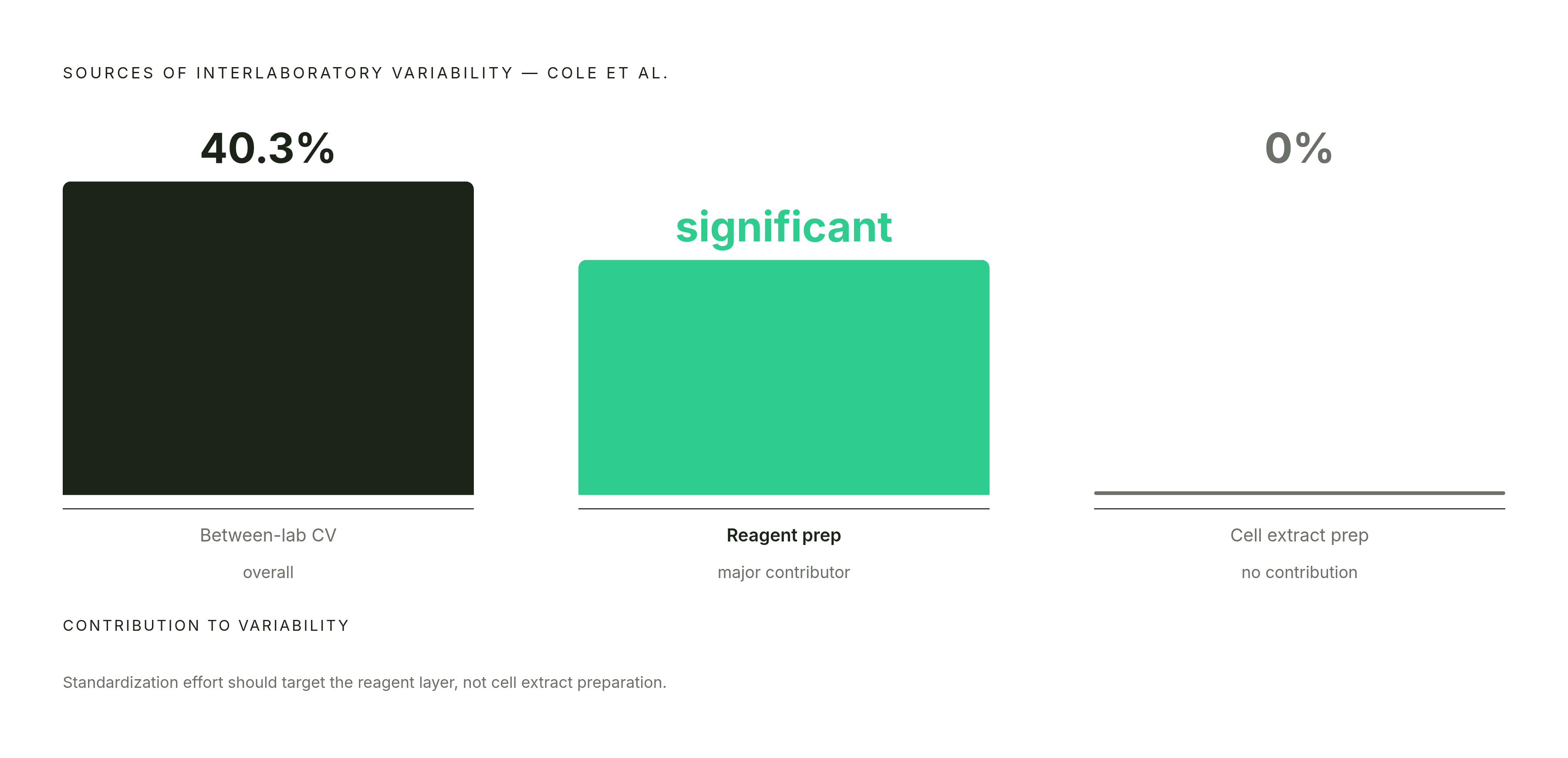
Cole et al. found that reagent preparations accounted for a significant share of interlaboratory variability, while differences in cell extract preparations explained none of the variation they saw. This is the study’s central diagnostic result. It directs attention toward the reagent mix rather than the extract preparation steps that have occupied much of the field’s standardization discussion. Improving lysis or run-off protocols alone would therefore miss the variable identified by this comparison.
The reagent layer contains consequential formulation choices, including energy substrate, NTP concentrations, T7 RNA polymerase activity, and amino acid pool composition. These choices differ between laboratories, and commercial kit suppliers rarely share them in full. Consequently, two sites can describe their work as the same CFPS protocol while supplying the reaction with different mixtures. Once a competent extract is in place, those differences can break cross-site reproducibility.
How opacity in commercial reagent formulations compounds the problem
An undisclosed formulation prevents scientists from tracing a reagent effect to its source. Most commercial CFPS kits do not publish their exact formulations, and lot-level QC data is rarely shared with end users. When performance shifts between orders, the user therefore lacks the information needed to separate a protocol error from a reagent change. The chemistry may be tractable, but the relevant input remains hidden.
The Reproducibility in Science 2026 symposium at Hood College, co-hosted by Frederick National Laboratory, documented how undisclosed validation data and lot inconsistency in antibody reagents compromised findings across hundreds of publications. That example illustrates a structural risk. In both settings, missing material records limit what downstream scientists can diagnose. Public formulations and SOPs let users check the materials and reproduce failures against a known baseline.
What lot-level QC documentation actually enables
Lot-level QC connects the formulation a scientist intends to use with the particular material that enters the experiment. A published recipe says what is in the material, while a lot record gives details about the batch it came from. A scientist can then examine whether a change coincided with the protocol, the reagent lot, or both, rather than treating every shift as an unexplained failure of CFPS.
Sepia Bio publishes lot-level QC data for OpenCFPS™ and documents its formulations openly, including exact NTP concentrations, energy substrate specifications, and polymerase activity levels. Those disclosures turn normally hidden inputs into variables that laboratories can track and audit. Their value is operational, because collaborators can establish what material they used before interpreting a difference in results.
Potency standards and reference materials add a common basis for interpreting those records. Characterizing a lysate against a reference would allow sites to compare activity without assuming that their starting materials are equivalent. Such references still need to be developed. NIST SP 1500-13 documented a workshop call for interlaboratory lysate studies, but did not announce a specific lysate-potency standards programme.
Extract preparation: where standardization effort is well-placed even if not the primary variance driver
Extract preparation still establishes the biological foundation on which reagent consistency depends. Lysis method, strain background, growth phase at harvest, run-off reaction conditions, and flash-freezing protocol can each suppress activity if poorly controlled. The shared record should state which methods, such as bead-beating, French press, and sonication, were used so that others need not guess how the extract was prepared. The absence of an extract effect in one controlled comparison does not remove these requirements.
The laboratories in Cole et al.’s study already used a shared base protocol, which likely explains why extract preparation was not the main source of variation. A less-controlled comparison could expose more extract-related differences. Shared SOPs make that baseline explicit and allow subsequent differences to be interpreted in context. The Frederick National Laboratory Scientific Standards Hub shows how a repository can give laboratories the same protocols to start from.
How decentralized CFPS networks stress-test reproducibility standards — and what survives
A network spanning different infrastructure, training levels, and supply chains tests whether a protocol is genuinely transferable. Da Silva, Matthews, Cazaux, Vigar et al. (2025) set up a technology transfer network that linked research teams in North America, South America, and Asia. Across four sites, the network achieved an interlaboratory coefficient of variation of 19.1% for LAMP assays using in-house CFPS. That result concerns an assay outcome and should not be treated as a direct repeat of the Cole et al. protein synthesis comparison.
Its relevance lies instead in the conditions under which reproducibility was achieved. The network combined standardized reagent supply, shared SOPs, and explicit QC checkpoints. A shared protocol defined the procedure, while controlled supplies and QC made its execution assessable across sites.
The energy substrate problem and its downstream effect on cross-site comparability
For laboratories seeking affordable CFPS reagents, the energy system connects purchasing decisions directly to experimental comparability. Phosphorylated substrates such as PEP are a dominant cost component in legacy formulations. Lot-to-lot activity variation also contributes to yield inconsistency between laboratories using nominally identical protocols.
Alternatives including maltose, glucose, and creatine phosphate can reduce cost. Where their degradation kinetics are better understood, they can also reduce variability, but that benefit depends on documenting and sharing formulation parameters. A 2026 formulation published in Nature Communications achieved substantial yield at substantially lower reagent cost through oxygen-flux optimization that replaced reliance on phosphorylated substrates. The example shows that lower-cost CFPS need not be pursued independently of reaction engineering. It does not establish a universal cheapest system for every high-throughput workflow.
For cross-site work, an undisclosed substrate substitution defeats that engineering discipline. Collaborators may keep the same extract and protocol on paper while changing a major input to the reaction. Large yield differences can then appear without an obvious change in the methods record. The evidence supports treating an energy-system substitution as a formulation change.
Automation and plate-based formats as reproducibility infrastructure, not just throughput tools
Automation addresses a different part of the problem, namely variation in how a specified reaction is assembled. Robotic liquid handling reduces pipetting inconsistency and volume errors that can propagate nonlinearly through energy-limited reactions. It also addresses dispensing-related edge-evaporation artifacts associated with sequential manual setup. Even when sites share a formulation, they need these controls to keep delivery consistent.
Standard well-plate formats, including 96-, 384-, and 1,536-well plates, provide a repeatable framework for low-volume reactions. Platforms such as the Opentrons OT-2 and Labcyte Echo support consistent dispensing in high-throughput CFPS workflows. Plate geometry, fill volume, sealing method, incubation temperature, and shaking protocol specify the physical conditions that another laboratory must reproduce.
Compatibility with that framework is a practical reagent-selection criterion, and Sepia Bio’s OpenCFPS™ reagents are designed for standard plate formats and automation systems. The relevant advantage is the ability to place documented chemistry into a defined setup process. Automation complements reagent transparency by controlling execution after the inputs have been specified.
What a practical interlaboratory standardization protocol looks like
At the reagent layer, fully documented formulations and supplier-provided lot-level QC establish what each site is running. Where possible, collaborators can use a single reagent source to reduce the differences that arise when each prepares its own reagents. In-house production remains an alternative, as the decentralized network demonstrates, but it still requires shared procedures and explicit QC. Neither buying a kit nor preparing reagents locally removes the need for traceability.
At the extract layer, a shared SOP supplies the starting point. Lysis method, strain, growth conditions, and run-off protocol belong in the record, with deviations reported as experimental variables. Energy substrates warrant the same level of specification as the plasmid construct because they materially define the reaction. Changes between experiments or sites should be flagged as formulation changes.
Reaction format requires the same discipline. Plate geometry, volume, sealing, and incubation conditions are part of the method, while automation can reduce execution differences where feasible. Reference materials and potency standards would provide QC anchors as they become available, making yield comparisons interpretable against shared material baselines.
Public repositories allow these practices to extend beyond a single collaboration. The Reproducibility in Science 2026 symposium demonstrated a model that combines DNA constructs on Addgene, SOPs on a public hub, and detailed protocols in peer-reviewed journals. Applied to CFPS, that model would make materials and procedures auditable together. It also gives later users a defined starting point for troubleshooting and adaptation.
Why the variability gap is a solvable engineering problem, not a fundamental property of CFPS
The evidence identifies addressable sources of variation rather than an unavoidable limit of cell-free chemistry. Controlled single-operator performance establishes that CFPS can be highly repeatable. The exchange study identifies reagent preparation as the principal diagnostic target under shared extract conditions, while the decentralized network shows that coordinated controls can support reproducibility across heterogeneous sites. Together, these findings distinguish what the reaction can achieve from what its supporting infrastructure currently delivers.
There are controls for each major source of uncertainty, from formulations that are shared openly and lots that have been characterized to shared extract SOPs and reaction formats that are clearly set out. Commercial systems can embody those controls, as Sepia Bio’s combination of published formulations, lot-level QC, and automation-compatible formats illustrates. Their effectiveness still depends on how laboratories document and transfer the complete workflow.
Shared reference materials, validated workflows, and common quality measures are still being built. The direction is nevertheless clear, because the field has identified both important sources of variance and practices that make them measurable. Reproducibility is an achievable operating state for CFPS, provided it is designed into the materials, methods, and records from the start.
Sources
- Reproducibility in Science 2026
- Quantification of Interlaboratory Cell-Free Protein Synthesis Variability
- Microbial cell-free protein synthesis and its progression toward industrial use - PMC
- International multisite implementation of distributed cell-free protein biomanufacturing to advance health and research equity
- International Multi-site Implementation of Local Cell-Free ...